When Social Media Channels Don’t Matter

If you don’t have a brand strategy and rich, compelling content to supply people on at least a semi-consistent basis, I don’t care how many social media channels are out there. You should not be on a single one of them until you figure out what your purpose is and what you’re going to supply in the way of content that people can benefit from.

Until you address that, you have no heart. No soul. No story. No brand.

“Should we be on Facebook?” If you don’t know what you’re going to say there? No.

“Should we be on Pinterest since there’s a lot of women on it and we’re a female-owned company?”
No. You should be on Pinterest if you see an opportunity for people to piece together what you believe and value  as a brand (or as a person behind that brand). The fact you share a gender has nothing to do with it.

“I have 25,000 followers on Twitter.” Am I supposed to be impressed by that, really? You could’ve bought those for all I know. Which, by the way, is really stupid and less than genuine. Now, if you were someone who got to that point of greatness through your constant back-and-forth interaction, I think you’ve got something. More than something, actually. You have a story to tell that provides a continuous stream of content that people can benefit from? You’ve got some meat to go with those potatoes. Some heart and soul. Some vision.

“Should we be on (insert any social media channel you want here) since our competitors are there?” No. At least not for that reason alone. Because all you’re doing is playing monkey see, monkey do and following their every move. Do you want to have a purpose or do you want to be a puppet?

Social media is the megaphone. But without knowing what to say and how to say it, all that comes out of it is noise.

For some of you, this may be elementary. If so, my apologies. But there’s still a lot of people out there who are putting up Facebook pages, Twitter handles, YouTube channels and Pinterest boards…without knowing why. Don’t put up a social media channel because everybody’s doing it. Be able to say “We put up a Facebook Page because our audience is there, it’s the best place for us to convey what our brand is trying to say, it’s where we’ve seen strong interaction, etc.”

It’s like buying a house and saying afterward, “Why did we buy that?”

Your spouse looks at you and says, “Well, because everybody said we should.”

“Yeah, but that doesn’t fit with our life’s plan or our goals. I don’t even know if I’m going to like this neighborhood a few years from now.”

“Well, jeez. Why are you telling me this now after we just invested in one of the most important purchases of our lives?”

It’s not easy to walk away from that decision, obviously. Once you’re in, you’re there to stay for a while. It’s not that different from the social media commitment in a way. If you’ve already “bought” a place on social media, it’s hard to suddenly say, “You know what, online universe? We don’t want to be on this channel after all. Never mind.”

It’s not too late to turn that ship around. But take a look in the mirror and ask why you’re there and what you want to say. Everyone should do this self-check regularly, myself included.

The story of your brand can never stop being told. Don’t waste another moment finding out what yours is.

This chicken sandwich doesn’t reflect my political views OR When Personal Beliefs and Brands Don’t Mix.

Should highly visible C-Level executives state their political and religious opinions freely without fear of repercussion to the brand?

I didn’t ask if they can. I asked if they should. Should we defend what is Constitutionally correct if it is strategically inconsistent with the brand?

“The Chick-fil-A culture and service tradition in our restaurants is to treat every person with honor, dignity and respect — regardless of their belief, race, creed, sexual orientation or gender.”
– Chick-fil-A Company Statement

“We are very much supportive of the family – the biblical definition of the family. We are a family-owned business, a family-led business and we are married to our first wives.”
                                                             – Chick-fil-A President-Chief Operating Officer Dan Cathy

A few years ago, I was thrilled to partake of a new restaurant that served Italian beef and was adorned with Chicago sports merchandise throughout. It was heavenly. And I suspect because the owner of the restaurant was looking to those heavens on Sunday rather than keeping his store open to Chicago Bears fans who like football and Italian beef that day most of all, his great store closed down soon thereafter. His beliefs were admirable and what he was freely entitled to, but it also sabotaged the big picture of his brand and what his audience wanted.

I’m disappointed in Chick-fil-A President Dan Cathy for this very reason.

Thanks to what he told Baptist Press in an interview, he’s turned where I eat chicken into a statement on whether or not I support gay marriage. If that sounds ridiculous or an overreaction, go to Chick-fil-A’s Facebook page and see the comments for yourself. It’s a full-on discussion of the pros and cons of gay marriage.

Considering the reaction some of my friends had to Mr. Cathy’s public support of traditional marriage, it’s certainly harder for me to a public advocate for that brand on Facebook or elsewhere. Regardless of my stance on the issue.

And that’s too bad. Because from a product standpoint, I love Chick-fil-A. I love their sandwiches, I love their shakes, I love their fries and because I’m 5 lbs. overweight, I probably love it all a little too much.

But now, we can’t have a discussion about a really great product with really great people working there, can we? We have to have a discussion about what eating a damn chicken sandwich means for what we believe politically or religiously.

I’d like a Common Sense Meal, please.

So indulge me enough so we can suspend debate of that political issue for a moment and think about this. Maybe I shouldn’t shop at Whole Foods because I don’t agree with John Mackey’s position on the health care debate. Maybe I shouldn’t be a Cubs fan because a member of Ricketts family wanted to run a vicious anti-Obama ad. Maybe the CEO of Macy’s says something tomorrow in conflict with my beliefs…do I avoid the next 50% Off Sale?

Maybe some actually will and do in these circumstances. That’s their right and I respect that decision.

But also respect that I’m still going to go to Cubs games. I’m still going to shop where I want to shop. I’m still going to eat where I want to eat. And I’m not the one in the wrong for doing so.

When the customer/brand advocate has to be moved from defending the brand’s product or service to an uncomfortable position of defending the CEO’s beliefs, I don’t place blame on the customer. I place blame and full responsibility on the executive for putting them in that potentially difficult position at all.

Yes, they are entitled to their beliefs. It is their American right. Whether or not it actually is right.

BUT just because something is covered by freedom of speech doesn’t make it a good idea for the brand. Not by a longshot.

The conversation shouldn’t be about Christianity or gay marriage or traditional marriage or Southern Baptists.

The conversation should be about the fact that people love to camp out before a Chick-fil-A store’s grand opening. It should be about the fact that people love those cow mascots of theirs so much that they’ll clamor for a cow calendar. It should be about a product that is fantastic in my book, not The Book.

Sometimes the conversation has been about the fact that the chain is closed on Sundays and what that means, but it hasn’t really been a major dividing line.

This is where the “If you don’t like it, don’t eat there” argument is too easy. I love the product. But what if I just think its chief executive has the wrong opinion? Why can’t I have both? Are we really that stupid that we can’t distinguish the difference?

But I’m not going to suggest that Chick-fil-A should be left off the hook either. What I’m talking about is evolution. No, not “Evolution,” but brand evolution. As in taking a hard look and realizing expansion demands adjustment to new demographic audiences and adjustment to new times. When the city of Boston declares it’s not going to allow the company to open franchises there, that should be a signal that a re-evaluation may be in order. Truett Cathy founded Chick-fil-A in a Georgia suburb in 1946. Well, it’s not 1946 and the brand isn’t just in Georgia anymore.

Brands and the values that go with them should be allowed to naturally evolve as they expand, especially as they enter more cosmopolitan and diverse areas rather than rural ones. 12 years ago, the closest Chick-fil-A from me was three hours away in downstate Bloomington, Illinois. Today, it’s steps from Michigan Avenue and less than 3 miles from the most predominantly gay neighborhood in Chicago.

The next move should be an apology from Dan Cathy, but not for the reason you may think. It should be because of the fact that he made himself the story when he’s not and shouldn’t be. He should issue a statement personally that sounds like so:

“My political and religious beliefs are my own and not a reflection of Chick-fil-A’s company policy, which aims to be inclusive to all sexual orientations. I apologize to every employee who serves our brand and every customer who consumes our brand, who may have been offended by my recent statements. I take responsibility for putting you in a potentially difficult and uncomfortable position of defending beliefs you may not share.”  

I don’t want religion and politics brought into where I eat chicken. The guy who makes that chicken should get that too. For the good for the brand, at the very least.

Nobody wins The Cheapies or The Speedies.

Do you ever notice that there are no awards shows in the advertising industry for being the fastest?
Do you ever notice there are none for being the cheapest?

I do, however, notice a whole lot of awards for being the most creative. Or the most effective.

Clios. One Show. Addys. Effies. Cannes. And so on.

Some of us get lucky enough to hoist these awards high in front of our peers and put them in our offices. And let’s face it with no apologies. It feels really, really good.

When it comes down to it, you will never get awarded for being the cheapest and you will never get awarded for being the fastest. It’s not even a great thing to get referred for – when I actually was, it was a disaster.

I actually had someone stand up in front of a room – more than once – and do this:

“Dan is great and I only had to pay him $____!” Oh no. You didn’t. It was the worst “compliment” I could’ve ever received.

Point being, it’s up to you whether you want to enter a formal awards show, but what matters more for positioning and a referral is valuing quality over price or speed. Some say, “It can be about quality, speed or price. You can have 2 but not all 3.”

Sure, you can have two of those, but in the end, there’s really only one that matters.

Strive to be about quality. That’s it.

Because quality is what’s ultimately the most fulfilling to you.
Because quality is what’s the most referable.
Because quality enables you to command greater leverage on taking more precious time you rarely have.
Because quality gets you to a place where you can command more money.

Or perhaps you don’t want fulfillment, referrals, quality time and greater income. If not, my mistake.

Did I say that focusing on quality first and foremost gives us license to take as much as time as we like? Oh no. Did I say we always get what we want money-wise? Unfortunately, not always.

But there are going to be people around us that pressure us for that ad now, now, now. There are going to be prospects who pressure us on price and shoot lines our way like, “If you do this for a little (or a lot) less now, I know a lot of people/there will be a lot of more work like this to come.”

You can play these games and see if it works out. But I also see people who get burned by this song-and-dance of “risk now and hope for something better later.”

How do you avoid giving into these pressures? It’s not easy. But I reached a point in my career – with the help of some very supportive mentors, colleagues, friends and family (you know who you are) – where I had unwavering faith in my own talent to stay strong and believe in what I was charging and how long I needed to do it right. From that moment on, I was done trying to be known, intentionally or not, as the guy who could do more in less time.

Because being that guy did nothing for me. It paid me no dividends. It earned me no referrals.

Why? Because I wasn’t positioning myself as the guy built for quality, even though what I was producing was high quality. I was positioning myself for speed and probably some value first. The quality guy I knew I was was suffering and I didn’t realize it.

So yes, that means you have to gently and diplomatically push back on price and timelines. I’m not saying to be a jerk about it. I’m saying to negotiate in your best interests rather than putting on a paper hat and asking if you may take their order. You have to be clear as day on what you’re providing for the time required.


The “Anybody Who Wants My Services” Problem 

You also have to constantly work on thinking about who you want and don’t want to work with. If you don’t define this, I have found there is a direct correlation between working with people who tend to be cheap and speedy vs. people who respect and value quality. And why wouldn’t there be when it’s clear you’ll take anybody who comes through the door?

The way to begin thinking this issue is through what’s called a Buyer Persona. Think about the most enjoyable client relationship you’ve ever had. It doesn’t have to be a relationship you still have at your current company.

Think about that person and where they stand in their organization. Consider the challenges they face in a day and why they chose you in the first place. Who else were they thinking about choosing? Are there any other challenges they deal with internally that might influence the direction of your relationship?

Now think about the top 5-10 of those Buyer Personas.
What’s the common thread that runs through those people?

What common traits do they possess? Don’t just think about on-the-surface stuff like age, title and location. What are the behavioral and emotional aspects they share considering they are going to choose you based on behaviors and emotions you elicit? You will have to dig deeper for this. But it’s worth it.

These are the people who represent the bulls-eye on the dartboard or close to it. The people who are more likely to see your services as an investment rather than a cost. I am continually working to understand them better, speak to them better and customize my offerings around them better. They don’t represent just “anybody.”

Your strategic partners need to understand that too – so they can get the value you bring to the table and be advocates for your brand when you’re not in the room. Hold them to this and make sure they get it. Meet with them monthly or quarterly. It’s probably best if they don’t place a huge value on being the cheapest or the fastest, because they may not get where you’re coming from and it wouldn’t jive with what you value most.

At the end of the day, when you are standing there with your award or a glowing email from your client for a job well done or a promotion, not many people will remember the mini-battles you had to fight to carve a little more time and a little more money. I suppose someone could say, “Yeah, he did an outstanding job and the client loves it, but he was a couple hours too slow on that one day.” But that’s getting into some petty territory if you ask me.

If we’re lucky to do what we love for a living, we get a small window of time to do it. And once it’s over, how do you want them to talk about you? That you were the cheapest? That you were the fastest?

I didn’t think so.

Are We Giving “Buzz” Way Too Much Weight?

“So, we’ll like, create a series of posters that are really in your face. Offensive to some, but whatever. It’s going to generate such a buzz. And everybody will be all over it in the media, so it’s a win-win.”

I picture the person saying this to be a Creative Director with a goatee, thin glasses, maybe a funky hat of some sort that’s backward. Oh, he’s so cutting edge. After all, he worked at DBKCF&GHA and worked on (Insert Campaign He Likes To Name Drop Here). Yes, I’m stereotyping. Like you haven’t seen a version of this person.

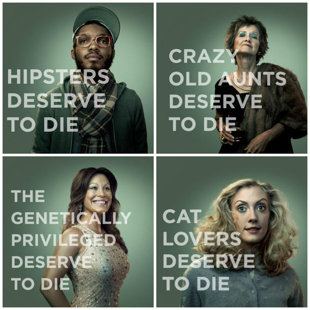
When marketing efforts like the recent “Deserve To Die” posters surfaced, I had to stop and wonder:

Where does cause marketing get off angering, hurting and offending without cluing in the people it’s trying to enlist to join its cause?

When it causes head-scratching to the point of where someone wants to violently rip down the ad, does achieving “buzz” become overvalued?

After all, these ads got buzz. And the cause behind it, Lung Cancer Alliance, is certainly a worthy one. I’m no fan of lung cancer, are you?

So why is getting buzz for it wrong? Because the strategy is so off. Consider this: In these ads, I have told that if I belong to a certain set of people, I deserve to die. Or that someone I care about deserves to die.

Most of us know there’s more to the story. But then, we wouldn’t really know what that is at this point, would we?

Because that’s the extent of the teaser ad. No call to action. No website. No QR code. Nothing. Just telling certain people they’re as good as dead and deserve to be.

I suppose that my writing about it proves that people noticed the work. But what troubles me about the whole thing was that it took too long for us to figure out the point of that work. The idea behind the “Deserve to Die” theme was to clear up a misconception that people who get lung cancer must have done something to deserve it, which is not necessarily true.

So to prove how absurd that sounds, posters with the message of “Hipsters Deserve to Die,” “Cat Lovers Deserve to Die,” and “The Tattooed Deserve to Die” started appearing across the country.

OK. I get it now. It’s still a reach.

I’m just not sure that people who are cat lovers are going to follow this awareness/conversion sequence:

“What the hell is this? Saying I deserve to die? Oh, it’s about lung cancer. So what you’re trying to say here is that people who die of lung cancer didn’t do something to deserve it, which is a misconception. Therefore, I guess it’s OK you said I should die. And I’ll support you now.”

Wow. Talk about a long and winding road.

In contrast, I like the guerrilla work behind the “Truth” anti-smoking efforts in recent years so much more. Why? It doesn’t insult the audience into trying to make its point. It says, “Hey, we’re all in this together against the big, bad, evil tobacco companies who are manipulating the people we love into buying an addictive product.”

It actually tried to rally us to work together against an identifiable enemy, almost immediately. Not divide us or keep us in the dark for days and weeks. In the “Truth” ads, we’re only in the dark for about 10-15 seconds tops before we understand the message quite well and what we need to do from here.

The people behind the “Deserve To Die” ads may say that lung cancer is the enemy we could rally around, but how long did it take us to find this out? Too long. Far too long. In a worse case scenario, I shudder to think about what kind of sick wackjob might’ve done harm to someone because a poster told him that someone deserved to die. In a lesser scenario, this kind of teaser doesn’t satisfy a society built on immediate gratification of answers. We get these answers from our search engines, from our social networks, from our smartphone apps. We expect the same in relatively short order from our other forms of media too and when we can’t get there by at least being given an outlet to use those devices, we turn into versions of the Hulk that want to smash things in our path. Including the brands and causes that made our lives that difficult.

I don’t mind when people stage a “body bag” event outside of a tobacco company to illustrate how many people die from smoking every day. The key here is that you can be provocative, even shockingly offensive to some, when the payoff is right there to complete the loop.

People often need that. It’s not that they’re stupid. It’s not that they’re mindless drones who will buy whatever we tell them to. It’s that they deserve more information for the buy-in of your work being in their face and them absorbing it. Teasers can’t hang like this for weeks on end, causing anger, hurt and frustration at an enemy that turns out to be a worthy cause. Because by then, it’s too late for people to fully understand what’s going on.

Nobody deserves that from advertising.

Finding new biz during the summer slowdown

Anyone who knows me will eventually learn that I can’t sing the praises of people I know and trust enough (although I probably should). One of those organizations I’m always happy to tout is Sales Results. If you’re a person who knows how to provide a great service but doesn’t know how to sell himself very well, you’re not alone. Most people I come across are like that. They’re very good at what they do, but they freeze up at the thought of giving a really compelling “pitch” to others over 30 seconds or more.

Jim Sheehan of Sales Results was an extraordinary help to me in this regard and I have a feeling I’m not done learning from Jim either. I’m certainly not done learning from his partner, Steve Fretzin. That’s why I hope you’ll join me this Friday for a great networking event and seminar that Steve is giving called “The 1-2-3 Punch: Finding, Selling and Closing The Deal.”

You’ll learn about some fantastic new strategies for getting clients through methods that aren’t too “sales-ish.”

Steve will be talking about areas such as:

  1. Challenges and inhibitors to obtaining new business
  2. Why clients want to “buy” as opposed to being “sold”
  3. Ways to measure business development success; the cycle
  4. Leveraging the “low hanging fruit” to obtain new clients
  5. “It’s all about the relationship” – trite but true
  6. The role of a coach – including planning, implementing a process, and accountability
In short, if you come away with as many useful tips as I think you will, it’s going to be the best $15 you ever spent.
To register for the event, just follow this link – http://www.salesresultsinc.com/calendar/details.asp?id=875Seating is limited, so get in while you can.

Hope to see you there.
-Dan