3 Big Tips For Relaunching Your Website

In the second part of my writing about working on your own agency brand, I’m really excited to share the news that Caliber’s new website is launched!! Go check it out when you get a chance and let me know what you think.
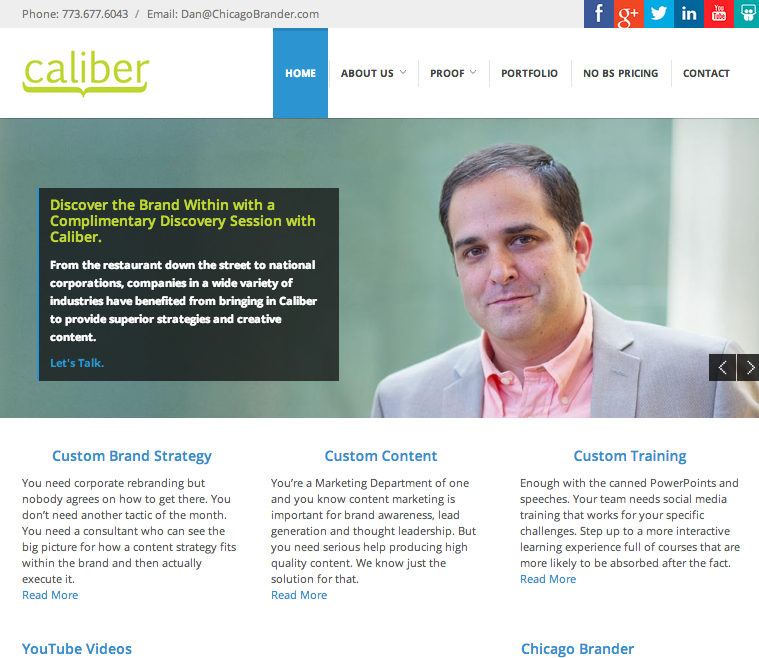
CaliberScreenGrab1Personally, I think the design rocks, thanks to Zach Weiner of Tandem Multimedia Partners. I’ve known Zach for 15 years dating back to the first agency we worked at together, so I feel very lucky to still have terrific relationships like the one I have with him. If you have the opportunity to work with Zach and his partner John Bauman, you’re in very good hands. I highly recommend them.

OK. Now let’s talk about you. How do you get your own agency’s site up and live in a timely fashion when you’ve got so much other client work to do?

Start with two things:
1) I’ve said it before and I’ll say it again: You have to see your own agency as a client.

2) Get a solid strategic partner to help you divide and conquer, especially on the things you don’t do best, have time for or internal resources to spare.

Granted, I’m coming from this in refreshing an existing site with a new look rather than launching a site for the first time. That said, that can be even more of a reason why you might be putting off your own work. “Eh, it’s the next version of our site. We’ve got something up there at least. Nothing to worry about.” Wrong.

Even if you have a web designer and programmer in-house, it’s very challenging if not impossible to ask that person (or team) to focus on the website exclusively. So they have to balance it with other client work and…here we go again, the other clients get the priority. Over and over and over again.

So what’s the harm in working with contracted talent you trust? Whether you want your in-house designer to work on the agency brand project or you want them to work on other client work, you don’t have to put it all on one plate for the sake of keeping it in-house.

Your Data Can Help Too.
People have all kinds of words and phrases they use to find you via search engines. WordPress is great for not only telling you these terms but helping you understand which pages and posts are the most viewed on your site – and that can play an important role in navigation. For example, when I viewed some of the top viewed pages of my previous site, I found it ranked in this order:

1)   Portfolio

2)    Contact

3)   What Makes Us Different

4)   About Us

5)   No BS Pricing

6)   Content Marketing Services

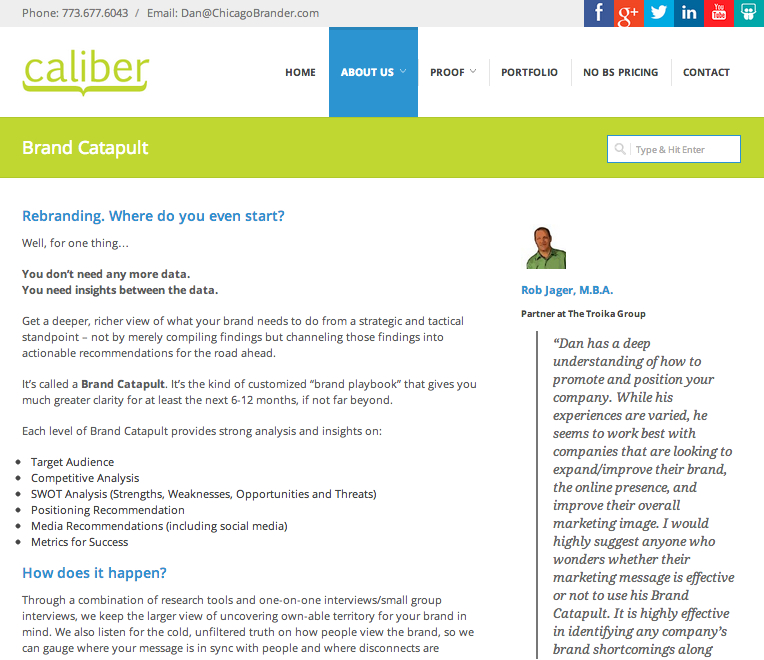
What’s interesting about that? Well, for one thing, half of these were secondary links underneath the top main menu. What if I moved a couple of them up into the main navigation, like Portfolio and No BS Pricing, to make it that much easier on the audience? So I did that in the new rendition of the site. The other point is that while I had had product-style pages, most people followed a logical order of wanting to see these “about us”-type of agency pages first before they dove into the actual offerings – even though those offerings were seen high enough on the home page.

The takeaway is that sometimes through the stats your audience is going to speak loud and clear about what they want to see and share first on the site. Give the people what they want. Make it easier on them to find. Don’t bury it (I can’t tell you how many companies make the mistake of assuming all their stuff is so easy to find on their site. “What? It’s on the home page!” Yeah. But if it’s sharing space with 20 other links, you do the math on the likelihood of visitors going there).
CaliberScreenGrab2

Let’s get back to the data. When I then took a look at the search terms, a couple popped up that were intriguing, which I might not have thought about:

“Brand Catapult”
“Dan Gershenson Caliber Pricing Range”
“Recommendations For Rebranding”

Brand Catapult is our main product for brand strategy. So while it wasn’t the top page viewed, it was one of the top searched for that leads people to our site. Then I noticed that rebranding was ranked high too. These actually go hand in hand, because as I thought back to why people often need a Brand Catapult conducted, most of the time it’s for a rebranding effort. So the language within that page is and will continue to be tweaked to reflect that.

The other interesting term? The one about having a pricing range.

Now, there’s a fierce debate among people about whether or not to list your pricing on your website. My opinion is this: It’s a conversation you’re going to have at some point anyway if things progress the way you’d like. And clearly here, the audience is telling me it’s something they want more information on, which justifies creating a page for it.

Here’s the other thing about that term you’ll notice though – it’s a pricing range they’re asking about.

That works well for me, since a lot of what I do is custom, so the prices will vary. But I can still give a decent range in the verbiage I write for a pricing page, which should guide people into one of three options for their budget. Again, it’s giving the people what they want – a little more clarity in advance. If they’re kicking tires on price and they can’t afford it, fine. If they can afford it, that makes our first conversations all the more efficient.

So to recap, 1) Think of yourself as a client. When you get into that mindset, think about how you can divide in-house talent with 2) a strategic partner to help share the load. And as you plan around where you want the audience to go, don’t forget to 3) “listen” to what they want through what the data has already told you during their visits. You don’t have to blindly design everything according to what they want – if you want to steer them through a process they’re not familiar with, gently guide them in that direction in your design – but like so many things when I’m creating a brand strategy, you have to get outside your own walls to know how your audience views you and what they value most. That might help you get on the same page. Literally.

Now don’t put your own agency brand to the side a moment longer. If that involves content or strategic thinking on where to take it, let me know if I can be of help to keep things moving along for you – dan@chicagobrander.com.


You’re Ignoring This Client The Most.

There’s a popular excuse that many agencies make for themselves when it comes to developing their own brand that has to do with “the cobbler’s shoes” and basically how we’re all like a shoemaker who makes shoes for every customer except his own children. I should know. I used to make this excuse myself. But with a semi-embarrassed grin that was actually more of a badge of courage, gosh darn it, you’ve got to service those clients that pay the bills!

I’d keep making this excuse over and over as if someone would take pity on me, “Wow, it’s so admirable that he services all those clients but doesn’t do anything for himself.”

Yeah. That pity party’s not coming.

That’s when I realized: You ARE a client that helps pay the bill.

Think about it. What helps register a powerful impression that in turn helps generate leads? Your business card. Your website. Your blog. Your social networking. Your “real world” networking. Your own professional development. These elements and more help your agency’s brand grow. So why would you kick all that to the bottom of the list every time?

We have to stop viewing ourselves as the last priority because we technically speaking don’t pay the bills via our own brand. That’s a huge mistake.

View your own brand as a client. 

This is the only way an agency can treat its own brand with any measure of respect. If you see your own agency’s brand development as another client among your roster, you will make it more of a priority. If you see it as something you should get around to doing, it won’t go anywhere.

There will never be a good time to work on your own stuff. Never.

There may be peaks and valleys in the workflow, but something else will come up. And then your own stuff will be pushed again. The new rendition of the website, a brochure, videos, whatever is part of your self-promotional strategy. Easy to do? Oh no. Not by a longshot, trust me. Right now, in fact, I’m in the process of updating my own company website. Is that pulling me away from other client work? No. I’m not suggesting you ignore them for one second. You bet that makes for an interesting juggling act when it comes to incorporating agency self-promotion. Still, there’s something about adding your own brand to the list of other client brands on the traffic list that keeps it front and center.

I do know that when you add a new client, you make time for that new client, don’t you? You add it to the roster, give it the attention it deserves, meet with key people, strategize a plan of attack, execute for them. You find a way to make it work. So the whole “We don’t have enough time” song and dance is covering up for the fact that you don’t see yourself as a high priority.

Sure, this integration is a work in progress. I get that. But the key word is progress. Kicking your own brand to the bottom time after time isn’t progress. It’s treating your own client – one of your most satisfying, rewarding clients – like an afterthought.

Would you treat any other client with so much potential as an afterthought? I seriously doubt it. Then think about how you’re going to service the client within so much better on a regular basis.

A thought to help you begin? Don’t spew out a bunch of tactics that you’re going to start doing tomorrow. I don’t recommend that for my own clients (Facebook! Twitter! LinkedIn! And more!). Instead, consider this change in mindset as your very first step. Because if you don’t truly view yourself as a client, your effort will go nowhere fast.

Once your head is in the right direction, your strategy and ultimately, your tactics can follow.

Congratulations on your new client.

Of Blackhawks, Parades and The 5 Levels of Employee Retention

 2013-06-28 10.35.18

You don’t get to celebrate a sports title coming to your city every day, every week, every year and in some cases, every few decades. That’s why as I took a few hours out of my day to savor the importance of celebrating this moment with the NHL champion Chicago Blackhawks’ Stanley Cup parade, I considered the hundreds of thousands of people who had joined me.

Sure, some of them might have had to take a vacation day or make up an excuse (“I..(cough, cough)…don’t feel so good, boss.”). Yet I know of at least a few Fortune 500 companies here that told their employees: “Go. Take this in. Spend some time within reason to applaud this team for what it meant to our city.”

It’s what I’d call a Retention Moment: These special moments where you supply and support your people through a surprising “extra” that caters to what they truly value most in life. Not what you think they want or think they would like, but what you definitely know they want.

Today it was related to sports. But other examples can relate to spending more time with family, getting tuition reimbursement and so much more.


What does this have to do with branding?

A lot – especially in the way of internal branding. You don’t build employee advocates of your company just because you gave them a raise. You build up that loyalty by understanding what makes each person tick and then giving them an easier path to celebrating more of what they value in life.

Unfortunately, retention matters at different levels to companies. If it even matters at all. In my mind, these are the 5 Types of Retention a brand engages in:

Retention Level 5: You’re One of the Family

I know how much you value time with your family and it’s been so hard to get everyone together in your house to take a true vacation. Here’s an extra $_____ to enjoy yourself on your vacation. Have a great time.

If you’ve ever seen the end of each episode of “Undercover Boss,” you know there’s a moment where an act the boss does leaves that employee in tears of gratitude. Why? Because the boss recognize their challenges as much as their accomplishments and he actually does something about that. It takes a special kind of person to reach this level. It’s a leader who wants to be there for his people because he cares about them. He knows that it’s pointless to expect them to fully productive at work if there’s traumatic issues at home. He helps them free of expectation, because it’s the right thing to do.

Who leaves an environment like this? Unless the role is menial, it becomes incredibly hard to – and that’s a very unlikely scenario because a boss who doesn’t care about the employee’s role isn’t suddenly going to shower them with rewards to try to bribe that employee to stay. No, when you reach this level, you’re the genuine article as a boss and an overall human being.

Retention Level 4: Victory Is Ours

To recognize our win of the Chrysler account. I am sending along a message via e-mail to our top brass mentioning the people on the team by name. Because without them, we never would have won this. I’m also taking our team out tonight to a nice restaurant to celebrate the moment.

Recognition of individual team members and celebrating every important win. It takes nothing but it’s still not always done. You shoot off an e-mail pointing out their specific achievements. You give an internal award (which doesn’t have to be financial). You frame their picture or images of their work. You savor the victories and make sure it’s a shared one. The more permanent these acts, the better. The more frequent these acts, the better. If you last celebrated a win 6 months ago, you’re missing Retention Moments. A company at this level doesn’t. Ever. Sometimes they don’t even need a reason for celebrating other than the fact that it brings people together.

Retention Level 3: Now We’re Getting Somewhere

There’s a championship parade downtown. Anyone who wants to go watch it can feel free to do so. This is a great thing for our city and I know many of you are fans. You will be paid for this time off and it will not infringe on your vacation/sick days.

This is still unexpected. Not everybody may want to go take advantage of this offer, but it doesn’t really matter. The leadership put it out there and that’s what counts. It’s not celebrating the individual but it’s still something the company can take advantage of. Well, Frances, the bitter and jaded Office Manager who’s 1 year away from retirement, may have an issue with it because she doesn’t like sports. Oh, lighten up, Frances.

A company at this level actually cares about following through to help the individual reach their goals – not in a way that tries to weed out underachievers but in a way that tries to bring out the best in people. They actually look forward to this planning with their employees – and beyond the talk, there’s action and evidence that the employee gets to where they want to go. Whether moving up means a promotion within the department or moving to another part of the company entirely, there’s a mutual dedication to maximizing the company’s talent in the right place.

Retention Level 2: Going Through The Motions 

It’s that time of year. We have to do an Individual Development Plan. Let’s sit down Friday and think of 2-3 goals you want to achieve. You’ll be expected to reach them next quarter. Or maybe that was within the next year. I can’t remember. Anyway, we’ll talk more and figure it out.

This is the average and expected. Many companies fall into this category and wonder why they don’t have more of a culture. Boss and employee sit down, review goals, critique, move on. They’ll remember it two weeks before they have to talk about it again. So what are the chances that this employee feels their work is being valued when talk of their development is treated like a chore or afterthought? Not much.

Retention Level 1: Why Hasn’t My Own Statue Hasn’t Been Built Yet?

I’m a terrific boss. I’ve been in this business for many years and everyone should be glad to be working here for me. I give them a job, a desk, a paycheck, a decent amount of time off and the ability to work on great accounts. If someone doesn’t like it, they can leave.

Egomania, ahoy! It’s all about him. Not his team. He thinks he’s the gift from above and all his minions should be happy to work in his presence. You’ve got to be kidding. While he’s imagining the documentary HBO is going to film about his life’s story, his employees are updating their resumes and portfolios to get the hell out of his environment tomorrow. But of course, in his view, they’re totally replaceable anyway. It’s a wonder he even knows all of their names – and in fact, he may not. It’s his world and they’re just living in it.

Where are you on this scale? How can you move up?

As you can guess, the manager who looks outward rather than inward, has greater humility than ego and takes the time to understand what his employees truly value rather than assuming it’s all about raises, bonuses and merely earning a paycheck can be the foundation of a better culture. That better culture can breed more brand advocates. You’ll also notice the scale moves upward from one manager thrilled with his own greatness to that manager striving to understand what makes each individual person happy (and supporting that in a selfless, compassionate way). People who are happier, more challenged and rewarded in a customized way are more productive people.

These elements are related in building the brand within – don’t kid yourself in thinking otherwise.

If you’re in any kind of position of influence, the momentum to move your company up the scale just may start with you.

That’s worth parading about town over.

The Future Favors The Nimble Agency

Big or small, traditionally focused or digitally focused, only one kind of agency will be left standing in the future:

The nimble one.

There is a grim future for agencies that have a process that looks like so:

Writer and designer team get Creative Brief.

Writer and designer concept, concept, concept, concept, concept…

Eureka! They stumble across an idea they love. Brilliant.

They present to their Creative Director.

Revise, revise, revise, revise, revise, revise, revise, revise, revise.

Think he’ll like it now? Hopefully so.

Re-present to Creative Director.

Looks good. Except just change this, this, this, this and this.

Writer and designer change all that stuff.

Cool. Now they present it to Executive Creative Director.

Nope. Won’t fly. Start over.

Writer and designer utter 500 curse words under breath toward ECD.

Concept, concept, concept, concept.

Present again to Creative Director.

Present to ECD.

Present to account person.

Present to account person over that account person.

Revise, revise, revise, revise…doesn’t the client hate blue? We should change that.  Well, even though this is technically something the audience will never care about, we should probably put that in too. But let’s ask 3 other people to make sure. Joe sent Mary an e-mail on this to confirm and he’s waiting to hear back since she talked to that client in the initial meeting and he wasn’t there.

In the meantime, more changes.

Revise, revise, revise, revise.

Rehearse presentation to client many times over.

(Wow. And this is just to get out the door of the agency, huh? Sure as hell hope it’s stellar work by now.)

Present to client.

She pretty much likes it. Just a few changes to make and it’s good to go.

Back to the agency.

Revise, revise, revise, revise, revise.

Back to the client.

Almost there, just a few more things to tweak.

Revise, revise, revise, revise, revise, revise, revise.

Photo shoot. Who do we know? Him? Her? Them? Let’s take a look at a few different options. Better yet, let’s have 3 meetings on it before we decide.

Locations – where are we going to go based on the budget?

Meet, meet, meet, meet, meet.

Choose photographer.

Wow, so many options. I’m sure this won’t take long at all for us to settle on just one.

Color corrections. Tweak, tweak, tweak, tweak. Can we get this yellow more yellow? Can we get this red less purple and more red?

Oh, it’s not a print ad we’re talking about? A radio spot then?

Let’s listen to a bunch of demos.

Choose the talent.

Schedule the session.

Can you put a little more smile in your voice?

Edit, edit, edit, edit.

What’s that? It’s a video, you say? OK then. Edit, edit, edit, edit, edit, edit.

How’s the sound quality?
How’s the video quality?
Let’s go through several rounds of back and forth internally.

Who saw it? Did Jim see it? Did Lisa see it? Did Bill see it? Did Ann see it? What did she think? On the email, did you CC her and him and everyone but their dogs and cats? What did he think? I heard he liked it for the most part but had just a few tweaks. Oh crap. You know what that means.

Tweak, tweak, tweak, tweak, tweak.

Eventual client approval.

Media placement. Negotiations. Phone calls and emails fly back and forth.

One ad produced.

So how long did that take?

Two months?

Three months?

Maybe more?

This process of production doesn’t work anymore. It literally doesn’t fit with the actual living world around it. It is the comet that is going to kill certain agency dinosaurs. Some of these slow-moving, methodical brontosauruses are dead already.

The rest of us in touch with Planet Earth will find a way to speak on behalf of clients in a way that balances creativity with a more timely approach. Put another way, we are able to say a lot more messages of relevance in the time you take to generate one message. One very expensive message.

Sure, it’s going to run many times over the next several months. OK. Congratulations. It’s still one message.

Meanwhile, once the dinosaur finally presents the completed ad to the world and it gets written up in trade publications and the creative team dreams of awards and the Executive Creative Director takes a picture with the client, one simple fact will remain:

That one ad, no matter how good or how bad, will have a very limited shelf life.

People may very well like it. But it still will have a definitive expiration date that may not justify the amount of work gone into creating it. It won’t run for years. If it’s like most, it will run for months. Heck, some even run just one or two times! It is a home-run-or-strike-out proposition. And nobody hits a home run every time out. But they can hit a lot of singles, doubles and triples.

Yet, I still believe there is very much a place in the world for traditional media. There is great power and beauty in a print ad done well, a radio spot said compellingly, a TV spot that captivates our senses and a direct mail piece that delights when we open it.

But the inefficient, long and winding production process that goes into creating it will be its undoing. Its process can’t compete with the fluidity of digital media and the immediacy of what we demand from brands.

Its only hope is an agency that breaks down the internal walls of approval and can get out of its own damn way so that great work can get out the door of the agency more frequently.

We have always strived for this in agencies. But now, more than ever in our fast moving world, quality will mean the life or death of an agency. We don’t need factories that churn out crap work more frequently either because that’s not a solution. Unless your solution includes miserable creative people who are continually looking for a job.

While some agencies can spend months coming up with one grand message, I will take a walk in a city full of millions of people who expect to access a website, view a Facebook page, connect with a colleague on LinkedIn, read a blog post, watch a video, share a photo, hold a Google+ Hangout or listen to a podcast on their smartphone or tablet – within only a few seconds.

Our demand for higher quality content from brands sooner rather than later isn’t a phase or describing some select group of people. It is the way of our world.

Quality in an agency system that lets better work rise to the top without overthinking, internal politics and logjams is the only hope. That takes three T’s: Talent, Trust and Technology:

Talent: You can’t fake talent at the Creative Director level. It comes from someone who knows a great idea when they see one. They don’t let logistics and technicalities bounce that idea off the table too soon. They don’t need to show it around the agency and collect a million opinions to know if it’s great. It requires the talent to write a Creative Brief that isn’t comprised of two sentences but gives the team real guidance (without confining them by telling them exactly what to create). And it takes the talent to understand that you’re not only in the business of serving the client but representing a hard-working team back at the agency that is counting on you to present brilliantly. It takes a special person to be creative, clear and captivating. You’ve either got it or you don’t.

By the way, you need talented vendors too. Not all printers, for example, are created equal. If you go with a trade printer who can get you a too-good-to-be-true deal, you probably shouldn’t be surprised when they screw up your business card that calls for rounded corners, unique textures and fancy die cuts.

Trust: You can’t fake trust. If you have the talent in the form of the best people in the right roles, how much second guessing and back-and-forth should there really be? Or if you have talented people who also have egos the size of Mt. Rushmore, there can be a lack of trust (and humility) there too.

Technology: The first two above are hard. They’re human elements. This one is much easier. When you have project management software like Basecamp (we use this at Caliber and love it – as do our clients), you are literally putting the team on the same page. Everyone can see the latest files, discussions, timelines, etc. It’s a beautiful thing. Assuming everyone actually uses it, it virtually eliminates the “Did you send me that latest version?” question that comes so often with conventional e-mail. This and other tools like it only make internal and external agency communication easier and faster.

When talent, trust and technology are humming along, you not only eliminate unnecessary steps in a cumbersome production workflow. You have a better culture and better relationships.

It’s not a big agency thing. It’s not a small agency thing. It’s not a traditional agency thing. It’s not a digital agency thing.

It’s an intelligent agency thing.

Because whether you realize it or not, life is happening while your ad is in production.

The future favors the nimble.