Two Things College Profs Should Teach Ad Students (But Often Don’t)

The student across the table from me at the Portfolio Review had one of those deer-in-the-headlights looks my way when I asked the question. It was a question that I thought was simple enough, but apparently it was a real brain teaser. I wondered if I was dealing with a kid who had just had too much to drink the night before at a frat party and was regretting it now. But she seemed fairly lucid, so I asked again:

“What was your thinking behind this campaign?”

She stammered out, “Well, I, uh, guess I just thought this logo effect would be cool and the colors looked pretty good.”

I asked it again to another student and got, “I did this because that was our assignment, to do a logo and an ad and a website…”

I kept hearing this and started to notice a disturbing pattern: More and more kids coming out of college into the Advertising profession don’t know diddly squat about how to sell their work in any convincing manner.

Oh, they have talent for sure. They can write well. They can design well. They know how to service an account at a junior level. But the ingredient they’re missing is one they should have been equipped with as early on in their schooling as possible – strategic thinking.

Colleges and Journalism Professors, listen up.

We in the professional working world expect you to teach them this stuff. Frankly, for the truckloads of money their parents are shelling out to your school or the amount of debt they’re going to accumulate due to student loans, they deserve to be in the best possible position to succeed. Not settle for another line of work.

So yes, you’ll excuse me if I hold your institution under a microscope to ensure it continues to prepare kids for the landscape in front of them.

Which brings us to the other thing I find lacking more often than not: presentation ability.

How much good do you think it does to teach them the merits of great Copywriting and Graphic Design and Web Development if they don’t know how to persuade a Creative Director or Account Director or client of the work’s reason for being?

I’m not asking them to be superstars in this skills area right after graduation. That’s unrealistic. But I don’t think it’s unreasonable to want them to be able to present their work thoughtfully and with confidence.

It’s not that they can’t get into the profession on talent. It’s a question of how far they can go. I don’t know too many people who advance that high up in a company in this field and also suck at selling.

Some choose to want to only go so far because they don’t want to get too far removed from what they love most, such as writing or design. I can totally respect that. But what I can’t respect is not being equipped to have the option of that choice because they weren’t given the presentational skills early on.

Wait, wait. Don’t tell me. Here comes the excuse for talent rising above all shortcomings:

“Great work sells itself.”

Let me know when you’re done sliding on that rainbow and read on when you are.

Because while great work should sell itself, it often doesn’t. There is an entire minefield of internal and external challenges to that brilliant work seeing the light of day and resembling what it began as.

It needs savvy, sophisticated people to link the mindset of the audience with what that work is striving to address. And while it may still get shot down or suffer what the great Luke Sullivan calls the “death by a thousand cuts,” you give it a fighting chance of emerging through the storm of critiques with a strong rationale.

I was lucky. I went to a Journalism School, Drake University, where I was given the ability to partake in campaign simulations that gave me not only a real taste for agency roles but also presenting work to a real company. I couldn’t get up there and justify buying off on a campaign because it was “cool.” I couldn’t just get by on creative writing alone.

I had to dive deep into the company’s challenge, learn about what hadn’t worked up to this point, what their competitors were doing better or worse than them, try to unearth a few nuggets of insight and use that insight to help them live up to a promise their audience could believe in. And of course, I had to sound really good in expressing that thinking.

It didn’t matter whether or not they were actually going to use that winning work. It was the presentation that mattered. And when our team experienced technical difficulties during the presentation and lost to another agency by 1 point, I learned a lot about improvising on the fly, walking a client through the thought process and, in the end, how much I hated to lose. Crazy valuable stuff to learn before I donned a cap and gown.

I was lucky a second time when my first Creative Director taught me about how to write better Creative Rationales. It didn’t need to be a 10-page report but 2-3 paragraphs that the client could use while hopefully bulletproofing the work. If we were taking the client in a new creative direction, why were we choosing to take them down that path?

And I was lucky a third time when my second Creative Director told me I needed to try a couple of classes in comedy improvisation. Trust me. This stuff scares the crap out of you if you were like me with no training but it’s a good thing for the long haul.

But…for the investment required, I think colleges and universities can help students accomplish a whole lot of the above before they get into the working world. They won’t all be lucky to fall into the right environment upon graduation and have great mentors when they get there like I did. Therefore, they deserve to be involved in more simulated or real campaigns. They need to learn how important strategic thinking is in the equation. And they should know what it’s like to present their work with passion.

Without these ingredients, we’re only going to have more graduates coming out of school who know everything about how to post and tweet and create hashtags and Instagram but don’t know why they’re doing it in the grand scheme of things as it pertains to the brand. They’ll be tactically intelligent but strategically empty.

On more than one occasion, I have been told by interns on how they had learned more with me in 12 weeks than they had in years at school. I’m proud of that and disturbed at the same time.

Yes, I still believe a college education is worth the investment. But please don’t tell me we can’t do better.

Prospecting: Separating The Believers From The Non-Believers

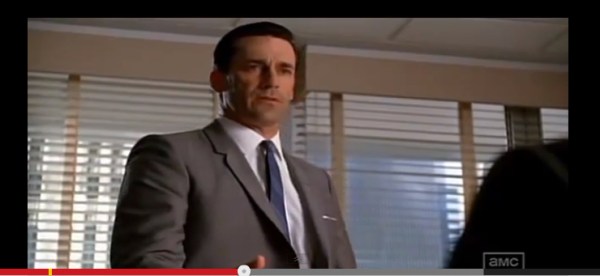
This scene from Mad Men sums up an important point for me about prospect relationship building.

There are Believers and there are Non-Believers. The difference is easier to spot than we make it.

As Don Draper says when explaining an ad campaign, “You either have it in your heart or you don’t.”

Let’s apply this to new business relationships. As we know, prospecting for the complex sale can be sophisticated, time-consuming and take many “touches” before an actual invitation occurs to be face-to-face with someone. Getting through that door isn’t often a one-time effort unless you’re in the right place at the right time.

But now you finally get that first meeting – it may come from your initiative or them finding you. They invite you in to learn more.

Here’s where you separate The Believers from the Non-Believers.

By the end of your first meeting, after you’ve discovered enough about the challenge before you do an even deeper dive and they’ve learned a solid amount about you, you should have a good sense of whether the person wants to have a relationship with you. They believe in you or they don’t. If they don’t want to move forward, so be it, but at least you know. If they do want to move forward, are we talking the details of a relationship in our second meeting or are we shooting the breeze?

This isn’t decided by logical factors. This isn’t a tally sheet of points on an RFP (Oh really? You’re going to tell me I just missed out because I scored a 94 and my competitor scored a 97? Riiiiight.).

For all the laundry lists of virtue that agencies throw out there (experience, creativity, number of employees/locations, awards), these have value – but none of them are exclusively own-able.

Relationships are emotional decisions. They go with you because they like you. And if they like you, they believe in you. And if they believe in you long enough, they refer you.

That last one is important. If they’re not referring, they like you but don’t like you enough.

Let’s take a look at the typical pattern: You meet. You greet. Both parties get to know each other. If it makes sense to do so, you present / quote.

Then what happens?

Sometimes it’s a “We’ll get back to you.” “We’re still thinking about it.” “So and so is on vacation.” “We’ve got a fire to put out in the next few weeks but we’ll get to this.”

We’ve all encountered a response like this in some fashion or another. It’s not that we’re necessarily bad presenters or that it’s all on us. It just might be that they’re not equipped to make change. The key word is “make.” Some companies don’t want to make change. They just love the IDEA of change. Because that’s safe and even romantic to think about. There’s no risk with an idea or merely talking about what could be. So they talk and talk and talk and want to meet with you over and over and over again. You keep getting lured in (“Oh wow! They’re bringing us back in for the fifth time! They must be really close to making a decision!”).

And that can’t happen. Because you go from being potentially paid consultant/agency to free therapist.

People who want therapy are not serious prospects. They are Non-Believers. If they are stuck and you have presented what could be a smart, strategic way out of being stuck, they should not be comfortable with where they presently are. You are taking them to a place outside of that Comfort Zone, yes. But even in their slight discomfort, The Believer knows that this is a vital and important thing for the company, not something to be feared.

It should take no more than one meeting for a person to not only believe change is necessary but that it has to happen now. It should take no more than two meetings for that person to believe that you are the right person to enact that change.

Beyond this, you need to ask yourself if you’re dealing with a serious prospect or a tire kicker.

I’m not proud to admit it, but on more than one occasion, I’ve had a prospect I’d met and spoken with several times before keep me on the phone for an hour talking about their problems. That was stupid. There comes a point where you must say, “You know, I’d love to continue this chat but I typically bill people beyond the ___ minute. Is that something you’re comfortable with?”

You have it in your heart or you don’t.

Think about your favorite brands – what do they have in common about their customers? They’re more than customers. They’re giant fans. They’ll defend that brand to no end. They’ll come back again and again. They’ll tell others how wonderful that brand is.

They Believe in that brand. There is no middle ground. No Semi-Believers.

This doesn’t stop when they become clients.
Are we wrong to want to strive for Believers in our agency in a collection of clientele? I don’t think so. Imagine your agency with 100% Believers. Every one of them loves you. Trusts you. Refers you business and/or might very well be open to doing more business in the right circumstance. Can’t say enough good things.

What’s that? Some clients don’t do that? Which ones? Why? How can that be improved upon from here?

Of course this doesn’t mean they’re going to blindly agree to everything you say and do. Of course they’ll question or suggest changes. That’s normal. There’s a difference between sharing opinion and dictating, “This is what I want the ad to specifically say.” The former is still belief. The latter is not.

Believers want to be led, guided and educated. They are inspired to act now. They don’t want to just talk about it over and over and over. They don’t pretend to know everything or better than their own customer. And they see you as the expert that you are rather than being dragged kicking and screaming into new ideas or new technologies.

Look, some people just aren’t ready to go forward when the time comes. I can respect that, but you also have to have respect for yourself. The first and incredibly important step of liking someone isn’t something you have to think about over a period of several meetings and months. You just know it the first time. And you know what the concrete next steps are as a result.

You either have it in your heart or you don’t.

Ebert found his voice again in social media

Mike Royko. Irv Kupcinet. Gene Siskel. Jack Brickhouse. And now, Roger Ebert joins the company of these and many other Chicago media icons who have passed on. For Ebert, most will memorialize him of course for his landmark TV program bantering with Siskel. But my first thought upon hearing of his passing was how this remarkable man, due to devastating cancer that had robbed him of the ability to speak, had found a new voice in his use of social media. Most of us couldn’t even fathom the thought of not being able to speak, yet Ebert channeled his energy into a wonderful new electronic format. There, in true journalistic form, he rendered opinions that carried great weight and credibility, just as he had for so many years before. In fact, unless it was my imagination, he even threw more opinions online that weren’t necessarily confined to cinema either.

Think about this – there are countless people who don’t have the focus or energy to do online writing. And they’re perfectly healthy.

Which made me consider something:

If you literally lost your voice and had 5 years to live, what would you “say”? 

Sure, you’d probably go through a wave of emotions, experience bouts of depression and question why this happened. But at some point, you might emerge from that, look at the hand you’ve been dealt and say to yourself that you still have time to communicate with the world through what you write.

What would you write about? Where would you say it? If you needed help, who would you turn to?

To make this easier, think about this in terms of your personal passions, not your business. We all have various topics that we love discussing: Food. Fashion. Cars. Sports. Travel. Politics. Technology. Religion. Beer. Anything. These are the other things outside of what we do for a living that also nourish the soul. They don’t go away even when our physical limitations prevent us from speaking them.

Knowing you could be blogging about that particular topic and that your time is limited, you’d reach a point where you’d plunge into it without restraint, without even thinking about it. You’d worry less about what this or that person thinks. You’d attack the day needing that blog. You’d just have to get the words out. There’d be something to say about our world today and something they’d remember you by later in the process. You’d worry less about financial gains from it first and foremost and instead, write for the pure joy of sharing and connecting to others.

But here’s the thing: Do we have to wait until we’re in a state like that to begin? 

You and I both know the answer to that. We don’t. We can consider how our own personal brands are sides of us that need nurturing too. There’s a story there worth telling that may or may not have anything to do with what we’re about professionally. And that’s OK. We just have to give some serious consideration to the purpose of our writing and choose the kinds of things that never feel like they’re a chore to say. There’s nothing to hold us back. It’s a remarkable feeling of freedom and self-fulfillment. And by the way, we have the technology to do it easier than ever, so that excuse is out the window too.

So…what’s stopping us?

Desire to share the story is the missing ingredient. You have it or you don’t. Thankfully for the rest of us, Roger Ebert didn’t fade away in these last years of his life. Even more powerful than the message was his inner strength to want to keep sharing, keep telling, keep communicating in other ways. And in the process, he showed many of us, healthy and disadvantaged, that when you have the passion to be heard, your final scenes can be as memorable as any that came before them.


Jack White, Quentin Tarantino and Equivalency Branding

0f69cd2

Jeff Segal, Message Therapist

Today’s guest post is brought to us by Jeff Segal, Content Manager of Kauzu, a social venture that’s changing the way jobseekers and employers connect. An experienced marketing professional and disciplined writer with creative flair, Jeff also consults for businesses under the moniker of “Message Therapist.”

Something occurred to me recently when I heard Jack White’s cover of “I’m Shakin’” on WXRT: Jack White is the Quentin Tarantino of rock.

They’re both obsessive fans who push well-worn genres beyond their traditional boundaries—low-budget crime, martial arts and western flicks for Tarantino; blues, rockabilly and R&B for White. They’re both unapologetically indulgent—Tarantino’s movies are rarely short of three hours, and White’s guitar solos can singe the hair from your ears—but find forgiveness with fans and critics alike. Both Tarantino’s movies and White’s music can feel like parody and homage at the same time.

Golly, Jeff, that’s some fascinating media criticism. What does it have to do with branding?

Say you’d never heard of White but you’d seen most of Tarantino’s movies. If I told you, “Jack White is the Quentin Tarantino of rock,” you’d have a pretty good idea what to expect from his music.

If you’d never heard of Jimmie Johnson, but I told you he was the Tiger Woods of stock car racing, you’d probably guess Johnson was the favorite to win every race and championship—even though Woods himself hasn’t won much of anything in years.

If I told you Sub Zero was the Ferrari of refrigerators, you’d probably guess it would be beautiful, high-performance, and staggeringly expensive.

If I told you Mr. Lee was the McDonald’s of China, you’d probably expect to see Mr. Lee outlets selling fast food on every street corner in Beijing.

You get the point. The human brain has a hard time understanding new concepts, but less trouble associating a new entity with a known entity. If you’re marketing a new concept, try to describe it as the equivalent of a known entity—in other words, a recognized brand—and you’ll get the idea across faster. It’s a branding shortcut.

Let’s call it Equivalency Branding.

When Kauzu introduced the employers’ portal to its hyperlocal, mobile job search tool, we had a hard time summarizing its benefits—until we called it “The Help-Wanted Sign for the 21st Century.” Then employers understood: it attracted jobseekers who were already in the area, with the added reach, mobility and analytics of a modern web platform.

The founder of a Chicago startup with an innovative online video editing platform sometimes describes it as “Shutterfly for video.”

Promoting a legal environment that helps Chicago startups pursue business models with a positive social impact, a successful local entrepreneur says she wants to “make Chicago the Delaware of social enterprise.”

Equivalency Branding doesn’t work in every situation, but it’s surprisingly adaptable with a little creativity.

Say you’re an independent operator in a field dominated by a massive competitor called Megajumbo. Here’s how you might leverage the well-recognized Megajumbo brand to position your own:

  • By niche market—“the Megajumbo for medical office management.”
  • By locale—“the Megajumbo of River North.”
  • By specialty—“the Megajumbo of custom-designed micro-widgets.”
  • Or by competitive advantage—“like Megajumbo with better customer service.”

You might not want to use Equivalency Branding for your official marketing materials—for one thing, Megajumbo’s lawyers might not appreciate it. But it can be a great way to introduce yourself in a small group, networking or sales situation.

Hey, and if it catches on, I’ll be the Steve Jobs of Equivalency Branding.

The Day Of Sales-Free Selling Has Arrived.

If you want to look old as a marketer, use tired old marketing tactics that, technically, might “work” but fail over 90% of the time.

Traditional direct mail, for example, offers a typical 2% response rate. So going in, you know that there’s an excellent chance that almost every little postcard you send out in carpet-bombing, non-personalized fashion is going to be filed in a cylinder under a desk or be used as birdcage lining. This is not the same as direct mail that utilizes Personalized URLs (PURLs) – those can be great – but instead a piece of paper that provides no further attempt to get to know the prospect or ever takes the prospect down a more personalized funnel.

Cold calling is another example. Traditional salespeople say it works, but they can’t deny that the percentages are not in their favor here either. You dial 10 people who are only marginally qualified at best and you’re going to have 9 out of 10 of those people say, “Not interested,” if not be outright pissed that you’re interrupting their day (and the one who actually talks to you may be a lead but not ultimately a sale). Especially when you launch into your script about how your life-changing services are just what they’ve been waiting for when you’ve made no attempt to truly understand their needs. Oh wait. That would take more intensive research on that prospect and who has time for that. My bad.

2% effectiveness.

Come on.

Can we get real about what “works” when we’re talking sales and marketing?

Maybe we can agree on this much, regardless of this or that tactic – sending out a blanket message to thousands of people you have never interacted with before may not be as good for conversion as you getting to know them, understanding their challenges and providing a path that helps them through a decision.

No, this isn’t a launch into how inbound marketing is King and everything else is dead (although inbound is extremely vital). There’s still a place in this world for “Push” strategies and advertising and selling. But the way we push can, is and will be more 1-to-1 than ever. More customized. More selective, pre-qualified and integrated with digital to improve our close ratios. More scalable so that more people can receive a personalized approach. What is continually evolving in our world is the need for greater business intelligence faster as we prospect. And as better technological tools catch up with that ambition to help identify our targets more specifically in advance, we may not have as much of a need to dial for dollars by the thousands of people.

But beyond the technology, how do you change that mindset so that you actually slow down sales and clarify yourself as a viable option in the prospect’s mind?

I do have a suggestion on that, which hopefully is as helpful to you as it has been to me.

One company that has had a profound impact in the way I’ve thought about selling myself and my services is Sales Results, Inc. To be honest, when I approached this company years ago, I was great at helping my clients build their brand but I had trouble with how I developed my own approach. I didn’t have a good “elevator speech.” I didn’t know how to set an agenda for my meetings – most were just throwaway “I’ll keep an eye out for you” coffees and lunches. And I didn’t hold myself accountable for my activities or should I say, lack of them.

Jim Sheehan and Steve Fretzin changed all that for me. I find myself continually learning that there are smarter ways to, in fairly efficient order, discover if there’s a natural fit between two parties as either a sale or a strategic partnership. And how liberating it can be to help someone clarify a decision – even if that decision doesn’t arrive at your business’ doorstep.

There are no shortcuts in sales (none I’ve found yet anyway). You still have to network. You still have to do one-on-ones and events. You still have to follow up after appointments. You still have to make referrals, not just take them.

But for some odd reason, when I employ the Sales Results methodology, it just doesn’t feel like hardcore, off-putting sales to me. And I consider that a very good thing. It’s more natural, comfortable and in my view, more effective.

SFSbook

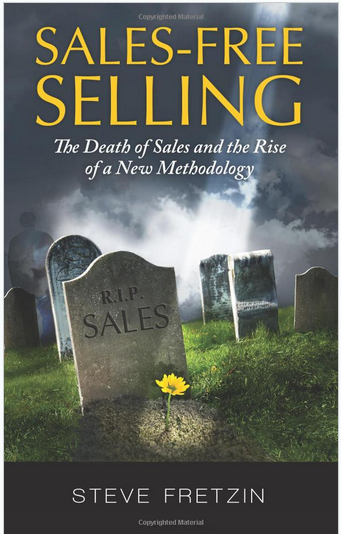
There are two ways to get a sense of what I mean. One is to actually go through the Sales Results program. The other is to pick up Steve’s new book just released today called “Sales-Free Selling: The Death of Sales and the Rise of a New Methodology.”

To be on the safe side, I’d do both.