Sometimes it’s not worth fighting a gorilla.

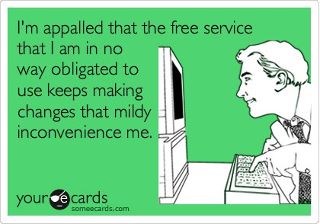
This photo from someecards.com (yes, proofers, there’s a misspelling in it, but you get the idea) pretty much sums up the “uproar” every time Facebook makes a change to their structure, layout and functionality.

We don’t have to like every change Facebook makes but this is part of the deal we’ve made with ourselves by using a service that literally costs nothing and is larger than most countries in the world. Would you rather pay for the right to use Facebook? Probably not. Even if you did, I doubt this would mean you’d have the opportunity to have your voice heard above the hundreds of millions using it. You may pay someone to help you facilitate a presence on a social networking site like yours truly, but there’s still only so much that can be done – when the sites want to make a change, they’re going to make a change. And they’re probably not going to ask you for your opinion – even though they should more often in advance.

When you do pay for services like project management tools or web hosting, you should, of course, expect more. You should expect better customization to your needs and better customer service. But wasting your time getting angry over a free social network making minor changes? Just roll with it and look at the other side of the coin – be glad that a service like Facebook is making an attempt to evolve and make things better. If not, you can employ the same practice you would in watching television – change the channel by using something else. Not that I’d recommend that if that’s where your audience is primarily living, but just saying there are options if it upsets you that much.

But in the scope of the world’s true problems, Facebook making some minor tweeks is really not a big deal.

I’d just take a deep breath and be glad it’s Friday.

1st Gen E-mail Is Over – Does Your Marketing Reflect It?

“Wait – what do you mean? Are you saying e-mail is going away? No way does e-mail go away. Everyone uses e-mail.”

I figure that’s the response I’d get from a headline like the one above. But e-mail marketing in its 1st generation form should be history. E-mail in its next generation form is where we should be thinking and how we should be acting in our marketing efforts already. Right now.

Why? Spammers and Yammer.

1) Spammers are ruining e-mail as we know it for the good marketers who have valuable messages the recipient can benefit from. The filters of unsolicited mail will only get stronger so we have to make our messaging more simple to identify with, customized as well as equipped with subscription and link mechanisms so people can continue the relationship if they so choose.

2) People won’t need internal e-mail as much with services that enable them to communicate in real-time formats like Yammer. The speed of how we connect within the company is ramping up quickly. In this internal context, regular e-mail with its lag time and ability to clog in boxes looks like a dinosaur.

Knowing this, what do we do as marketers? First, we relax. Second, we adapt to this development by equipping our e-mails and e-newsletters with springboards. In other words, we stop doing e-mail that doesn’t give people anywhere to logically go from there. Otherwise what you’re sending out there is a lot like the direct mail issue I mentioned earlier. No links to more info? No landing page or blog? No place to channel the conversation further toward an appointment and hopefully a sale? No ways to become a Fan, Follower or Connection from there? No pictures they can share or video they can watch?

Then I don’t get it.

Closing a customer when the e-mail starts and ends with that message is hard to do. Even if you’re designing it as something to be read in 60 seconds or less, you’re doing so with the intent that the person subscribe to get more of those e-tidbits. Yet, strangely, some things get sent out without them.

We should incorporate RSS Feeds into our content, giving people the ability to subscribe to us or providing even the option to choose certain sections of content that’s relevant to their world. And while we have e-mail and people use it, we need e-mail subscription sign-ups. It means we have to be more visible than ever before when it comes to producing great blogs, great videos, great e-books, great social interactions that aren’t just about how we’re having 3 for 1 Bud Light Specials tonight.

If we’re going to do e-mail, let’s do e-mail that respects the person’s time by getting in and out of the person’s life in a reasonable period. If they want to spend more time than that with us, they’ll Like, Follow, Connect, Subscribe and Download. The first interaction should not be a company’s life story nor should next steps be just about only a phone call or e-mail. That’s done as far as I’m concerned.

If all this sounds like it’s only going to get harder for you as a marketer, well, you’re right. But I see this as a good thing. People still crave answers to their challenges as much as they ever did. We just have to get smarter and more sophisticated how we pave the road from them back to our solution. We can’t blast away at them with nothing but ads that have virtually no response mechanisms or only “old school” methods like dialing a phone number. We have to create online and offline channels that enable them to learn more about us and understand our offerings – on their terms.

TV adapted. Radio adapted. Newspapers and magazines tried to adapt but aren’t doing a bang-up job of it. Now it’s direct mail and e-mail’s turn at bat.

The way we market through the mail, both in direct and electronic form, needs to change. Or it won’t matter how many days the Postal Service trims from its schedule because we won’t be effective or appreciated in any of them.

How has your brand been adapting? Or have you not yet? 

The mail system is changing forever. Not just on Saturdays.

It’s time we wish the first generation of direct mail and e-mail a happy retirement to Del Boca Vista. I recall stories of when ol’ direct made the eyes of David Ogilvy twinkle with glee. Or when e-mail came on the scene, a hot, young upstart in the electronic world.

But like all things, there’s a new generation of direct mail and e-mail taking over and doing things differently. A generation of mail made for new technologies. Therefore the people receiving their messages demand more. The people using them for marketing purposes had better demand more of themselves in how they create, strategize and measure.

Let me explain. The ways we use mail has worked well for some period of time but like anything else, they are evolving.

Younger generations such as Millennials are embracing alternative communication methods through social media and internal project management tools to get information and send information beyond the standard send-and-receive e-mail systems. They also are responding to those offline techniques that incorporate online communication for continuing the conversation and relationship. I hardly think the generations that follow them are going to revert back the other way. We’re only going to get more electronic, more segmented, more fast and more personalized.

Marketers have the choice of evolving with this development or not at their own disappointment, if not their own peril.

Bottom line: Your message will not be nearly as effective if you ignore the ways to inject more technological applications into that direct mail or e-mail while adding inbound marketing mechanisms into your efforts.

We have to act as if direct mail in its most traditional form of “here’s our message, call this phone number if you’re interested” is irrelevant right now in terms of the call to action. We have to act as if spammers are ruining the quality of e-mail communication by the day.

It doesn’t mean mail is over. It means old direct mail and e-mail marketing messages are over.

Farewell to Direct Mail Marketing as We Know It

Let’s pick up the bugle and play “TAPS” for traditional direct mail as we’ve known it – a static piece like a postcard that merely asks your recipient to call or e-mail you without leading them anywhere else isn’t working hard enough. Even before the U.S. Postal Service decides to trim a day or more from its schedule, you should be re-evaluating conventional direct mail – not whether or not to use it necessarily but how you will inject a much-needed online component into that DM.

Direct mail with no online component such as a landing page or QR Code to scan or code to enter when they get to a website for a discount/prize….is probably going to get about a 1% response rate at best. So if you want to send out some general postcard to promote your business and get awareness, it’s your dollar. But expect no less than 99 out of 100 people to pitch it in that format. It’s good to at least have that expectation so that you’re not surprised (and if you are pleasantly surprised, that’s gravy). If you want better than that, the next generation is about driving the recipient to a personalized URL. You should be doing that right now if you’re using direct mail. Do you want a static piece that provides a response at best of awareness without likely action or do you want a piece that potentially drives the person online to take action and possibly even find long-term connectivity through a social network?

In the second half of this topic in my next post, I’ll talk about why you should bid adieu to the first generation of e-mail marketing right now too.


The Daily Herald Betting Far More Than $20 Per Reader

Newspapers need a new pricing model that reflects the online age of readership.
I’ve got 3 ideas on how to help.

The front page of the suburban The Daily Herald, penned by the Editor, shouted the newspaper’s stance loud and clear: “Why our digital news cannot be free.

The 139-year-old newspaper has officially made the decision to charge for most content from the paper online. If you want to read The Daily Herald online from now on, you’re going to have to pony up $19.99 a month to do so. And by the way, no other paper in Chicagoland is charging digital readers on this kind of scale.

On paper – no pun intended – it seems to make sense that people should pay for digital content. We pay for books on news, we pay for TV and radio on news, so we should pay for papers that provide news, right?

Well…it’s not quite that simple as some would make it out to be.

Journalists and Editors say their content has value and needs to be paid for, because advertising isn’t bringing in enough revenue. Readers say the minute they’re charged money to read online content that they’ll go elsewhere to find it.

How does it all shake out?

The answer comes down to this: Is the content exclusive and original?

I have nothing against paying to read outstanding, exclusive content I can’t find anywhere else. But I have plenty against paying to read decent content that I can find elsewhere.

If a reader can get that content elsewhere from a source that isn’t charging for it, that’s where they’re going to go. So the paper has to provide content that’s spectacular and can’t be found anywhere else. Is the Herald’s content spectacular? It certainly has good columnists. But can I find solid reporting and opinions of the issues elsewhere? Honestly, much of the time the answer is yes.

The New York Times can get away with charging people a decent monthly flat rate for its digital version because it’s The New York Times. Let’s be honest. Is such a price worth it for unique reporting on the news of Bolingbrook and Hinsdale? I’m not trying to be rude here, but I’m wondering if local news reported on DuPage County is worth that investment to people these days.

Let’s look at the issue from a different medium – radio. When Howard Stern went to Sirius Satellite Radio several years back, people wondered if we’d hear the last of him as a result. Well, like him or hate him, Mr. Stern has a loyal, passionate fan base who know they can’t get Howard Stern or anything close to him anywhere else. The investment is a no-brainer for them because the content is original and exclusive. Is it working? Did you not see the gigantic contract he signed for more years on the air at Sirius?

For the same reason, like him or hate him, this is why I think Glenn Beck probably made a good move in asking people to pay for his content too.

So here are 3 ideas that might make more sense for smaller newspapers like The Daily Herald:

  • Subscribe by Columnist
    My suggestion is simple. If the columnist is good, people can pay through a Newspaper App Store to subscribe to that columnist. If the columnist is ordinary, they don’t. So there’s no waste in subscribing to a newspaper or magazine full of other stories I don’t want to read. On the other hand, if it’s a Chuck Goudie or Mike Imrem, they read who they want. Why force people to read a person who doesn’t have value in their eyes?
  • Subscribe by Story
    Come on. How much of that paper do you end up throwing away because you haven’t read the whole thing? And how many of us read the whole thing anyway? Enable us to subscribe by certain topics (or even possibly keywords) that ensure greater value for the readership because we stand a greater chance of reading what we want, when we want it.
  • Preview, then Pay
    Each story is previewed with 50-100 words, which then means the reader has the option to pay for the rest of that story if they want. I’ve certainly seen this strategy employed by other websites and if the content is powerful enough, I’ve paid to read the rest.

If structured correctly and reasonably, the newspaper actually has the ability to make more money through these methods than a flat rate. Plus, they’ll know which columnists bring more value to the paper through the quality of their stories being purchased. While it might not be free, the win here for readers is that they pay only for what they’re interested in reading.
If they don’t explore these alternatives, what you will find with the Daily Herald and other papers like them will be a smaller, more concentrated readership of people who value the content. The question of their survival will be how small that readership becomes. The paper has to go through growing pains of potentially trimming staff and printing fewer papers, but this is a natural progression of where the world is going. Bottom line: Do I see charging people $20 a month across the board to read online content as a good growth strategy? No.

To be clear, there’s still room in this world for the information put forth from journalists. No doubt about it. But newspapers have to create subscription plans that reflect readership habits of an online world, not a print one.

What’s your take? Do you agree with The Daily Herald charging $20 a month for online reading? What about charging for online readership in general? What are some examples of online content that’s worth paying for, in your opinion?

 

Memo to a Mayor: Make Chicago the most socially connected city government

A couple months ago, I heard Chicagoland Chamber of Commerce President Jerry Roper tell a story of how Mayor Richard J. Daley (that would be Chicago’s first Mayor Daley for history buffs) used to instruct staff members closest to him to always carry a pad of paper with them. That way, when they saw something in their daily lives such as a pothole in need of fixing, they would jot that down and give it to the Mayor. I’d like to think the pothole in question then got promptly fixed.

I can also remember Newark Mayor Cory Booker speaking on Piers Morgan’s program on CNN about how he successfully used Twitter this past Winter to quicken emergency response times toward those residents trapped by a snowstorm.

Some say these examples are from long ago or apply to a smaller city than our own. But really – is the notion that Chicago be the most socially connected city be a pipe dream? No. I don’t think so. In fact, I believe we have the tools and resources to make this possible. And I think a relatively new Mayor in Rahm Emanuel is the perfect opportunity for renewed advocacy and accessibility with governmental leaders.

Let’s start with the ground level.
If someone sees a pothole, we may complain about it and say, “somebody should fix that.” Or we could snap a picture of it and tweet it to an alderman or City Hall with the location of where it is. At the end of this post, I’ll give you their Twitter handle if they have one. Easy enough? You know it is. You have time to use your phone for good in between games of Angry Birds.

Getting City Council More Social
Every Chicago Alderman should set up with a Twitter handle so they can be sent questions in the form of tweets from their constituents and respond in kind. Or use it to listen to relevant conversations going on among Chicago’s most passionate citizens. Currently, only about 1/2 of the 50 Wards have Twitter accounts and several of those are poorly updated (but glad to see my neighborhood’s Alderman, Tom Tunney, doing a good job with the tweets – @AldTomTunney). For more in-depth postings that incorporate pictures and video, having a Facebook page is not the worst idea, particularly since most constituents are likely on Facebook if they are not on Twitter. All you need once you’re set up with an account is to be responsive to the people who most likely live in your designated area – which is, after all, what you were elected to do, right?

Town Hall meetings
What works for President Obama can work at the very localized level too – broadcast Town Hall meetings or other types of monthly discussion meetings on YouTube to bring together roundtables of citizens with their Alderman to discuss topics that need to be raised. Now, I understand that the content at times may be no more thrilling than C-Span, but I didn’t say this has to be recorded in its entirety either. Taking the most useful snippets that are then posted on the Alderman’s site can help convey quick answers to questions that are very top-of-mind for the neighborhood.

Civic Investment
As funding from the private sector is important to help grow our city, each of our Aldermen should also be set up with a page from the leading B2B website, LinkedIn. I’m not merely talking about creating a page, however. I’m talking about creating an outlet for connections between the politician and corresponding C-level executives as well as associations can occur. It takes no time to create this and establish connections. Besides, LinkedIn also has a Polls application and no matter how much they say they don’t look at them, politicians can gain some significant insight and goodwill from polling their constituents on a variety of local issues.

“How do I do this?”
For the politicians: It’s incredibly simple to be set up with the right tools to engage your electorate on a daily basis, including all the ones I’ve outlined above and then some. It’s smart for your visibility, accessibility and yes, your election or re-election efforts. The main point is that what I’m suggesting is a small but important opportunity to improve communication between City Hall and its citizens just a little bit better. The upside is worth the investment of time.

For the people: Courtesy of the people at Progress Illinois, here’s a Chicago Aldermanic Twitter Directory. If your Alderman is on this list, connect to him or her and make the link to government in Chicago just a little bit closer. Don’t forget to follow our Mayor while you’re at it – @RahmEmanuel.

For those who may question the effectiveness of being the most socially connected city…do you really find the traditional way of getting things done in politics marvelously efficient?

That’s what I thought. Let’s give this way a try now.