10 Endangered Species Leaving Your Office by 2017

Dinosaurs are fun to look at in The Field Museum. It’s not actually fun to look like a dinosaur in an entrepreneurial setting.

“Oh, that’s not our company,” you scoff. Well, put down the phone in your cubicle and stop sending that fax because depending on the tools and practices you’re using, you might not be quite as progressive as you think. Especially if you witness the opinions of more than 7,000 professionals surveyed by LinkedIn as part of its “Office Endangered Species” study released yesterday.

Here’s the top 10 list of tools and cultural practices that professionals worldwide see as becoming potential relics by the year 2017:

1.    Tape recorders (79%)

2.    Fax machines (71%)

3.    The Rolodex (58%)

4.    Standard working hours (57%)

5.    Desk phones (35%)

6.    Desktop computers (34%)

7.    Formal business attire like suits, ties, pantyhose, etc. (27%)

8.    The corner office for managers/executives (21%)

9.    Cubicles (19%)

10.  USB thumb drives (17%)

The Dream Office

What would these same professionals like to see in the future?

  • Having a clone or assistant to help them through the day’s tasks (practically speaking, I’m thinking more Siri-like technology than literal clones of people)
  • A place in the office that provides natural sunlight
  • A quiet place where employees are allowed to take a nap
  • Amusingly, almost 1 in 5 people surveyed said they’d like a mute button for their co-workers, so they didn’t have to hear them talk.

With the global rise of tablets, cloud storage and smartphone usage, along with flexible work hours and social networks, it’s not surprising that we’re becoming more untethered to our desks, to our offices and to traditional business practices. I see entrepreneurs leading this charge more than ever, but it’s not limited anymore to the up-and-coming startups. The trend here is clear and has implications for future employee recruiting, particularly to the Millennial set – if you’re doing business as usual, it may be time to re-evaluate how you want to be positioned internally and externally.

It begins with asking the question – how truly essential is this tool or practice to our success? Do we really need corner offices and cubicles to appropriately establish a hierarchy or can the CEO sit next to the entry-level person? Do we really need everybody to be at their desks in order to feel connected or can some work virtually, communicate via Skype and accomplish the same goals? Does everyone really need to be there at 9am and leave at 5pm every day or can adjustments be made to accommodate special work / life balances?

I wouldn’t wait until 2017 to figure it out.

Northwestern ups the ante for football brand

A couple of years ago, Northwestern unveiled a brand campaign for its football program that touted it as “Chicago’s Big Ten Team.” Whether or not Northwestern has truly claimed that title is debatable – especially as area bars proudly fly flags from Illinois, Michigan, Nebraska, Iowa, Michigan State and more – but what isn’t as much in question is evidence that the program is on the verge of transforming its gridiron brand into a much higher state of awareness with some strong offline and online milestones.


“A game changer in every regard”

To be competitive in The Big 10 Conference for recruits, it’s imperative that the program have a state-of-the-art practice facility. And from the way it’s been described by University President Morton Schapiro, it’s clear now Northwestern intends to have one.

This past weekend, the University announced its Board of Trustees had approved a plan to build a new $220 million sports complex on the north end of campus which will feature a practice facility that seats 2,500, a swimming pool, an outdoor practice field, locker rooms, weight rooms, sports medicine facilities and a parking structure with 1,200 spaces.

While the lakefront complex will benefit a variety of sports across the university, there’s little doubt what sport it appears designed for most.

 “Football is the engine that drives this department,” explained Northwestern AD Jim Phillips at the press conference announcing plans for the facility. “It’s the emotional engine. It’s the financial engine. We have to invest not only in all sports, but certainly football. This will allow our football program to be in the heart of campus.”

Marketing bringing home results

In drawing 31,644 against Vanderbilt, Northwestern boasted its largest opening crowd at Ryan Field for an opening home game since 2001. Sure, those numbers may not seem like much compared to other Big 10 Conference giants like Michigan or Ohio State, but it’s little coincidence in my mind that the average home attendance increased significantly around the same time that Northwestern rolled out its first marketing campaign in 2010. So while there’s work to do to live up to the “Chicago’s Big Ten Team” message, the results of the campaign are encouraging so far.


New Social Media Hub

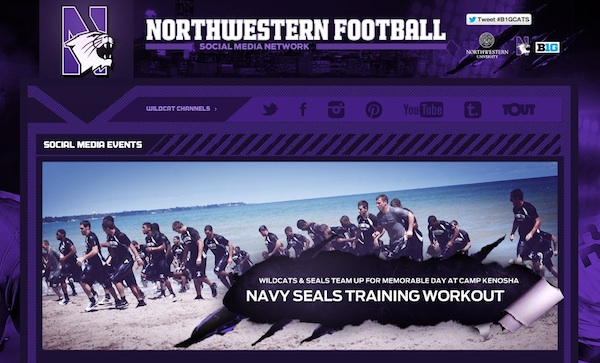
Just two weeks ago, the football program launched the Northwestern Football Social Media Network, which brings together a multitude of platforms in one page: YouTube clips, Facebook updates, Twitter feeds, images from Instagram and Pinterest and more. More than an aggregator that mashes content together, however, the site from interactive studio Uncommon Thinking cleanly connects fans to their favorite channels for ongoing browsing and content sharing.

By the way, there’s one channel on the site that you probably won’t immediately recognize but should keep your eye on. It’s called Tout, a networking outlet that allows you to create 15-second status updates on your smartphone you can share in real-time and automatically on your social media networks.

The real brand message? Value.

In an economic time where fan dollars become even more precious, the brand positioning of Northwestern shouldn’t necessarily be “Chicago’s Big Ten Team” but to hammer home a reality they have consistently lived up to – win or lose, their down-to-the-wire games are hardly ever boring. It is an electrifying college football experience, whether you went to school to Evanston or happen to be rooting for the visiting team from, say, Ann Arbor or East Lansing. And because of that experience week in and week out, the “Cardiac Cats” provide a product that is absolutely an excellent value.

In fact, it might be the best sports value in town for the money.

That’s right. You heard me. Consider what it costs a family of four to attend a sporting event that includes parking, concessions and tickets.

Now calculate that over six home games. How easily can your family swing that?

While that’s unthinkable for many of us to afford, it becomes more palatable when tickets can be had in the $20-30 range, parking nearby is free and you don’t have to pay a fortune for beer, which keeps the overall cost low and the overall atmosphere more, well, family-friendly.

The “Transformation”

With a team that believes it can play in a BCS bowl – and it’s not as far-fetched as it sounds – investments in new marketing campaigns, practice facilities and long-term coaching contracts aren’t just refreshing but reflecting a new era of greater expectations that truly began when Gary Barnett took the team to the Rose Bowl in 1995.

Going to bowl games are the new norm. Winning them with consistency must come next. And once that new ground is reached? Better bowls. Bigger recruiting results. Hopefully greater enhancements to Ryan Field, complete with luxury boxes.

Let’s just say things could get really interesting in Evanston.

5 Trade Show Inspirations Manufactured by IMTS

I’m writing this from the International Manufacturing Technology Show (IMTS), the largest manufacturing show in America, at McCormick Place. Over 90,000 people have registered for this gigantic event so far.

Walking across a floor of 1800 exhibits, you quickly get the sense that, at a time when marketers tend to question if trade shows are worth attending, it’s clear there are no such hang-ups as it applies to this show. There’s a whole lot of heavy investment from manufacturers going on here in their presence. With this in mind, I can’t help but wonder about Return on Investment and what kind of steps brands can take to help themselves stand out once they say, “If there’s one trade show we want to be at this year, that’s the one.”

Here are some takeaways and tech ideas from IMTS I’ve witnessed that you can consider incorporating for your own trade show efforts this Fall, especially if you’re preparing for a massive, high visibility trade show like this one.

Stand Up For iPads

You’re trapped with one attendee who is talking your head off and it’s clear they’re not going to be a serious buyer. Meanwhile, isn’t that so-and-so who you’ve been meaning to talk to walking up to your booth? How do you ditch the gabfest in front of you elegantly? You may be able to divide and conquer resources if you have a securely mounted iPad display stand. Visitors can walk up to the stand and scroll through valuable information about your company’s products and services. 

Walking by hundreds upon hundreds of booths at IMTS, I saw two of these stands used. I expect I’ll only see more of them at future shows. It’s very slick and helps act as another “salesperson” for your brand.

Webcasting

There’s a great opportunity in live webcasts at the show: First, it extends your appeal beyond the immediate trade show floor to the social web. Second, it involves people in your booth on a deeper level as interviewees and not just casual browsers. So it’s no longer just a booth but an experience. Many booth experiences start and end with the physical walls of the brand. It doesn’t have to be that way any longer.

IMTS had several live webcasts throughout the day via its IMTS TV, which could be seen at nearby hotels, the event’s shuttle bus and online. Taking a page from this experience, who could you interview at your booth, even for just a couple minutes? Could you target them in advance of the show and invite them to be a part of your webcast, which may extend into a longer conversation afterward? Where can you share this information beyond your website?


3D Video Projection

A screen mounted on a stand? That’s OK, but rather expected. When done well, a video projection on an ample-sized banner, complete with audio, can lure people in and tell more of the brand’s story with a high-end quality. I’ve seen but one company only lightly touch upon this application, without audio.

Or there’s really taking the experience up a notch – using 3D images (also called “3D projection mapping”) to transform a part of the booth into a captivating spectacle of video. Just Google “3D projection mapping” and you’ll see what I mean.

So if we can create 3D video projections on landmarks, why can’t we do these at trade shows? The answer is we can. Compelling video that brings the product to life gets noticed, especially in a crowded hall.


Private Rooms/Sections

You heard me. Get a room – as in think about how your booth can be sectioned off to accommodate “VIPs” you reach out to advance or converse with at the show.

Several exhibitors at IMTS have created what could be described as less of a booth and more of a lounge or café. That can be visually appealing and inviting, but for my taste, private rooms/sections within an area facilitate better one-on-ones and lend themselves to sensitive conversations that can’t be conducted out in the open.

By the way, don’t forget that shows can be multi-purpose to also be used for recruitment opportunities too. The issue in manufacturing isn’t so much a lack of jobs as it’s about finding qualified people to fill specialized positions. Some here have seized on that opportunity by realizing that their audience isn’t only made of potential buyers of product but also potential referrers of talent.

Granted, I know creating a “private” area of your booth isn’t necessarily cheap, but really, when you’re spending a lot on this as it is, do you want to treat a serious buyer/candidate like anybody else wandering by?


Social Media

I get a lot of questions about industries that aren’t “ready” for social media just yet. Some skeptics say manufacturing is one of them. Which is interesting, considering I’m looking at a Twitter stream with the hashtag #IMTS and seeing major manufacturers tweeting about their booth’s events and engineers chatting it up with each other about what they’ve seen and heard at the show.

So if someone says, “Our industry isn’t into social media and won’t care about using it at the show,” challenge that assumption. Could people check into your booth on Foursquare and be rewarded for it? Could you tweet your booth location and share what events are next? Could you upload pictures and video for those who missed a crucial speaker? Yes. And they’re doing it here.

Remember, much of this activity with social media isn’t confined to the booth or even the show. It extends beyond that.

It’s easy to fall in love with how big your logo looks on a trade show wall over a few days. But there’s a much bigger picture than that. If you can capture some long-term leads today, you can continue the conversation on the web long-term, which can grow into something much more tomorrow.

So think about how you can integrate your online presence more so your trade show booth works even harder.

Like a machine.

Do You Have Enough Beer-Worthy Clients?

The other day I had a client meeting not in a conference room or a Starbucks but the local establishment down the street serving cold frosty ones. It’s not mandatory by any means that my clients go out for a beer with me…but there’s an interesting pattern I’ve seen emerge over the years with the ones that do.

The ones who do seem to open up a little more about what’s on their mind, where they want to take their brand and the greater vision for what they want to achieve will invariably find themselves talking about it to me outside of their walls. And when they do that, they tend to say, “C’mon. Let’s go have a few beers. I want to pick your brain about…” 

It’s not about the alcohol, really.
This is a magical moment. What I’m talking about is an extra level beyond the “satisfied client.” I’m talking about the client that sees you as not just a supplier of services but an advisor. A confidant. A consigliere. It’s not just about a conversation about ads or social media or marketing.

It’s a business conversation. A product development conversation. A cultural conversation.

This is rarified ground. Not every client is comfortable taking it here. They have their barriers they want to leave up. For now, anyway.

The ones that don’t have such barriers, however, will often not see themselves in that higher ground of respect they deserve because they’ll think it’s all about the billing that determines their place on the totem pole. Ah, but how wrong these humble souls are.

In truth, they’re giving you access to a deeper level of communication that you won’t get just anywhere. Seize it. These are the ways great relationship stories are told. These people can be your best advocates to others. These are the people who let you in so you can become more than a “writer” or “designer” or whatever you put in your job description.

This is one of the great things I like about calling myself a consultant because I feel the business of helping clients communicate internally and externally could be more consultative than a typical “vendor-client” relationship.

We could all use at least one “beer-worthy” client. Or at least the kind of client you could easily visualize having a few beers with. It doesn’t make it less serious business or that we’re about to get tipsy. Just the opposite. It means a bond is about to be strengthened.

Some will blow this opportunity with schmoozing and sales-ish butt kissing. Please. Don’t be that cheeseball stereotype. Laugh and let your guard down a little. As long as you keep it real about the purpose of why you’re there and stay on point. And above all, use the two devices that so many people neglect – those things on the sides of your head called ears. It is at this moment when they’re opening up even more than usual that intense listening would not be a bad thing.

Just a couple of beers? I call it something more – an opportunity for relationship building on tap. And it’s amazing how it works out that way time and time again with some of the best clients I’ve had and cherish.

Cheers.