Let’s Truck In Some Sanity, Shall We, Restauranteurs?

The strangest thing about the food truck debate in Chicago is why it’s taken so long to resolve, considering every other town is doing it.

The second strangest thing is why brick-and-mortar restaurants are this upset about the prospect of a food truck parking nearby. Why? If they looked a little deeper into who their audience was and developing their own brands, they probably wouldn’t have the burning desire to turn over a truck. Here’s why.

If I run a moderately priced restaurant that’s built a loyal following, I have a certain clientele who is willing to pay far more than the average meal wrapped in aluminum. This is not true competition for me. I know my guests are going to keep coming because my food is quality and consistent.

If I truly run a restaurant that competes with a food truck, I have to realize that it could’ve just as easily been another type of brick-and-mortar restaurant that opened next to me or across the street offering cuisine within the same category and pricing. It’s the nature of the ultra-competitive business I’ve chosen in hospitality. And it wasn’t going to get any easier, food trucks or not. Does this call for changing up the menu, enhancing the environment, creating a better loyalty program (I don’t necessarily mean a Groupon), hosting events for greater publicity, etc.? What can you do within your establishment that a food truck couldn’t hope to offer? Some of these restaurants are competing on a plane that they don’t have to be and frankly, missing their brand’s vision and target completely.

Let’s also play Devil’s Advocate here – it’s entirely within the realm of possibility that a food truck that brings traffic near your restaurant could spill into your restaurant, driving customers in through the door that otherwise might not have been aware of your presence.

Rather than seeing a food truck as the enemy, better to focus on making the entire dining experience of your restaurant as sensationally memorable as possible. Creative food offerings. Ordering on iPads at the table. Online ordering that remembers the person’s favorite meal from last time. Special appetizers that arrive at the table unexpectedly for long-time customers.

Your biggest competitor may be the one within your own mind that exudes more of the same and traditional. Take your eye off the truck and focus on your own brand. The positive implications of doing so are far more delicious.

State Farm Shows Off Its Entrepreneurial Side

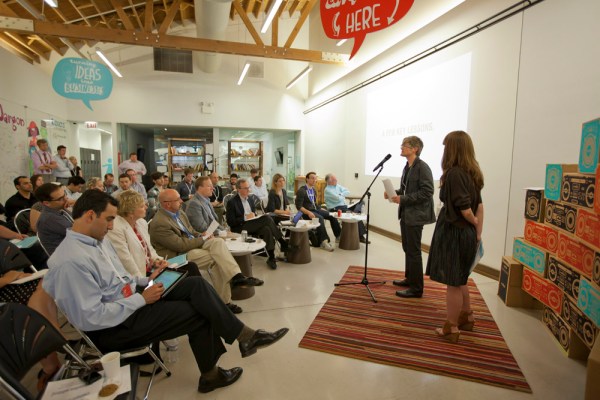
2 members of IDEO Chicago offer words of wisdom on pushing the boundaries of design and development in between lightning rounds of pitching during Next Door’s “Amplify’d” event.


I’m actually leaving my job tomorrow,” one brave entrepreneur announces to the audience.

He doesn’t appear to have any employees, dedicated office space and it’s unclear how much working capital he has.

But make no mistake. He’s making The Leap. Because what he does have is a promising piece of software with slick interface that delivers the most viable job candidates to recruiters.

Of course, he wasn’t alone. Last Thursday, 20 other startups made the cut to join him for “Amplify’d,” a one-day lightning round of pitches at State Farm Next Door. During the event at the part community workspace, part café, each participant had 5 minutes to pitch their ideas to a panel of judges from incubators, retail consultancies and business accelerators.

Think Chicago’s version of “Shark Tank,” but a little kinder and gentler (these are still the people behind the concept of being a Good Neighbor, after all).

As the participants gave their pitches, I could see the judges would have their work cut out for them in selecting one brilliant idea above all or even a few.

How useful would it be to have an app that helped me find everything in the neighborhood for my dog?

What kind of progress could a pair of multisensory gloves with sensors and lights make during interactive therapy for children with Autism?

How many times would I love to have a “Hold-On” button on my phone to tell the caller I would be answering momentarily?

In between the lightening rounds, speakers from IDEO Chicago, BodyShopBids.com and RentStuff.com offered some words of wisdom and war stories about obtaining funding. Like every entrepreneur (myself included), they had made plenty of mistakes between where they began and where they are today – and learned what to do differently. But despite all those miscalculations, false assumptions and disappointments, I’m fairly certain they wouldn’t have traded the experience for anything. Even when the alternative was the “sure, safe thing.”


And the winner is…

In the end, the winner of “Amplify’d” was a mobile app called FasPark that delivers real-time local information about street parking and provides a driving path for getting there. Which couldn’t be more fitting, considering we were in one of the hardest areas to find parking in the city.

Second place went to eduLaunchPad.com, a “next generation” college search site where families of college students can find the best potential opportunities for financial aid and potentially minimize the student’s loan debt upon graduation significantly.

The third place award was given to a former college professor turned entrepreneur who developed an educational app called Nidaba. Designed to send daily activities to the parents of K-12 students, the app incorporates social gaming, points and badges so that completing learning challenges is a fun experience for parents and their children alike.

In a way, State Farm was on the big stage too.

In my view, “Amplify’d” represented one of the bigger moments for State Farm Next Door in its first year of operation. At its most ideal, it’s a community hub for collaborating and holding business meetings. But events like this are the much-needed extra step to build credibility even further – an excellent opportunity for the company to show its support to the very same entrepreneurs who might be using its space regularly to brainstorm how to get their ideas off the ground. For the good of building Next Door’s brand presence and judging by the participation, I hope they’ll continue with events like it.

Finally, forgive me for briefly getting on the soapbox: “Amplify’d” got me thinking that if more corporations hosted events like this to give aspiring entrepreneurs a greater spotlight for potential funding, we’d further develop and strengthen another needed financial avenue to the small businesses that are often referred to as the lifeblood of the economy. Not to mention it’s good PR for the brand hosting it, other sponsors/judges and of course, the entrepreneurs themselves.

At the very least, it’s the kind of event that’s a lot more exciting than watching entrepreneurs fill out paperwork for a bank loan.

Where’s Your Buyer on This Graph?

It’s not easy to put social media users into nice and neat demographic profiles, but we’re getting smarter about it by the day.

Personally, I like to err more on the side of how people behave online and level of interaction with social media when classifying them anyway over too much of the traditional “age/race/income” classifications. I’m not sure that all 65-year-olds shy away from social media, for example. They may have a Facebook page and/or LinkedIn profile while displaying a comfort level with e-mail and using search engines.

Nonetheless, I thought this infographic from Aimia, a loyalty management company from Canada, was an interesting breakdown that offers some compelling ways to categorize people when planning social media strategy. I wouldn’t take it word for word as every brand’s audience is different, but it still may begin to paint a better picture when planning your brand’s buyer persona. Enjoy.

Are Ad People Serious With Appearing This Serious?

An ad agency in San Francisco recently redesigned their site and I enjoyed it, except for the fact that all 33 members of their team for the most part were not smiling, laughing or even mustering a smirk. At all. Many weren’t even looking into the camera.

Are you serious with being this serious?

This is an industry that, at its best, can be a blast. We get to come up with creative ideas and unique strategies for a decent living. We joke, we laugh, we usually find ways to have a beer or two at the end of the day. We don’t have to often wear suits and ties. Many of us can even show up in a t-shirt and flip-flops, for crying out loud.

If you think this is just about how someone takes a photo, remember that impressions mean something. Especially the first ones.

Agency sites are opportunities to show personalities. Showing those personalities with a little more levity doesn’t mean we’re any less serious about furthering a client’s business. It actually is to the advantage of the client’s business because a fun and collaborative environment often increases the likelihood that better ideas will bubble to the surface.

And you know what? A lot of clients, whether they admit or not, are looking for that quality in a partner.  You have to spend every week, if not every day, dealing with someone helping your brand along. You’d like to be able to, well, like that person.

It’s great that people can spit out data and talk about their experiences with the other agencies/brands they’ve worked with and speak to the current clients they’ve helped. And while that’s truly terrific because it can often get them on the short list of businesses to consider in a pitch situation, sealing the deal may depend on showing they are human beings who have the ability to relate well to other human beings.

Like their clients. Like those clients’ target audiences.

Without this ability to form a rapport, the person most impressed with someone so serious will be the one looking back at them in the mirror.

Don’t be that guy or that lady. Loosen up a little. Have a little more fun. Show some personality with that bio photo. But don’t stop there. Inject several personal aspects into your bio that could create talking points and common ground. Put it right into your LinkedIn profile and don’t apologize for it. Show those pictures that capture your culture on your Pinterest page. Share some video of your next mockumentary on your agency’s YouTube channel.

Your ability to win some business may be counting on it.

5 Steps To Creating A Better Internship Program

As college students prepare to kick off their summer with the hope of landing an internship, there’s still time for your company to design an intern experience that’s worthwhile for both them and you. When it goes well, there’s nothing like mentoring a person who has the passion for learning more. When it doesn’t go as well? There’s a reason for it. It usually comes down to the company’s lack of planning, not so much the intern candidate.

Here are four signs that you’re about to offer up a lousy internship experience:

• You see interns as “grunts.”

• You feel they should just be happy to have an internship at all.

• You don’t know what they’re going to do but you’ll figure it out.

• You feel they should be broken rather than taught.

Wow, where does a young mind sign up for that experience of giant ego and rampant disorganization? The fact is, one bad internship could sway a person unnecessarily from a career path they’re actually made for.

Fortunately, here are five key points associated with offering internship experiences that will start your program on a path that’s a lot more rewarding for all parties.


Step One: See them as real team members, not “extras.”

This is a big step because it forces you to aim higher for a candidate who is expected to demand more of themselves and contribute to your company regularly. I didn’t suggest to give an intern the exact same responsibilities as anyone else. I’m saying to give them the opportunity to collaborate with staff while creating and presenting their work — real work — to others. What can you unload that challenges them but something you can still evaluate?

When you do this, some beautiful things tend to happen: First, you demand more of the student and if they rise to the occasion (as they often can and have), they give you a tremendous effort back. Second, they never forget the trust you had in them, not to do the work singlehandedly but at least to be involved and contribute as part of a larger team.


Step Two: Write their role description.

I know it seems crazy, but some internships have no structure. The intern shows up and hangs out to see if anybody needs any help. Don’t believe me? Yours truly had that from an internship. Part of this lack of definition might have something to do with the fact that the people hiring them just wanted an intern who could “help out when the situation calls for it.” Whether you’re talking about a job or an internship, writing out the role on paper gets everyone quite literally on the same page about what is and isn’t entailed.


Step Three: Find out what their goals are.

This is what sets apart ordinary programs from better ones in my opinion. Beyond the fact that they want to “learn a lot,” dig deeper and press your candidate to give you one to three very concrete goals they want to achieve during their experience with you. And hold them to it, although it’s something you both work toward and monitor the progress of, too. When it’s more customized to the intern’s goals, it’s hard to find two experiences that are exactly the same.


Step Four: Determine what your goals are.

What’s your purpose or gain for adding them into the fold for a few months? What do you get out of it? It might be a fresh perspective on regular challenges, a good way to evaluate a potential employee (if not now, then a couple of years down the road) or even as a tactic that fits in with what your brand stands for.

Think about how your role is going to change a bit, too. These are young minds that crave feedback. Are you or others on your team going to be in a position to regularly give it in a meeting, at lunch, in the course of your day? Or will you be hardly ever around?


Step Five: Decide whether it will be paid or unpaid.

Let’s agree that if you’re in a position to pay an intern, you should. But what if your company genuinely can’t swing that, financially speaking, and students are still interested in an opportunity?

Press on with an unpaid internship program. And don’t let the critics of this practice dissuade you.

There are some people who believe the only internships that should exist are paid ones because otherwise it creates a system of “haves” and “have nots.” I have news for those people – if some small businesses are forced to do paid internships, they may be forced to do away with the program altogether, which punishes all student candidates. That’s not a solution.

If you do an unpaid program, you should still think of the small but meaningful things you can do to make the student’s life easier financially, whether paying for their gas money, lunches now and then, reading materials and more.

Personally, I think the value of a solid internship program is underrated. These opportunities become a fantastic marketing tool for the brand – after all, when the student returns to school, who is your former intern going to tell about his or her hopefully positive experience?

That’s right. A pipeline that may include your next potential intern.

Read more: http://www.chicagobusiness.com/article/20120530/BLOGS06/120539991/5-steps-to-creating-a-better-internship-program#ixzz1xEvH6DI6
Stay on top of Chicago business with our free daily e-newsletters