With so many social media tools, why do things still feel broken?

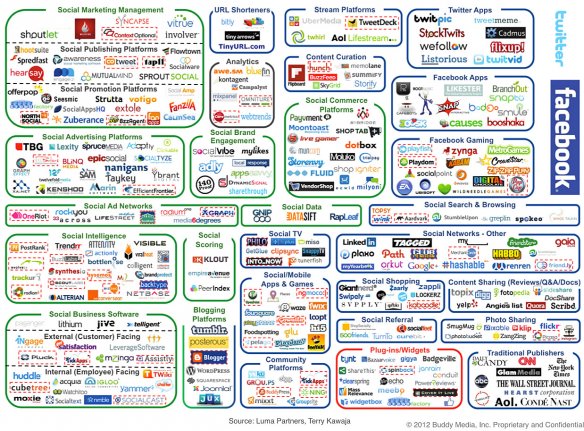
The following graphic from Buddy Media is quite interesting, does an excellent job of organizing sets of features and at the same time, may very well make your head hurt. It’s not that we don’t need more social media tools or that they shouldn’t continually evolve. It’s that we often start with them before thinking about strategy or put up posts like, “10 ways your brand can be built on Pinterest.”

Um, may I ask a stupid question? Who said Pinterest may be right for the brand at all in the first place?

Focusing on the tools first is short-sighted but some marketers don’t know any better than what they’ve been told. Let’s take it a step back and get back to things like company vision, mission, culture…essentially your company’s reason for being.

If you’re confused on that or your company isn’t on the same page on that, you’re only adding to the problem by trying to communicate a message of who you are that people within aren’t completely on board with. Fix that part of the house first. It may take a few months, but the social media tools will still be there by the time you’re done. I’d wager there will probably be 1000 more to choose from anyway.

Let me know if you need a hand sorting any of it out – Dan@ChicagoBrander.com

Will Wall Street “Like” Facebook In The Long Haul?

As a social media brand strategist, it’s often hard for me to leave Facebook out of the equation entirely in recommendations. Oh, it happens. But not as much as other social media channels that could be completely left out of the media mix.

That part of “buying in” to Facebook is relatively easy, whether that means creating a Facebook Page, choosing Facebook Ads, etc. Practically everyone I know is on it and some of those people don’t hop from social network to social network with ease. So I don’t see Facebook disappearing anytime soon. I think it’s going to be around for a while, which is more than I can say for other social media channels that come and go.

Yet, the new part of “buying in,” literally buying Facebook stock, may give some people a degree of pause. Here’s why. The question becomes whether or not we believe it can continue to evolve and give us new, exciting experiences vs. having reached its peak.

This is going to be a huge challenge for Mark Zuckerberg because on one hand, he has to not only bring those new developments to the table to appease a new audience of investors but he also has to appease an audience of users who can be extremely sensitive to change (Timeline or Beacon, anyone?). Granted, people have to deal with that change and unless it’s a colossal miscalculation on Facebook’s part, I don’t see those users switching away with each evolution.

But when you think of Apple, for example, is it easy for you to imagine their next evolution without enraging a core group of fans? Sure, I can see that. Not everybody may buy, say, an iPad mini version, but it’s probably not going to be met with a backlash by those who don’t buy it.

When you think of Google, there are different products that are put forth from the company – some make it, some don’t – but we still by and large turn to Google for what we need, whether that means search, Google+, AdWords, etc.

It’s potentially harder for people with Facebook because so many changes they have affect the whole of the product. We can’t easily select what we want and don’t want from Facebook. They just do it and it’s our option to put up with it or leave entirely. They tell us these changes are good and we, sometimes reluctantly, have to go along with it because it’s not worth leaving behind the connections we have.

The other hard question to ask is this – do we want a social media department store? Because if Facebook evolves, it may have to keep adding on and buying companies like Instagram. But what if we don’t want all of our social media in only one place? Maybe we like having Facebook, Twitter, Pinterest, LinkedIn, YouTube, etc. in many different channels rather than One Channel To Rule Them All. If we look at physical department stores like Borders and Circuit City, we can see that the strategy of having many media under one roof doesn’t play with the public as well all the time as you’d expect.

Can a social media network actually reach a point where it becomes too big, too clunky, too fast? This concept has happened with other industries. Whether you buy Facebook may depend on whether or not you buy into the belief that each evolution they make will be fluid, intuitive and elegant or like turning around an aircraft carrier.

Why I do buy about Facebook is this much – there will be change, a portion of the audience won’t like that change (inevitable with an audience this massive), the size of that portion will depend on how great the change is and there will continue to be new players in the social media universe – not to take down Facebook entirely, but to outdo certain features.

I wouldn’t want to be on the other side of Zuckerberg. But he’s got quite the challenge at the opening bell.

How Much Do Clients Care About Advertising Awards Shows?

If you’re in a position to influence agency decisions, I have a simple enough question for today.

I just want to know, once and for all, if you ever chose an advertising agency primarily because of the fact that they won creative awards.

There’s no right or wrong answer to this. Was it a:

A) Determining factor in your decision
B) Nice support point to help justify your decision
C) A total afterthought that had no bearing on your decision

I know that generally speaking, agency people value them for a variety of reasons. There’s absolutely no doubt how good it feels to win and to accept an award with your team. I know and I get it. But I’m wondering whether or not there’s a disconnect if the outside world views these shows with as much weight. Frankly, with the changing economic and media landscape (we’re awarding for TV spots above all in a world that’s shifting more to digital by the day?), I’m just not as sure as I once was. I think they like getting a plaque of the award on their wall. But how much does that really mean? I think they like telling the people above of the agency’s success, but how much do those people above really care?

Does it help indirectly with reputation building? Sure. I can see that. But I’m talking about direct impact if that’s possible.

Agency folks are welcome to answer this question similarly –

What’s the ROI of entering?
Can you measure it and draw a direct line from statues to new business or more pitch invites?

Or was that even your goal? Was internal morale building as a result of victories the primary goal instead and new business was a nice “extra”? And if you didn’t enter, why?

Ponder that and let me know your thoughts if you would. Again, there’s no wrong answer and I realize the answer can depend on different types of client personalities and values. But I’d like to hear the shared stories and views regardless. Many thanks in advance.


Be remarkable? That’s not all there is, Seth.

Every day I learn something new and am inspired by brilliant minds in a variety of places – articles, conferences, books, seminars/webinars, you name it.

But there’s a group of people I’ve been scratching my head about to understand the appeal. One of them has come to symbolize this group. We’ll just call him…Seth. Seth’s written many books and given thousands of presentations. There are disciples of Seth and he seems like a likeable fellow.

Yet something has always bothered me about Seth and I have to say it: I don’t get how what Seth’s saying is all that remarkable or mind-blowing. At all.

I really don’t mean to pick on him alone. There’s something that’s been bothering me about people who write and say things like, “The key to success is to make your content remarkable.” Or in Seth’s case, “Remark-Able.”

I get this. But if they don’t help people by showing them the path to being remarkable, I have to call BS on them. Every single one of them.

Here’s why. They make a lot of money for telling people really basic things. Telling someone to produce remarkable content is like saying if you want milk, you need a cow.

DUH. No kidding. You mean if I have to stand out from others, I have to create something different? WOW. Who should I make the $1000 check out to for this wonderful insight?

Come on. Don’t give people little steak medallions and charge them for a 23 oz. steak.

I’m just tired of the cute mottos, the pithy lines, the haikus posing as books and the anecdotes about, “What if there was a magenta giraffe at the zoo? You’d surely remember that among the other ordinary giraffes, wouldn’t you? Be the magenta giraffe.”

Good grief.

Yes, we have to think different to succeed. But a lot of people don’t know how. And it ticks me off when people get up in front of a stage, yell at the audience about the need to think different and then leave. Audiences with budgets and hard choices about where to spend their quality time deserve better than that.

I have gone to seminars full of wonderful speakers who have gotten me pumped about everything from metrics to culture to the future of social media (while they’re at it, if they can use a few compelling charts and graphs, I’m a sucker for those as they usually crystallize the point further).

So after reading a couple of his books, I finally had the opportunity to see Seth. I thought, “Maybe what I’m not seeing on paper will translate better in person.” I was rooting for him to be different. Come on, buddy. Don’t just give the same talk I’ve seen you give on TED. Give the people something original. Something that speaks to this year, not 2009.

Sigh. Nope. It was the same presentation was probably given a million times about thinking different.

But I STILL wanted to give him the benefit of the doubt. So I read another one of his books – his latest. After all, maybe it was me. And the whole thing was basically about…thinking different and why it’s important to get off your butt to think different.

Feeling alone in the universe, I took to Amazon to read some book reviews and see if I could understand what I was missing about Seth.

And then I saw it – as it turns out, I wasn’t alone. There were a lot of people feeling like they didn’t get Seth. There was a great divide of people giving a 4-star and 5-star review to his books but then a lot of people giving 1-star and 2-star reviews. And those people on the low end were saying what I was saying – “An experiment at the reader’s expense.” “I feel like a lemming following the crowd over the cliff.” “The same message rehashed.” “A colossal waste of time for a person who has any entrepreneurial experience.” “Not worth a walk to the library to pick it up.”

Again, my point isn’t to take aim at one person in a mean-spirited way. My point is I’m troubled at the idea of a management guru who oversimplifies life and thinks his or her theory, now available on Amazon for $19.95, is the real key to success rather than a customized strategy. Sorry. It’s not that easy. Oh, it’s easy for you if you’re that guru. You talk for 45 minutes, use some cute slides, take no questions, get your check for thousands and then get whisked away to the next presentation.

But it’s not easy for the people out in the audience to naturally do what you’re saying. I completely agree that being “safe” rather than being different is far more dangerous. Yet we have to understand that change is not always impulsive in a “go, go, go!” way. It’s planned. Rather than slammed through, it has to be carefully massaged through twists and turns in a sophisticated way.

It serves as a reminder for those of us who are in Advertising, Marketing, PR, Social Media and more that, just because it’s so obvious to us that the idea we’re trying to sell is the right one, we have to do more than say, “You need to be different. You need to be remarkable. You need to stand out. Can’t you see that, dummy? Now go do that.”

That can call for things like a really good creative rationale. Speaking to how this concept resonates with the specific audience and is designed to improve upon a previously discussed set of metrics. And constantly communicating how the brand can move a little farther down the path internally too (customer service, identifying social media ambassadors, etc.).

It’s time to demand better. We need to be better guides in the new frontiers of social media. We have to go further than telling people to be different and calling it a day. We have to show them on a regular basis. Jay Baer does this. Jason Falls does this. John Jantsch does this. Michael Stelzner does this.  Mari Smith does this. HubSpot does this. And more. These kinds of people and companies are giving concrete examples of tools we can use to convey our brands in different, compelling ways. They’re not just saying, “Be remarkable.”

The “get off your butt, change and be remarkable” stuff is crucial – absolutely, positively no doubt about it. But if that’s all you suggest and you’ve got loyal followers anyway, I suppose I have to tip my hat to you as you must be some kind of marketing genius of your own brand. Like Seth.

Reality: Chicago was “on the map” long before NATO.

There’s an interesting argument that’s been put forth that Chicago really, really needed to host the NATO Summit to be taken seriously in the eyes of the world. The phrase I hear most often is that, as far as branding our city goes, the presence of NATO puts Chicago “on the map.”

I guess they’re right. Before NATO, we didn’t have much going for us.

We didn’t have arguably the finest restaurant in the country, Alinea, along with ridiculously good steakhouses, Mexican food and every other ethnic cuisine.

We didn’t have professional sports teams and rabid fans certainly on par with those in New York and Boston.

We didn’t have a Marathon that got 45,000 registrants in 6 days before it was closed.

Nightlife? With NATO’s influence, maybe we can have some now on Rush Street and Bucktown and Wicker Park and Wrigleyville.

Musically-wise, we sure were suffering. If only we could get concerts by every major act in the world you can imagine or gigantic music festivals like Lollapalooza.

Before NATO, we didn’t have the corporate headquarters of Motorola. Baxter. McDonald’s. Hyatt. Boeing.

Thanks to NATO, it’s only a matter of time before we have greater cultural diversity. Perhaps someday we’ll have a Greektown, Chinatown, Puerto Rican Day parades and St. Patrick’s Day parades. And the largest Polish speaking population outside of Warsaw.

Shopping? Yeah, not much there on Michigan Avenue.

Thank goodness NATO is here so we can soon have a Chicago Stock Exchange and CME Group to turn the wheels of financial trade.

Maybe now O’Hare Airport will get some much-needed traffic.

In time, perhaps we’ll have a profound impact upon the theatre community with the momentum of NATO. Second City and I.O. will have alumni as famous as Tina Fey or Bill Murray. Maybe we’ll even be able to bring Broadway-style productions here.

I hope our art scene gets greater recognition at some point as well – it would be really great if we had a phenomenal art museum to house the works of Renoir, van Gogh, Monet, Cezanne, Picasso.

Ah, dare to dream.

Hopefully someday we’ll have the finest orchestra in the world and a renowned opera company.

I suppose now we can finally have some architectural development around here.

Oh. Wait.

I don’t mean to sound ungrateful for the opportunity to host the diplomatic community. Especially since we host so many international embassies and consulates here every day.

And I really don’t mind that NATO is coming or its inconveniences. What I do mind and am offended by is the notion that now because NATO is coming, Chicago has finally “arrived” as a city.

Please. We arrived well before any world leader gets here and says so.