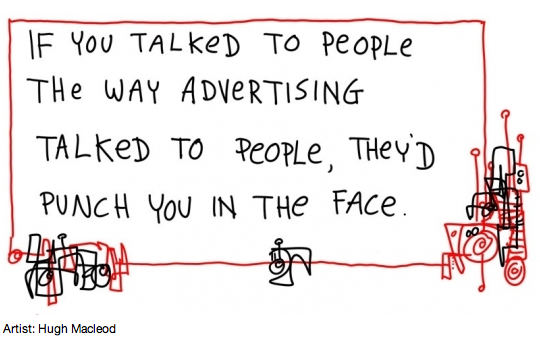
Making Your Brand More “Conversational.”

So true.

Why can’t we talk to potential customers as if we were sitting across the table from them?

I believe we can. I believe we have to.

Instead, brands look at their audiences as a set of statistics rather than a one-to-one conversation. And it’s little wonder why they often wind up sounding like they’re talking to a set of statistics. Why? Because there’s a fear that your brand might not sound professional?

First of all, if you don’t make it conversational enough, there’s just as much risk that your brand might sound professional and completely non-captivating. Secondly, you can be professional and relate to the audience at the same time. It’s not impossible. Third, conversational doesn’t necessarily mean so loose that it’s off brand in some instances.

It’s time to err on the side of talking like a human and sounding less like an ad. There’s nothing wrong with ads. Just ones that are dead-ends for making meaningful connections with their ice-cold tone.

The Chicagoland Conversation with Hireology

Recently, I had the opportunity to sit down on behalf of the Chicagoland Chamber with Adam Robinson, who is the Chief Hireologist of Hireology. Previously, Adam was the co-founder and CEO of illuma, a leader in high-volume recruitment outsourcing solutions as well as the creator of the Ionix Hiring System, a full suite of interview and assessment tools.

Hireology is a company that specializes in interview guides, applicant tracking, candidate assessment and selection. Just this year, the company was featured in Entrepreneur Magazine, Crain’s Chicago Business and Fox Chicago, where it was profiled as a “tech company to watch.”

Adam, on your website, you describe Hireology as a company that was 13 years in the making. What do you mean by that and what inspired you to start Hireology?

AR: My last company was an outsourced recruitment provider and through the course of my time there, what I learned was that most companies are terrible at hiring. Fewer than 10% of companies know how to conduct an interview. It’s a coin flip whether it works out or not.

Why? The company doesn’t think far beyond next week or next month with that person and instead just focus on the fact that they have a hiring need.

So at Hireology, we’ve used technology that helps correlate behavioral tendencies to a person succeeding in a given job. We work through that data to see if it’s a good fit with an easy to use online tool that incorporates an applicant tracking system, interview guides, online skills tests, background checks and more. All within one interface.

Can you speak more to how that science occurs? Is there a real criteria behind it all?

AR: We’ve analyzed 1000’s of interviews across hundreds of companies to come up with the 67 Elements of Success™, traits that, when present in a candidate, enable us to predict his or her likelihood of success in a specific role.

What type of training and tools do you provide to managers on how to evaluate a candidate?

AR: The manager logs in and runs their entire hiring process from our website. Thousands of potential questions get customized based on requirements into an interview guide. The manager receives questions that are perfect for their hiring scenario, which makes their life tremendously easier.

We’re increasingly giving people the tools to help find the right candidates. When you put a job in our system, you get a unified URL for that given job. When you’re no longer hiring for that job, you turn off the product. Hiring spree? Turn it back on. There’s no contracts or math. It’s $24 a month.

What’s a good example of a company that needed your services at Hireology and prospered from hiring you?

AR: A woman in the medical space recently turned to us because she was having difficulty attracting the right kind of candidates. She posted on Craigslist, did flyers and it wasn’t that organized of a search. Then she talked to us about activating a full account with our processing tools. She couldn’t be happier and she’s able to scale her growth with this tool.

Is there an ideal company that hires you at Hireology?

AR: We really work with all kinds of companies from industry associations and healthcare systems to franchises and small business owners. No matter what, we want to work with people who will embed our platform into their hiring process rather than handing a confusing binder off to a hiring manager. There’s no reason to do that when we can set up the system in literally 60 seconds. You pick the plan you want and it’s a 14-day trial. It just works. And it works for a lot of people.


Don’t Let Content Syndication Make You Lazy.

The other side of content syndication: Does it cause us to cut down on quality interactive time spent on each social media channel?

A couple weeks ago, I had a bonafide Freak Out Moment. One of the apps used to syndicate my blog was having an error and decided to post the latest post – even before it was done – onto the web over and over again. If you were on the receiving end of that noise, I do sincerely apologize for the insanity. Fortunately, if there’s any good that came after I had my meltdown and got the situation under control (hopefully, please Lord) by undoing the app altogether, it was that I had a bit of an epiphany about content syndication.

My epiphany

While I had originated a lot of content from my blog, in my passion for syndication, I was unintentionally neglecting some of those other channels, such as LinkedIn and Twitter, for the venues of discussion they have been for me. Technically I was there, but I wasn’t really there as much as I was distributing stuff there, thanks to syndication of my posts. I was posting, but I’d fallen into a trap of doing the very thing I despise doing: broadcasting in a 1-way format more than 2-way interaction.

As a result, I have not done as much interacting on LinkedIn in Discussion Groups or asked/answered questions in the Q&A forums. I’d maybe done some Retweeting of others on Twitter, but I needed to do more true responding and commenting to those tweets.

The trouble with syndication

Here lies the hidden trouble of syndication if you’re not careful. There’s absolutely nothing inherently wrong with having your blog sync with other channels, so I’m not blaming those tools – the problem is when users get in the habit of clicking off check boxes to sync that content with and forgetting to do anything else on the channels by and large. 

What’s that? LinkedIn? Twitter? Facebook? Sure, you’re there. But if you’re relying on syndication for your interaction alone, are you really there?

You can become so focused on the content under your own roof and how you’re going to push that out to the masses that you forget that each channel deserves as much of its own strategy as possible. What is it that makes this certain audience different? What is it that you’ve found they appreciate most? How will you have a relationship with them that’s different and unique from your other channels?

Without consistently doing this check-up on yourself, you can fall into a pattern of regular publishing – which seems great – without showing others that you know how to converse, absorb, appreciate and advise. You could actually have extraordinary content but totally un-extraordinary people skills within a community. 

You need both qualities to do business successfully and build a brand. At least I don’t think you can be nearly as successful being a pure content shoveler vs. responding to others.

So go ahead and syndicate. And of course, make your content as excellent as possible. Just remember to have your commenting skills accompany your content writing skills too.

The End of Meetings, The Start of Missions

As I was reading my Facebook stream this morning, a simple message from Sally Hogshead, author of the book, Fascinate (and a great, inspirational speaker on creativity) struck me:

“Every meeting should be planned with a specific change in mind. Nobody needs more status quo!”

As I thought about this, it occurred to me that the whole problem with meetings is that most of the time, things don’t get done. Or not enough gets done.

One objective = one meeting.

What we need isn’t more time. We need less of it.

See, we’ve become far too comfortable in trying to do a lot with the time we have. Because we come armed with too many objectives. Whether we’re talking about co-workers or clients, the excuse here has always been that getting everybody together at once is rare, so we need to make the most of when it does happen by shoving everything possible all those people have in common in one meeting.

You don’t. Staying true to Ms. Hogshead’s mantra, you couldn’t possibly make more than one big change as a result of one meeting that’s efficient. That’s why it’s more than a meeting. It’s a mission. And the purpose of that mission is to achieve an answer to _____.

As I mentioned in an earlier post about brainstorming, this doesn’t have to mean locking everyone in a room for hours. It means having a clear agenda, having a defined period of time when brainstorming is going to occur and having a clear stopping point. Part of the reason meetings are such a drag is because they have no clearly defined beginning, middle and end.
If it’s not that big of a deal and doesn’t change business as usual, why are we meeting? Good question. Maybe we shouldn’t be. At least not in the conventional way.

Which brings us to some tools that maximize what we really need to be having most of the time – efficient conversations. Yammer, Skype, Google Hangouts and 37 Signals’ Basecamp product are just some of the simple tools to help us collaborate quickly by instant message or video. What about that extra-curricular stuff people tend to chatter about that isn’t absolutely central to the main reason for assembling together? Push it into this area too, using these types of tools for what they’re best for – communicating quick questions or even holding a virtual brainstorm.
Call these the new “meetings” if you like. Because they aren’t business-changing like a “mission.” But they are still much better than the tired, old method of waiting for everyone to cram together in one place to talk.

We’re not getting any more time to spend with our colleagues and clients. We’re getting less of it. So don’t just meet. Make it your mission to hit the ground running – with one purpose, one defined period of time and one result that strives to shake up the status quo.

Although they may not actually say it, everyone in the room will be mentally thanking you for it.

We’ll Always Love Movies. But Will We Love Movie Theaters?

Can luxury and tech upgrades rescue movie theater brands from oblivion?

On the afternoon before the Oscars, I was sitting in the AMC River East Theater on Illinois St. wondering if I was sitting in what was about to be a relic.

After all, my wife and I had just paid about $22 for two tickets before popcorn and drinks. With a small bag and shareable Coke, we were looking at close to $30. I could only imagine what the expenses would be for a family of 4 in an economy like this.

In that context, the brand of the traditional movie theater, the status quo, is no longer a practical option. There is only one way to go – up. As in a very upgraded luxury experience and in turn, luxury brand.

There was a time not so long ago that movie theaters with all the bells and whistles were considered above and beyond the standard. Loveseats. Restaurants in the same theater complex. Valet parking. Gourmet food delivered to your seat by waiter. Beer and wine selections. The ability to actually choose your seat by touch screen. Now, I believe the era has shifted to where, if movie theaters are to survive at all, they have to live by the mantra:

Go Luxury or Die.

The above items will not be “nice-to-haves” but “must-haves” in order for theaters to be a justifiable expense. The notion of Premier seating will go away in favor of all seating being that way. The price of admission in this category is going to be built on who can be the most supremely innovative and entertaining before, during and after the movie.

Remember, beyond economical challenges, people have technological advantages they didn’t have before. They can build their basements into Man Caves with deluxe speaker systems and a 50″ LED TV so that the picture and sound quality is amazing. When you have that kind of setup, who cares if they don’t see “Moneyball” in the first week it’s released when they can wait a few months to get it on Pay-Per-View for a lot less? And they can watch it in the privacy of their own home rather than deal with the jerkwad kicking their seats and talking loudly behind them.

This is why shifting downward as some theaters have, intentional or not, is not really a strong option. Paying a buck to see a movie long out of the theaters is cute once in a while at best and not sustainable. If you’re going to spend 2 hours out of your life watching something, not completely sure if that something is going to be any good, you at least want everything else to be pleasurable. Not sticky floors, cramped seating and a general experience that makes you want to shower afterwards.

It seems almost sad when you think about it. The Drive-In was a big part of my moviegoing experience growing up, but those are few and far between now. Will we be referring to movie theaters overall in the same way as technology innovates upon what is already a movie-quality experience at home? Perhaps. But to me, the way  for AMC and other chains to survive and grow their brands further is to create what people can’t get at home.

That’s why I’m very curious to see how Florida-based Muvico will further expand.  Five years ago, the chain of luxury theaters opened one of its first locations outside of the Sunshine State with an 18-screen location in Rosemont, complete with a full-service bar and restaurant. Having lived in Florida for a number of years, I can say the Muvico experience at the Premier level was definitely one that made me feel that it was money well spent. Why? Mainly because it has all the luxury aspects I mentioned above built-in.

So often, the assumed place to go for brand categories in a state of flux is to go downward by discounting. You’d probably assume the case here too given how people have little to no extra spending money for leisure. But discounting or even the status quo isn’t the long-term answer for theater chains. It’s about going all out to give people noteworthy things to write about and share across social media channels like Yelp. Sure, some will still consider these features overpriced. But isn’t the status quo of theaters without them overpriced anyway? If we’re going to spend more than we wanted to, shouldn’t we get more out of it?

Hoping Hollywood to upgrade its content to provide us better quality movies for the buck rather than churning out more sequels isn’t the answer. If we keep shelling out money to see Transformers 17, they’ll keep making them. No, the answer lies in hoping theaters do the upgrades.

The bar needs to be raised to the highest standard of where the theater experience is re-imagined, with the brand that wins realizing luxury and technology is the best ticket to success they can buy at this point.