Comics Journalism: Tales From The Cusp

Last week I had the opportunity to spend some time at The Cusp Conference, a 2-day celebration of all things design put on by the agency team at Multiple. I originally planned on writing about all the guest speakers but frankly, there were so many of them I would be writing solely about each of them between now and next year. So I decided to select a few shining examples of speakers at Cusp who inspired me and opened the mindset to how I view design. If one of them strikes a chord with you, you’ll want to attend Cusp in late October next year when it comes back around.

mag_cover01_storenewsstand

So often, we think of design in a traditional sense, such as graphic design, illustration, sculpture and painting. But we don’t often think of how design can be applied to business models to create ambitious industry approaches. See, things that can look beautiful (or even just orderly) on the surface can also be filled with clutter – and in the path of changing that clutter are people too close to the problem within the company or industry, set in their “that’s the way it’s always been done/that’ll never work” ways. And yet, they never asked the customer about their experience. Imagine that.

Thankfully, the people I’m about to focus on this week with a few different selections are showing in their own ways how to make such changes through good design.

Bad Design: Journalistic formats that give little clarity to issues

Jon Stewart gives news outlets like CNN an epic FAIL for good reason. If you are a news outlet that doesn’t give insight and are nothing more than trying to win the race to be the “first to speculate,” that’s bad design. If you’re a journalist who makes it harder for the audience to understand the elements of a news story and is guessing right along with everybody else, what are you really adding?

Worse, what do you add by shouting about it as a foursome? Tell me that this doesn’t cause greater divisiveness. Cable network news is often bad design.

Good Design: Change what a news narrative can be and how it can be interpreted so that the audience is able to better absorb the issues at hand.

Who says the news solely has to be on TV? Who says the news solely has to be streamed via video? We have to look for these new opportunities that the traditional newspaper is having a hard time fulfilling.

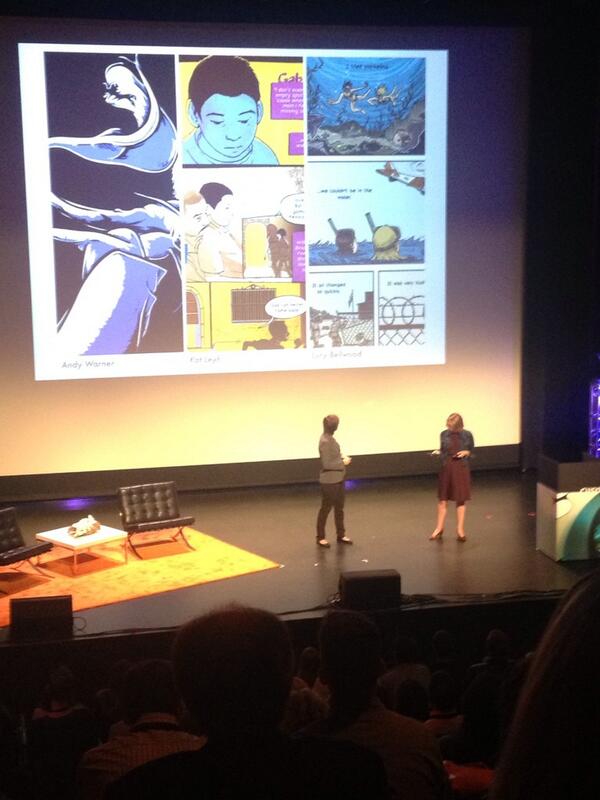
What if investigative reporting met the graphic novel format and was delivered through a tablet magazine?

Such as how Erin Polgreen and Joyce Rice are delivering it through their digital news magazine called Symbolia, for example?

My morning at CUSP came with a jolt of inspiration from these two ladies who have already been covered by Fast Company a few times. Simply put, Erin went from reading a Wonder Woman comic book to reading a news magazine and, in between, a light bulb went off. She realized that perhaps a form of “Comics Journalism,” could bridge borders.

BUiEPCECEAAXGMu

Indeed, it appears this bi-monthly product is proving that to be true. Published online, through the iPad, Kindle and in PDF form, Symbolia focuses on everything from rollerbladers in Northern Iraq, secret species in the Congo and Zambian psychedelic rock. What the duo has realized in that process is that comics have become a powerful teaching tool for their stories to people outside of the U.S., of which 45% of their readership consists of.

What’s more, even the comics format itself is elevated at Symbolia, with uses of animation within stories. Imagine a band being featured within the pages of the magazine that you can actually listen to and watch in a whole new interactive way – and then share it?

No matter what your preference of story is, think about what this format holds for a not-too-distance future when more and more of us will be able to absorb our news and share it with others who can appreciate it. I’m talking far more than just liking and sharing something on Facebook. I’m talking about getting into the content like never before. Combine that with investigative reporting that’s more insightful than much of the present product and guess what?

That’s good design.

Next: How Dr. Joyce Lee used a personal challenge to create an important health care solution to bad design.
Carnival Barking and Rapid Fire Posting Chaos: Improving Online Communities From Within

There’s a Facebook community I was recently excited to join, led by one of of the people in our industry I truly respect.

Within two weeks, I found I had to leave it.

It wasn’t largely the group leader’s fault. It was the people who killed it from within. Why? The entire mission of the group was to be a helpful forum, where people could learn from one another. Admirable enough, right? I could go with that. There are always good things to learn from one another.

Well, to make a long story short, it was overrun by people who self-promoted themselves. All. The. Time. The number of people who genuinely were asking for help were outnumbered by the fools trying to stand out from the crowd by talking about themselves to no end. They’d sell first, second and third. Helpfulness wasn’t even on their agenda.

Let’s meet these people. Everyone, tell me a little bit about yourselves – after all, it’s what you do best – and how you screw up well-intended online communities like the one I just left.

The Carnival Barker
“Well, my mode of operation is that I’m going to come into your group and do N-O-T-H-I-N-G but promote my own group. That’s right. I actually have the cojones to say, “Hey everybody in this group. Let me tell you about my other group and you should follow this link to go there right now! Come one, come all!” 100% of what spills out of my mouth is related to my own promotion and I don’t give a crap about anyone else’s group.”

Dan Gershenson: Interesting. I noticed you have an upcoming event. Would you like to plug that? Never mind. You already do. It’s your reason for being. Let’s meet our next person.

The Rapid Fire Poster
“Look at me. I can post 5-10 times in a row on LinkedIn. That means I’m a guru. I must be smart. Hire me. See? I post a lot at once. There’s my picture many times. So I’m an Influencer. Did I mention I’m in the top 1% of LinkedIn users for connecting to everyone with a pulse? What’s a brand strategy?”

DG: Funny, I was wondering if something was malfunctioning with my LinkedIn account and that my only connection was you. Then I realized you’re hogging up the whole damn stream. By the way, do you blink between posts or is it that you don’t understand how to use Buffer properly? Because there are actually settings that enable you to do posts at other times of day. Just saying.

Who’s next? Sir? I’m over here. Are you aware there are other people than yourself? Can you hear me?

The Content Snooze Button
“I post about my own company in the news all the time, like the fact that our company is having a cocktail hour and that it’s Jan in Accounting’s birthday. I’m not talking about the compelling stuff that probably goes on around here, like a case study that makes for an interesting story people might want to read or an entrepreneurial idea that benefitted our culture that others may want to consider adopting for theirs. No, I’m talking about all sell, all the time. I never comment on anything. I don’t even “Like” anything. Because that’s what it’s about in being social – talking about, well, me. The less relevant to their world or captivating whatsoever, the better. 

DG: Hey, I don’t know if you’re interested, but I have this article you might like to read about…

ENG: Why, is it about someone’s birthday in the office?

DG: No, but…

ENG: Don’t care.

DG: OK then. Moving along to our next person. I just connected to this gentleman and while we haven’t met personally, I just received a direct message from him. Let’s hear from him.

The Templatizer
“Hi you. How are you? Follow me. We do blah blah blah blah blah. I’m looking forward to knowing you and all that you do. Here’s my link.”

DG: I feel so close to you already.

Look fellas. Let’s take a time out. You’re flat out wrecking the nature and goodwill of online groups. It’s beyond the point of the fact that you don’t get it in your inward looking nature. Thanks to you, let’s call it what it is for the effect that your presence does to a Group:

A series of display ads. Not a community. 

We can change this by commenting more. Sharing more of other people’s content of value. Just “Liking” more to show we appreciate thoughts other than our own. Just a little bit from each of us would help. Asking a question such as, “Hi, I just helped a client finish a book and am now in need of a publisher to help publish it either traditionally or on Amazon. Does anyone in this group have someone they can recommend?” (side note: I really do need this!). Even our quality of our shares should be better – don’t just post a link on your industry and call it a day – tell me why I should care and why you think it’s an important development so you can your own added thought.

Don’t get me wrong. I’m not telling you to stop promoting items such as upcoming events your company is holding. My point is that the balance and quality I see from some people absolutely stinks and needs to changed immediately so that a good online community doesn’t turn into a self-promotional posting dump. That doesn’t show authority, collaboration or an openness to network with others.

Think about the best communities in our own physical world – they come from getting to know your neighbor, letting them borrow your rake, asking for help and inviting them over for a barbeque. They become more than just a name and face. They become friends you can speak highly of to others.

They become, you know, a relationship.

Let’s have more variety beyond the 1-way promotions that are completely devoid of story. I’ll bet you may surprise yourself and even find it to be far more fulfilling.

One final note: If you’re the host/moderator of such a community, it’s your responsibility to regularly monitor and step in if these behaviors above aren’t changed after a warning from you. Don’t let some bad apples spoil it for the rest.

Carnival Barker: Can we talk about the breakfast my group is having next Tuesday now?

DG: You’ve got to be kidding me.

McDonald’s golden opportunity in Russia

In Russia, wearing a rainbow flag pin will land you in jail.

In Russia, two men cannot hold hands because they could be beaten to death — not necessarily by neo-Nazi skinheads but by ordinary citizens. You can’t be caught talking about “nontraditional sexual relationships” in Russia for fear of being fined up to the equivalent of $31,000.

This is the very real climate of persecution in Russia as a result of President Vladimir Putin’s sweeping — and dangerous — anti-gay propaganda law.

Good thing there isn’t anything important happening there soon, like a worldwide convergence of athletic talent in Sochi, Russia, for the 2014 Winter Olympics. It’s safe to say that some of those athletes will be gays or lesbians. I can practically guarantee that several of them will not be silent about their orientation, either — nor should they.

It’s a toxic mixture of intolerance with extremely high visibility that must be hugely unsettling for a major sponsor of the Olympics, such as Oak Brook-based McDonald’s Corp. If that weren’t enough, McDonald’s will get a reminder of this challenge right outside its headquarters tomorrow afternoon, when an LGBT rights group protests the company’s involvement in the Olympics and urges it to pull its sponsorship.

Don’t tell me it’s business as usual at the Golden Arches. There’s no way it can be.

Yet, I see an enormous opportunity for McDonald’s: Tighten the screws on the Russian government to repeal a law that, in turn, might prevent a catastrophic incident at the Olympics. In doing so, McDonald’s takes a true leadership position that extends far beyond billions of hamburgers sold.

We’re talking about an iconic brand going on the offensive and using the platform of the Olympics to cause a bullying, oppressive government to back down. It makes a worldwide statement. And I don’t mean the kind of carefully worded statement put out by its company spokesperson.

A stretch, you say? McDonald’s may be the only company in the world with the leverage to make this happen. First, it’s sponsoring Sochi to the tune of $100 million. With that kind of backing, it could be called the McOlympics. Second, let’s remember how much money McDonald’s is spending in Russia to establish and maintain its restaurants, as well as the 150 stores it’s going to build in the country over the next few years.

Dealing with rights violations head-on with Mr. Putin isn’t just a moral imperative for McDonald’s — it’s a business imperative to protect its investments, and a brand imperative to protect its corporate image at an Olympics spinning out of control.

Nobody else is ramping up the intensity of conversation. Certainly not the International Olympic Committee, which seems perfectly happy to accept statements from the Russian government that the anti-LGBT law will not affect athletes or attendees in Sochi.

Oh. Well, as long as they said they’d be good, we should believe them. Look, Russians are not going to suddenly play nice. According to a recent survey by Pew Research Center, almost 75 percent of respondents in Russia believe homosexuality should not be accepted.

It doesn’t appear likely that the Olympics would move to Vancouver, British Columbia, as a replacement host city. A U.S. boycott of the Olympics feels even less likely.

So at the end of the day, they’ll probably be in Sochi. But here again is the opportunity for McDonald’s to tell international audiences that it fully supports equality and tolerance. Loud and clear, through traditional and electronic media. It should be educational, bold and inspiring.

In other words, go big or go home.

Will the Russian government tear down ads or block electronic activity from the Olympics’ biggest sponsor and one of its country’s larger investors? Will the IOC oppose this effort (and the very spirit of the Olympics) and ignore the fact that more states and countries are legalizing gay marriage?

They might. It’s still a risk worth taking. And if it does happen, Russia and the IOC look like the bad guys, not McDonald’s.

More than ever, corporations are influencing government policies and — if some have enough of a say about it — who gets elected. But there’s another side of influence, in which the brand does something important to improve the way of life of its community beyond the product or service it manufactures and sells.

For some brands, that community is right around the corner. For McDonald’s, that community is unquestionably global.

It’s easy for brands to slap a logo on everything, issue a statement expressing support for everyone and say how they’re going to stay out of politics. But in the age of social media, when the event you are sponsoring invites deep international scrutiny, you are a part of that uncomfortable conversation whether you like it or not. It lives and grows by your audience on Facebook, YouTube, Twitter and more.

Anyone can run the standard marketing playbook by issuing a company press release or reciting a mission statement that hangs in the conference room as proof of its core values.

But a global giant flexing its muscle to enact positive social change that gets talked about for years to come after the Olympics is over and its brand consequently seen in a brave new light?

I’m lovin’ it.

Original post by Dan Gershenson in Crain’s Chicago Business: 

http://www.chicagobusiness.com/article/20130816/OPINION/130819847/mcdonalds-golden-opportunity-in-russia

Choose Chicago – But What Brand Do We Want Them To Choose?

Here, go craft a brand that speaks for an entire city.

It’s a gigantic challenge for the Choose Chicago team that CEO of Johnson Publishing Desiree Rogers heads. Chicago needs a fresh tourism campaign that captures the imagination of potential travelers abroad who can spend a pretty penny on their destination of choice. Why? There’s a new set of questions. There’s crime. There’s teacher layoffs. There’s a pension crisis. There’s an inordinate amount of debate over Wrigley Field Jumbotrons. And we’re still feeling a bit of a sting over not getting the Olympics and what that means in terms of how the world views our city.

2013-07-13 11.46.25

A view from the quieter, more family-friendly Ohio Street Beach. Just one of the many pleasant surprises you can find in Chicago that you don’t have to look too hard for.

Well, let’s start by not relying on tired old cliches to describe ourselves if we want to brand differently. Yet, in a recent interview with Chicago Magazine, Rogers described some ads that frankly, sound like the kind of tourism ad messages that anybody could come up with in their sleep.

Chicago Magazine: What are the U.K. ads like?
Desiree Rogers: Tongue in cheek. From “Over the pond, we have a lake” to “You have Big Ben, we have a big Bean” to “Put down your shepherd’s pie,” with an image of a deep-dish pizza. It’s on double-decker buses, taxicabs, even the receipts in the taxis.

That’s a little too cutesie. The kind of expected stuff that everybody thinks about. Yes, we have a lake. And pizza. And hot dogs. And the Cubs. And the immortal Frank Sinatra singing about us. But please, let’s stop going to that well. We just can’t keep going there if we’re going to change perceptions. People know all that about our city without coming here – right down to the tagline of “Chicago: Second To None.” We get it. We’re the Second City. Never heard that one before.

Can we get real here and step into the minds of potential tourists?

You don’t invest thousands of dollars on an overseas trip to Chicago because you want to compare bodies of water and try some pizza – even if the pie is fabulous. That’s Cliche Chicago. Not why you Choose Chicago.

If we dig deeper, we know that Chicago is so much more. We have to raise the profile of the hidden gems that make our city so worth discovering.

Let’s take music. If I see one more reference to the Blues Brothers, I’m going to puke. We know the movie. It was also done about 35 years ago (ignoring anything attempted by Jim Belushi to channel his brother). We’ve got a lot more going for us in the present day we can talk about.

People want great quality blues and jazz? They can have a fabulous experience at Buddy Guy’s Legends. The Green Mill. Kingston Mines. They know the Chicago Symphony Orchestra’s world-class reputation, but have they taken in the experience of listening to live classical music (CSO or Grant Park Symphony Orchestra) under the stars in Millennium Park?

Or let’s take restaurants. Look, I love a cheezeborger, cheezeborger from Billy Goat Tavern as much as anyone. Ditto the pizza from Gino’s. But let’s throw a little more into the mix. A lot more. We’ve got hundreds of options populating every possible ethnicity known to mankind. Let’s showcase those too. I’m not imagining the fact that there are 300 options or so highlighted every month in Chicago Magazine. It’s a foodie’s paradise.

My thought? Take everything that the average person would know or guess about Chicago without coming here and wipe it right off the table as an option. Yes, they know Oprah and Michael and Da Coach hung their hats here. That’s over and done. They know about Al Capone – that’s really, really over and done. And don’t get me started on the tourist trap also known as Navy Pier.

This town’s charm – for someone who has spent the majority of his life in it – is that there is always a new restaurant, new bar, new concert experience, new shopping destination, new sporting event, new architectural marvel to tour, new museum exhibit to absorb and more.

Chicago is an ever changing-experience. It is never boring. And so much of it is wonderfully accessible without overwhelming its guests in a bad way. It is the easiest big city to customize your experience around with a myriad of options and still not feel as though you left so much more on the table unfulfilled.

From those experiences, you tell your friends upon your return of the things you never thought you’d partake in in Chicago. It whets their appetite to learn more. And they do.

In so many ways, our brand can be a best kept secret and some would say almost too secret for their tastes. But if we’re going to raise the profile and convert event opportunities from a short list of bids to a victorious outcome, we have to share the stories of our city that nobody could hope to read in a standard Wikipedia entry about Chicago. There’s thousands of those stories being told by visitors who are single, married, have kids, retired and more.

That’s why traditional advertising isn’t the best way to share that story unless it drives the reader to a place where they can read more online. We need lots and lots and lots of positive Chicago experiences shared. I’m very skeptical you can get there in a 3-5 ad campaign series. You can get there in a series of social media posts, however. So if we’re going to plaster London and other European cities with our advertising, let’s make sure it’s only the beginning of the conversation, not cute throwaway headlines that go nowhere.

For example, can we follow each day of an English couple’s first stay in Chicago? Can we follow them to their romantic stops? See their pictures and videos? Learn more about why they chose to come Chicago and to ramp up the interactivity, even recommend places for them via social media in the moment while they’re here? And when they return home, can we encourage these travelers to be tour guides for future travelers considering Chicago?

There is massive opportunity to share multiple stories simultaneously via Facebook, Twitter, YouTube, Pinterest, Instagram, Google Plus and more – and in fairness, Choose Chicago is doing a solid job of that storytelling online, particularly on Facebook. The concern I have is that I wonder what’s taking the lead in telling the story media-wise (traditional or social) and message-wise (here’s an idea – let’s use images of real people who are actually still alive and, if we’re going to use real residents, let’s choose ones that live here throughout the year rather than celebrities who call it home among their multiple other homes. Deal?).

It’s time to step away from the comfort zone of what everybody assumes about Chicago and share the unexpected, unplanned and remarkably surprising it can and does so often give.

After all, that’s what the best vacations are made of.