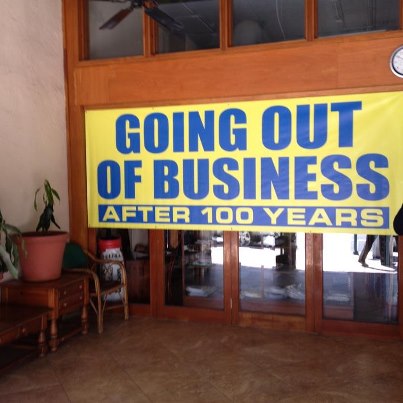
Evolution Windows and Why “Existing” Is Worse Than Death

photo

“I just don’t get this whole blogging thing.”

“We’ve gotten by just fine on word of mouth.”

“I just see Facebook as being for kids, not for business.”

“The eNewsletters I get are so boring so I don’t know if it’s for us.”

I wonder if the owner of the above business ever uttered statements like these. I’ll bet he probably did. The big deal to me about this isn’t the resistance to new media. Yes, I’ve heard statements like the one above and I don’t agree with any of them for a variety of reasons.

But there’s a far bigger problem with all of those statements – can you spot it?

I. We. Us.

Time after time after time, you will hear the same skeptics with their arms folded looking inward and placing their own opinions over those who are far more important:

Their customers and prospects.
Their employees.
Their distributors, vendors and strategic partners.

Evolution of your business is vital to survival but even more importantly, a resistance to listening to those who would support your products/services through either their dollars or their labor is one of the greatest sins of a marketer I can think of.

And let me call it like I see it – the more resistant to listening to others, the bigger the ego. “Well, we’ve been successful for 100 years” or “I’ve been in the _____ business for 25 years and it’s always worked this way for me.”

Again with the We statements. I statements. Us statements.

What about the Our and They questions? As in:

“What is our audience using right now?”

“How are they communicating with us and if they’re not, who are they talking to?”

“What do they value most? Have those priorities shifted as their household changes?”

Remember, this doesn’t apply merely to your customers. It applies to the fellow in the mailroom who has been a part of your culture for the last 10 years. The guy who walks the floor of your business who also happens to get invited to after-work happy hours and interacts with the rest of the team. He could be just as connected to the real sentiment of the company than you are because, let me guess, you’ve got more “important” things to worry about.

By the way, it doesn’t mean everything you develop as a product or service has to rely strictly on their opinion here and now. You can actually project what you think they’ll want. But that comes from knowing and understanding their innermost behaviors. What does their day look like? What are their challenges? How does your brand fit into that agenda and help them through it?

It’s possible for long-established businesses to lose their way and forget this stuff. After all, the guy who started a business 100 years ago left the business – and this world – long ago. And then it changed hands from one generation to the next.

The reality is that every business has an Evolution Window.

In that Evolution Window, the business has the opportunity to re-evaluate, modernize, even possibly re-invent itself. It’s more than a new chapter – it’s a real moment of truth that defines the next era.

Sometimes the Evolution Window comes from internal changes, like:

  • New leadership
  • New product/service development
  • An initiative to change how customer service is delivered
  • A shift in how the brand’s messaging is being conveyed
  • A change to the structure of salespeople in the field
  • New hirings (and firings)
  • Entry into new markets

Sometimes the Evolution Window is due to external trends at work, such as new technologies in the social media realm that present themselves or changing tastes and behaviors of the target audience. And many times it can be a combination of several factors in play simultaneously, both internal and external, that influence each other.

The business can make that important evolution of talent, processes and technology or ignore it and rest on their laurels – saying “that’s the way it’s always been done.”

Do they face a choice of Evolve or Die? Not always. More accurately, the choice is Evolve or Exist. Because there are a whole lot of companies that are evolving and others that are going through the motions. They’re not officially dead. Yet anyway. They’re just thinking that existing is the same as being successful. And it’s not. Not even close.

These Existers are easy to spot. They’re not questioning if it’s time for change. They’re not learning. They’re not integrating. They’re not evolving. Instead, they’re waxing nostalgic about the only methods they’ve known and talking about the good old days before the new stuff came along.

And they sure aren’t listening hard enough to voices other than their own.

It may not happen right away, but when they miss the Evolution Window, they shouldn’t be surprised why, after all these years, they have to trim their staff or close their doors.

It’s actually a fate worse than death. Because if your business dies, at least you have a chance to figure out where you went wrong from failure quicker and create a new entity that’s learned from past mistakes. Existing without evolution is just being on life support. Congratulations. You have your name on the door and provide the same services as everyone else. Punch in, punch out. Repeat until retirement or business closure.

The effect on company culture of the Existers isn’t often great either. Employees go about the motions too. They get comfortable – too comfortable – in the way things are done. This can lead to either complacency, cockiness or both. “We don’t need to change. We’re the best.” or “We don’t need to change. If it’s not broke, why fix it?”

Committees can be bureaucratic and ineffective at their worst, but it’s certainly a good idea to have a group of people (non-title specific) who study the tools and trends affecting your industry and report back to upper management on a monthly or at least quarterly basis. Agencies and consultants, where appropriate, can only help provide insight and in turn, an extra value to their own services. It becomes more than just creating ads or blog posts or public relations tactics but actually helping the client create a better culture, product, operational structure and more. I personally love being a part of that process.

Every business has their Evolution Windows. You might be seeing one right now. Which means there’s no time like the present to get the right people on board to help plan for adjustments.

Because when that window closes, there’s no telling what else can close with it.

The Challenge of Writing One Original Sentence.

I was having an interesting discussion recently on LinkedIn about whether or not you accept people who invite you to connect with no personal message other than “I would like to add you to my network on LinkedIn.”

Apparently in the eyes of some, ignoring this message is egotistical. That we’re passing up potential opportunities for business. That we’re navel-gazing and only care about ourselves.

How dare we get so high and mighty to ignore the invitation from a faceless person who has no ability to write one original sentence other than the template given.

You’ve got to be kidding me.

Are we being social or are we social networking? There’s a difference. Because if we’re striving to create satisfying, mutually beneficial relationships, the initiating party should show they give a damn beyond collecting one more name. This is kind of like the person who comes up to me at a networking event, talks 100% about what they do, gives me a business card and then leaves (I swear this has happened to me more than once and it’s probably happened to you).

Here’s the next argument: “You need to be clear about who you want to deal with in your intro.” Ah, but I do. And yet, I still get these blanket intros. Which is expected when you have millions of people on a social network, I suppose. But this is about taking back ownership and control of your circle of who you want to deal with and who you don’t. And somehow, saying “No” to a person who makes absolutely no effort to show they value your acceptance of the introduction one way or another is…being snobby? Really?

“I saw your website.”

“I read your book.”

“I read your profile.”

“I’m a friend of ____.”

“We share a Group.”

“I’m a Chicago Bears fan like you.”

ANYTHING. This is…hard? This is considered expecting too much of people?

Well, put me in the camp of greater expectations of my fellow man and woman. On LinkedIn and elsewhere.

I’d say the people who accept everyone and anyone need to re-evaluate themselves and their relationships more. It’s not being snobby. It’s part of being a professional. It’s part of striving to achieve strategic partnerships instead of being Connection Collectors.

Deeper business relationships aren’t born from a template.

What Heavy Metal and Burgers Can Teach You About Branding

Over the weekend, I had the opportunity to partake in the wonderful burgers of Kuma’s Too, a sequel to the famous Kuma’s Corner. Don’t worry, this isn’t really a restaurant review but a point about brand identity and targeting.

When you enter Kuma’s (either one), your ears are blasted by the sounds of heavy metal music at an insanely loud volume. And yet, there’s a line spilling out the door. In frigid Chicago temperatures.

Why? That’s easy. The product isn’t just good. It’s incredible. The burgers aren’t just burgers. They’re creations that nobody else can match. They don’t just throw ingredients on a piece of meat like ketchup and mustard. That’s for amateurs. They arm themselves with a toolbox full of ingredients like Cholula Lemon Vinaigrette, tortilla strips, fried eggs, Siracha, red wine BBQ sauce and more. I had a hard time deciding between the burgers of Plague Bringer, Metallica or GoatSnake.

They put a ridiculous combination of goodness together that just works miraculously. Which is ironic, since for a heavenly taste, the place has the address of 666 w. Diversey and you can’t help but think this is a perfect sign for what Kuma’s represents: Raising hell and serving beef that’s incredible but going to blow your arteries up.

Is it for everyone? You tell me if you want to bring your 2-year-old in a restaurant that blares Judas Priest.

But this is the great thing. They have a niche that is so powerful, it’s cult-like in its following.

You don’t like loud music? Get out.

You’re a vegan? There’s no one item on the menu for you and never will be.

You don’t like lines? You want to make a reservation? Too bad.

This excerpt from the restaurant’s Facebook Page says a lot about Kuma’s.

“Our second location Kuma’s Too opens this coming wednesday at 666 W. Diversey Parkway here in Chicago. A few things you can plan on. The food will be the same as it ever was with some choice improvements here and there. We will still be blasting Judas Priest at 1000000 decibels from open to close and we still won’t quote the wait time over the phone. But, that said, we are proud of the work we’ve been doing in the space and we hope you feel the same way. We open there at the same time we open at our location on belmont so please come and bang your head with us. Various media outlets have already written about the change of guard at the Belmont location chefwise so I’m not going to bore you with more of those details. I still oversee everything and the team there is more than capable of holding my standard. You can still email me directly or come visit at either location should you desire to talk shit to my face directly instead of hiding behind a keyboard.”

Brands can learn a lot from this unapologetic approach, particularly small businesses.

Oh, let me guess what the next comment is going to be: “Well, we’re a (insert complex set of professional services here) business. We’re not exactly just serving burgers to customers.”

If you want to hide behind that excuse for not identifying your target audience and who is outside of it, you can keep saying that to make yourself feel better.

But there’s no truth to it.

Complexity of products and services does not change the fact that you need to find your soul. You need to find the people who would wait in that line out the door for you when it’s ten degrees outside. And if you don’t have them or enough of them? That’s a good place to start. Why is that? Are we not clear enough in our message? Are we trying to kiss the butt of everyone who needs our services instead of qualifying them and turning certain unqualified segments away (or referring them out to others)? What will we absolutely not compromise on – and does everyone understand that or is the CEO keeping this set of principles buried in his or her brain?

It’s too bad that wackjobs ruin a perfectly good word like “Cult.” Because forming a cult following behind your brand is worth striving for – not merely to get more people through the door but to transform them into rabid advocates who will promote you, stand up for you, sing your praises in an unsolicited way. It’s not easy to get to this point. It will take serious time and focus. But you will absolutely, positively never get here by having an open door that welcomes anyone and everyone. Nor will you get here by lacking clarity for who you cater to and who you don’t.

Just like Kuma’s would probably not work well for your classical music-loving Grandmother or your vegan girlfriend, you have to ask yourself who you are NOT for. Do you know this? Does everyone in the company believe it? And once they do, do people in the outside world believe it too? Because here’s the thing – you can write it down and pay lip service to this concept internally until the cows come home. But living and breathing it in external settings is the true test. Kuma’s lives it by what’s on the menu and what’s a part of the fabric of the people that they are. You can’t fake it.

What is it that you can’t fake? And when you put that out there, are you willing to stand up for it again and again? Are you willing to turn off people who have dollars who don’t believe in it or you going to bend and bend and bend until you lose your way and your people don’t recognize your brand anymore?

Stand up for your brand is easier said than done. But it’s worth it every time. If you can do it well enough and consistently enough, your most loyal fans will eagerly await to spread the word on how much you rock.

One Book Could Make You A Thought Leader: Your Own

void(0)

Jacqueline Camacho-Ruiz, JJR Marketing

When I met Jackie Camacho-Ruiz of JJR Marketing several months ago, I was enthralled by our conversation. It began the way many networking meetings do, with us sharing our experiences, challenges and strengths. But then Jackie started telling me about how writing a book changed her life in ways she couldn’t even have imagined at the time. It’s earned her speaking opportunities, media invitations and an extra level of credibility as an author of a published work.

It was one of those hours that goes by all too fast. But after speaking with her, I immediately began planning an event that showcases this amazing woman’s thoughts on how to be recognized by your circle of influence.

It’s called “The Art of Becoming a Thought Leader” and it’s hosted by the American Club Association (ACA). It takes place on Wednesday, March 20th at 5:30pm at Mesirow Financial (353 n. Clark).

After some light mingling, Jackie’s going to show you how to:

–       Explore intentional strategies to becoming a thought leader, including writing your own book

–       Uncover key benefits of being an expert

–       Discover how media plays a major role in getting the credibility you deserve

In addition to Jackie’s presentation, this group has had some great success with small group networking, which aims to put 4-5 people together from similar industries for more purpose-driven relationship building. By doing some of the legwork for you once you register, it beats wandering around a big room wondering, “Is my next potential client or partner in here?”

I hope you can make it! Follow this link to Register.

What: “The Art of Becoming a Thought Leader” presentation and networking
Where: Mesirow Financial, 353 N. Clark
When: Wednesday, March 20th, 5:30pm – 7:30pm

Branding Like A 2-Year-Old

“I help companies tell more exciting stories about themselves and the people they help.”

That is about as close to the explanation of what I do, created for a 2-year-old, that I can make.

I was thinking about this while looking at a picture of my nephew, who is literally a 2-year-old. He’s a genius in my book. But of course, even he needs some simple explanations some times about how things work in this new world he’s experiencing.

As a parent, a grandfather/grandmother, Uncle, Aunt, friend, etc., surely you’ve tried to explain something complex to a very small child. And in that instance, you know that making things so simple compared to how you’re used to describing them is pretty darn hard, isn’t it?

My college professor once told me over and again, “In Advertising, you never tried so hard to make something so simple.” He was right then and still is.

Whether you work on the client side or the agency side, whether you work in traditional media or online media, try this exercise: Think about explaining what you do to a 2-year-old. Or, if that’s too hard, think about explaining it to these kids in the latest AT&T commercial. Or the role of Aaron Rodgers in the latest State Farm commercial – the poor guy is having a hard time explaining himself to kids in a classroom and he plays football.

http://youtu.be/UyDXUjU7sZk

It’s a crowd you can’t use industry lingo in. You can’t speak jargon in. They won’t be impressed. They probably won’t even understand it.

Now here’s the crazy part:

It’s not all that different than the audience you’re trying to speak to. 

I’m not trying to be insulting in saying that whatsoever. I’m saying that speaking on our terms rather than trying to relate to their world is a recipe for the attention span wandering quickly.

Some call this Dumbing It Down. Whoa there. Not so fast. We can be clear in our storytelling without losing our sophistication. As I think about my 2-year-old nephew, he’s got a ton of books (yes, these things with actual pages in them, not an iPad) and the ones he chooses to have read to him are the ones that are the most magical to him. The story is captivating and easy to understand. The illustrations are unique. I like to think the tone in which it’s being read is important too.

I can hold his attention for a solid 3-4 minutes, which for that age is amazing. Imagine having that ability with your own audience. Anything over 30 seconds and you’re doing better than most TV spots.

“Are you saying I literally have to say things in their most basic form?”

No. I’m saying to think about how the human mind works. Think about how we make decisions. When we’re making purchases, even of the most complex variety, there is one gigantic motivator that strikes an emotional chord.

You can hide behind bullet points and machine specs and in-depth research that suggests a multitude of positives that should be listed.

Doesn’t matter. There’s just one thing that makes people want to buy. You either hit on it or you don’t. And when you do, it’s about eloquently and powerfully conveying how you have that one thing more so than the other guy.

Anything else that gets in the way of that one thing is a distraction. Which is why it’s so important during strategic planning to strip away all the other jargonistic industry lingo you could be saying and instead envision yourself having a real, honest conversation with that potential buyer.

I have seen respected CEOs have a hard time with this. I have seen those with MBAs and Doctoral degrees have a hard time. And people with 30+ years of experience in their industry. It’s not their fault, really. It’s what can happen when we get so insulated within our own company walls in what’s standard communication (think about how many abbreviations you use that are specific to your business or industry) that we forget there’s a level of Plain English that needs to be spoken in a captivating manner to the world outside.

Your customer may not be a 2-year-old. But you have to communicate company virtues on their turf, around their needs, on their time, in their tone. Not expect them to figure it all out on yours.

It’s that simple. And yet, just that complicated. Need a hand finding that insightful nugget and then explaining why your treasure is important to someone of value? Let me know.