5 Steps To Creating A Better Internship Program

As college students prepare to kick off their summer with the hope of landing an internship, there’s still time for your company to design an intern experience that’s worthwhile for both them and you. When it goes well, there’s nothing like mentoring a person who has the passion for learning more. When it doesn’t go as well? There’s a reason for it. It usually comes down to the company’s lack of planning, not so much the intern candidate.

Here are four signs that you’re about to offer up a lousy internship experience:

• You see interns as “grunts.”

• You feel they should just be happy to have an internship at all.

• You don’t know what they’re going to do but you’ll figure it out.

• You feel they should be broken rather than taught.

Wow, where does a young mind sign up for that experience of giant ego and rampant disorganization? The fact is, one bad internship could sway a person unnecessarily from a career path they’re actually made for.

Fortunately, here are five key points associated with offering internship experiences that will start your program on a path that’s a lot more rewarding for all parties.


Step One: See them as real team members, not “extras.”

This is a big step because it forces you to aim higher for a candidate who is expected to demand more of themselves and contribute to your company regularly. I didn’t suggest to give an intern the exact same responsibilities as anyone else. I’m saying to give them the opportunity to collaborate with staff while creating and presenting their work — real work — to others. What can you unload that challenges them but something you can still evaluate?

When you do this, some beautiful things tend to happen: First, you demand more of the student and if they rise to the occasion (as they often can and have), they give you a tremendous effort back. Second, they never forget the trust you had in them, not to do the work singlehandedly but at least to be involved and contribute as part of a larger team.


Step Two: Write their role description.

I know it seems crazy, but some internships have no structure. The intern shows up and hangs out to see if anybody needs any help. Don’t believe me? Yours truly had that from an internship. Part of this lack of definition might have something to do with the fact that the people hiring them just wanted an intern who could “help out when the situation calls for it.” Whether you’re talking about a job or an internship, writing out the role on paper gets everyone quite literally on the same page about what is and isn’t entailed.


Step Three: Find out what their goals are.

This is what sets apart ordinary programs from better ones in my opinion. Beyond the fact that they want to “learn a lot,” dig deeper and press your candidate to give you one to three very concrete goals they want to achieve during their experience with you. And hold them to it, although it’s something you both work toward and monitor the progress of, too. When it’s more customized to the intern’s goals, it’s hard to find two experiences that are exactly the same.


Step Four: Determine what your goals are.

What’s your purpose or gain for adding them into the fold for a few months? What do you get out of it? It might be a fresh perspective on regular challenges, a good way to evaluate a potential employee (if not now, then a couple of years down the road) or even as a tactic that fits in with what your brand stands for.

Think about how your role is going to change a bit, too. These are young minds that crave feedback. Are you or others on your team going to be in a position to regularly give it in a meeting, at lunch, in the course of your day? Or will you be hardly ever around?


Step Five: Decide whether it will be paid or unpaid.

Let’s agree that if you’re in a position to pay an intern, you should. But what if your company genuinely can’t swing that, financially speaking, and students are still interested in an opportunity?

Press on with an unpaid internship program. And don’t let the critics of this practice dissuade you.

There are some people who believe the only internships that should exist are paid ones because otherwise it creates a system of “haves” and “have nots.” I have news for those people – if some small businesses are forced to do paid internships, they may be forced to do away with the program altogether, which punishes all student candidates. That’s not a solution.

If you do an unpaid program, you should still think of the small but meaningful things you can do to make the student’s life easier financially, whether paying for their gas money, lunches now and then, reading materials and more.

Personally, I think the value of a solid internship program is underrated. These opportunities become a fantastic marketing tool for the brand – after all, when the student returns to school, who is your former intern going to tell about his or her hopefully positive experience?

That’s right. A pipeline that may include your next potential intern.

Read more: http://www.chicagobusiness.com/article/20120530/BLOGS06/120539991/5-steps-to-creating-a-better-internship-program#ixzz1xEvH6DI6
Stay on top of Chicago business with our free daily e-newsletters
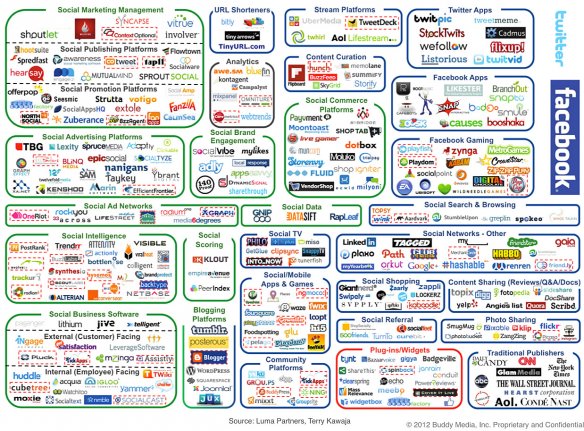
With so many social media tools, why do things still feel broken?

The following graphic from Buddy Media is quite interesting, does an excellent job of organizing sets of features and at the same time, may very well make your head hurt. It’s not that we don’t need more social media tools or that they shouldn’t continually evolve. It’s that we often start with them before thinking about strategy or put up posts like, “10 ways your brand can be built on Pinterest.”

Um, may I ask a stupid question? Who said Pinterest may be right for the brand at all in the first place?

Focusing on the tools first is short-sighted but some marketers don’t know any better than what they’ve been told. Let’s take it a step back and get back to things like company vision, mission, culture…essentially your company’s reason for being.

If you’re confused on that or your company isn’t on the same page on that, you’re only adding to the problem by trying to communicate a message of who you are that people within aren’t completely on board with. Fix that part of the house first. It may take a few months, but the social media tools will still be there by the time you’re done. I’d wager there will probably be 1000 more to choose from anyway.

Let me know if you need a hand sorting any of it out – Dan@ChicagoBrander.com

Will Wall Street “Like” Facebook In The Long Haul?

As a social media brand strategist, it’s often hard for me to leave Facebook out of the equation entirely in recommendations. Oh, it happens. But not as much as other social media channels that could be completely left out of the media mix.

That part of “buying in” to Facebook is relatively easy, whether that means creating a Facebook Page, choosing Facebook Ads, etc. Practically everyone I know is on it and some of those people don’t hop from social network to social network with ease. So I don’t see Facebook disappearing anytime soon. I think it’s going to be around for a while, which is more than I can say for other social media channels that come and go.

Yet, the new part of “buying in,” literally buying Facebook stock, may give some people a degree of pause. Here’s why. The question becomes whether or not we believe it can continue to evolve and give us new, exciting experiences vs. having reached its peak.

This is going to be a huge challenge for Mark Zuckerberg because on one hand, he has to not only bring those new developments to the table to appease a new audience of investors but he also has to appease an audience of users who can be extremely sensitive to change (Timeline or Beacon, anyone?). Granted, people have to deal with that change and unless it’s a colossal miscalculation on Facebook’s part, I don’t see those users switching away with each evolution.

But when you think of Apple, for example, is it easy for you to imagine their next evolution without enraging a core group of fans? Sure, I can see that. Not everybody may buy, say, an iPad mini version, but it’s probably not going to be met with a backlash by those who don’t buy it.

When you think of Google, there are different products that are put forth from the company – some make it, some don’t – but we still by and large turn to Google for what we need, whether that means search, Google+, AdWords, etc.

It’s potentially harder for people with Facebook because so many changes they have affect the whole of the product. We can’t easily select what we want and don’t want from Facebook. They just do it and it’s our option to put up with it or leave entirely. They tell us these changes are good and we, sometimes reluctantly, have to go along with it because it’s not worth leaving behind the connections we have.

The other hard question to ask is this – do we want a social media department store? Because if Facebook evolves, it may have to keep adding on and buying companies like Instagram. But what if we don’t want all of our social media in only one place? Maybe we like having Facebook, Twitter, Pinterest, LinkedIn, YouTube, etc. in many different channels rather than One Channel To Rule Them All. If we look at physical department stores like Borders and Circuit City, we can see that the strategy of having many media under one roof doesn’t play with the public as well all the time as you’d expect.

Can a social media network actually reach a point where it becomes too big, too clunky, too fast? This concept has happened with other industries. Whether you buy Facebook may depend on whether or not you buy into the belief that each evolution they make will be fluid, intuitive and elegant or like turning around an aircraft carrier.

Why I do buy about Facebook is this much – there will be change, a portion of the audience won’t like that change (inevitable with an audience this massive), the size of that portion will depend on how great the change is and there will continue to be new players in the social media universe – not to take down Facebook entirely, but to outdo certain features.

I wouldn’t want to be on the other side of Zuckerberg. But he’s got quite the challenge at the opening bell.

Reality: Chicago was “on the map” long before NATO.

There’s an interesting argument that’s been put forth that Chicago really, really needed to host the NATO Summit to be taken seriously in the eyes of the world. The phrase I hear most often is that, as far as branding our city goes, the presence of NATO puts Chicago “on the map.”

I guess they’re right. Before NATO, we didn’t have much going for us.

We didn’t have arguably the finest restaurant in the country, Alinea, along with ridiculously good steakhouses, Mexican food and every other ethnic cuisine.

We didn’t have professional sports teams and rabid fans certainly on par with those in New York and Boston.

We didn’t have a Marathon that got 45,000 registrants in 6 days before it was closed.

Nightlife? With NATO’s influence, maybe we can have some now on Rush Street and Bucktown and Wicker Park and Wrigleyville.

Musically-wise, we sure were suffering. If only we could get concerts by every major act in the world you can imagine or gigantic music festivals like Lollapalooza.

Before NATO, we didn’t have the corporate headquarters of Motorola. Baxter. McDonald’s. Hyatt. Boeing.

Thanks to NATO, it’s only a matter of time before we have greater cultural diversity. Perhaps someday we’ll have a Greektown, Chinatown, Puerto Rican Day parades and St. Patrick’s Day parades. And the largest Polish speaking population outside of Warsaw.

Shopping? Yeah, not much there on Michigan Avenue.

Thank goodness NATO is here so we can soon have a Chicago Stock Exchange and CME Group to turn the wheels of financial trade.

Maybe now O’Hare Airport will get some much-needed traffic.

In time, perhaps we’ll have a profound impact upon the theatre community with the momentum of NATO. Second City and I.O. will have alumni as famous as Tina Fey or Bill Murray. Maybe we’ll even be able to bring Broadway-style productions here.

I hope our art scene gets greater recognition at some point as well – it would be really great if we had a phenomenal art museum to house the works of Renoir, van Gogh, Monet, Cezanne, Picasso.

Ah, dare to dream.

Hopefully someday we’ll have the finest orchestra in the world and a renowned opera company.

I suppose now we can finally have some architectural development around here.

Oh. Wait.

I don’t mean to sound ungrateful for the opportunity to host the diplomatic community. Especially since we host so many international embassies and consulates here every day.

And I really don’t mind that NATO is coming or its inconveniences. What I do mind and am offended by is the notion that now because NATO is coming, Chicago has finally “arrived” as a city.

Please. We arrived well before any world leader gets here and says so.

News station, Korver polar opposites on Rose’s dark day

“NBC Miami reporting that a Derrick Rose Hologram will take over as a starting point guard for the Bulls.”

“NBC Miami reports the Chicago Bulls have lost the Eastern Conference Finals to Thomas Dewey.”

“NBC Miami reporting their baseball team is missing.”

When NBC Miami reported prematurely that Bulls point guard Derrick Rose had torn his ACL – even though the report ultimately proved correct – you can see the importance of how knowing you got it right the first time becomes on Twitter with the actual tweets from people above. In the time the first tweet was launched from NBC Miami on the injury, thousands of tweets exploded in the Twitterverse of how the station was reporting it. NBC Miami then had to put out a tweet to say the news on Rose’s injury was premature – wow, do you think? He hadn’t even been to the hospital yet to have an MRI, but somehow a news outlet in South Beach knows what’s going on with his anterior cruciate ligament??

Boy, did they ever luck out with ultimately getting it right, because prior to that, on Twitter they were all kinds of wrong. I surely hope they didn’t turn around with a “you heard it here first” spin.

On the other hand, let’s celebrate someone who not only got it right but also didn’t have to apologize for it in between – the Bulls’ Kyle Korver. So many athletes put out foolish, PR-nightmare tweets and posts before they have any business doing so, so it’s refreshing when someone from within the organization rises up and posts something thoughtful on Facebook like so:

Right about now, the disbelief has faded, anger has subsided and were all wondering… why? Why. Why. Why Derrick, again? Derrick is more than an MVP to our team. He’s our friend, our brother he inspires us to be the very best we can be, just by who he is and how hard he plays. That he has spent so much time this year hurt, was frustrating. Now that he is out for the rest of the season, well its just plain sad. No one is to blame; what happened, did. We send him our prayers, our love, our good wishes that he heals and comes back stronger, better, healthier than ever before. 

Bulls fans. Now is not the time to ask why or to get bitter. Now is the time to refocus and ask “How are we going to win this Championship?” We have the best Team in the league. This season has proven, we are a TEAM and it has taken us ALL to have the best record. Lets focus on whats ahead. This is an incredible opportunity for All of Us to step up and make it happen. We’re all gonna have to work harder and smarter. We are all gonna have to believe in ourselves. That we are more than the sum of our parts. We need YOU to believe with Us. We need You to believe for Us. We are going to keep going strong. One quarter, one game, one round at a time. Until its over. That’s how we’re gonna do it.

How often can an athlete write something like this when the moment of winning/losing is so fresh? Almost never. Usually it involves a tweet followed by a second one that starts with “What I meant to say was….”

The entire Chicago sports media on that day didn’t put out something so eloquent and in tune with what people were feeling at that moment. Far too easy for most of them to go negative and say, “This team is done.” Wow. How…uninspiring. Especially when you’ve watched a team like this play every game without most of its starters, including Derrick Rose and still have the best record in the NBA. Back to you, Ron and Kathy.

Here’s my point – rapid-fire journalists on Twitter need to remember they’re playing with a loaded gun in the social media realm. It’s going to be hard for them because their instinct is to be the first one breaking the story. Yet it’s dangerous to just get it out there before thinking, “Hey, maybe we should check our sources before posting this to see if that source is actually real.” That’s Journalism 101. They don’t need to overanalyze their tweets to death before publishing, but they have a responsibility that if they want to be taken seriously, there’s going to be thousands of people who will retweet that news, especially the more dramatic it is. And then all of their followers could potentially run with it.

When news that’s done in error is spreading like wildfire, you don’t blame the wildfire. You blame the person who started the wildfire.

Sure, it’s more than a little scary to know what the potential of starting a panic with bad information could be. But it’s the world we’re living in that’s getting faster by the day. When we do screw up, we apologize for it lightning quick. I get that we’re human beings and all make mistakes. The best we can do is try to put a little more thought behind the content we generate rather than rushing to be the first one to say something. The problem isn’t so much the tweet alone but the ensuing effect. If journalists want to continue to be taken seriously, the more of them that set off a Tweetpanic won’t help.

In that sense, I think Kyle Korver reminded us of two things that day:

1) How timeliness and thoughtfulness can and should very much live together in harmony in the social media universe.

2) Great performances in clutch moments don’t always happen during a game.