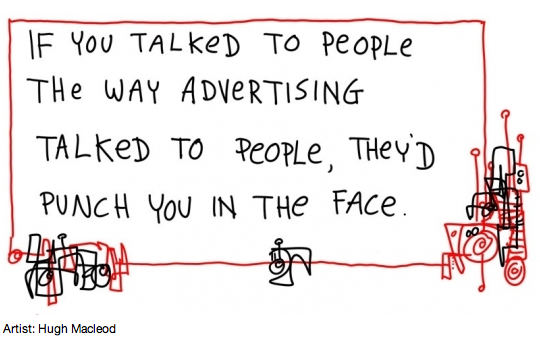
Making Your Brand More “Conversational.”

So true.

Why can’t we talk to potential customers as if we were sitting across the table from them?

I believe we can. I believe we have to.

Instead, brands look at their audiences as a set of statistics rather than a one-to-one conversation. And it’s little wonder why they often wind up sounding like they’re talking to a set of statistics. Why? Because there’s a fear that your brand might not sound professional?

First of all, if you don’t make it conversational enough, there’s just as much risk that your brand might sound professional and completely non-captivating. Secondly, you can be professional and relate to the audience at the same time. It’s not impossible. Third, conversational doesn’t necessarily mean so loose that it’s off brand in some instances.

It’s time to err on the side of talking like a human and sounding less like an ad. There’s nothing wrong with ads. Just ones that are dead-ends for making meaningful connections with their ice-cold tone.

Don’t Let Content Syndication Make You Lazy.

The other side of content syndication: Does it cause us to cut down on quality interactive time spent on each social media channel?

A couple weeks ago, I had a bonafide Freak Out Moment. One of the apps used to syndicate my blog was having an error and decided to post the latest post – even before it was done – onto the web over and over again. If you were on the receiving end of that noise, I do sincerely apologize for the insanity. Fortunately, if there’s any good that came after I had my meltdown and got the situation under control (hopefully, please Lord) by undoing the app altogether, it was that I had a bit of an epiphany about content syndication.

My epiphany

While I had originated a lot of content from my blog, in my passion for syndication, I was unintentionally neglecting some of those other channels, such as LinkedIn and Twitter, for the venues of discussion they have been for me. Technically I was there, but I wasn’t really there as much as I was distributing stuff there, thanks to syndication of my posts. I was posting, but I’d fallen into a trap of doing the very thing I despise doing: broadcasting in a 1-way format more than 2-way interaction.

As a result, I have not done as much interacting on LinkedIn in Discussion Groups or asked/answered questions in the Q&A forums. I’d maybe done some Retweeting of others on Twitter, but I needed to do more true responding and commenting to those tweets.

The trouble with syndication

Here lies the hidden trouble of syndication if you’re not careful. There’s absolutely nothing inherently wrong with having your blog sync with other channels, so I’m not blaming those tools – the problem is when users get in the habit of clicking off check boxes to sync that content with and forgetting to do anything else on the channels by and large. 

What’s that? LinkedIn? Twitter? Facebook? Sure, you’re there. But if you’re relying on syndication for your interaction alone, are you really there?

You can become so focused on the content under your own roof and how you’re going to push that out to the masses that you forget that each channel deserves as much of its own strategy as possible. What is it that makes this certain audience different? What is it that you’ve found they appreciate most? How will you have a relationship with them that’s different and unique from your other channels?

Without consistently doing this check-up on yourself, you can fall into a pattern of regular publishing – which seems great – without showing others that you know how to converse, absorb, appreciate and advise. You could actually have extraordinary content but totally un-extraordinary people skills within a community. 

You need both qualities to do business successfully and build a brand. At least I don’t think you can be nearly as successful being a pure content shoveler vs. responding to others.

So go ahead and syndicate. And of course, make your content as excellent as possible. Just remember to have your commenting skills accompany your content writing skills too.

We’ll Always Love Movies. But Will We Love Movie Theaters?

Can luxury and tech upgrades rescue movie theater brands from oblivion?

On the afternoon before the Oscars, I was sitting in the AMC River East Theater on Illinois St. wondering if I was sitting in what was about to be a relic.

After all, my wife and I had just paid about $22 for two tickets before popcorn and drinks. With a small bag and shareable Coke, we were looking at close to $30. I could only imagine what the expenses would be for a family of 4 in an economy like this.

In that context, the brand of the traditional movie theater, the status quo, is no longer a practical option. There is only one way to go – up. As in a very upgraded luxury experience and in turn, luxury brand.

There was a time not so long ago that movie theaters with all the bells and whistles were considered above and beyond the standard. Loveseats. Restaurants in the same theater complex. Valet parking. Gourmet food delivered to your seat by waiter. Beer and wine selections. The ability to actually choose your seat by touch screen. Now, I believe the era has shifted to where, if movie theaters are to survive at all, they have to live by the mantra:

Go Luxury or Die.

The above items will not be “nice-to-haves” but “must-haves” in order for theaters to be a justifiable expense. The notion of Premier seating will go away in favor of all seating being that way. The price of admission in this category is going to be built on who can be the most supremely innovative and entertaining before, during and after the movie.

Remember, beyond economical challenges, people have technological advantages they didn’t have before. They can build their basements into Man Caves with deluxe speaker systems and a 50″ LED TV so that the picture and sound quality is amazing. When you have that kind of setup, who cares if they don’t see “Moneyball” in the first week it’s released when they can wait a few months to get it on Pay-Per-View for a lot less? And they can watch it in the privacy of their own home rather than deal with the jerkwad kicking their seats and talking loudly behind them.

This is why shifting downward as some theaters have, intentional or not, is not really a strong option. Paying a buck to see a movie long out of the theaters is cute once in a while at best and not sustainable. If you’re going to spend 2 hours out of your life watching something, not completely sure if that something is going to be any good, you at least want everything else to be pleasurable. Not sticky floors, cramped seating and a general experience that makes you want to shower afterwards.

It seems almost sad when you think about it. The Drive-In was a big part of my moviegoing experience growing up, but those are few and far between now. Will we be referring to movie theaters overall in the same way as technology innovates upon what is already a movie-quality experience at home? Perhaps. But to me, the way  for AMC and other chains to survive and grow their brands further is to create what people can’t get at home.

That’s why I’m very curious to see how Florida-based Muvico will further expand.  Five years ago, the chain of luxury theaters opened one of its first locations outside of the Sunshine State with an 18-screen location in Rosemont, complete with a full-service bar and restaurant. Having lived in Florida for a number of years, I can say the Muvico experience at the Premier level was definitely one that made me feel that it was money well spent. Why? Mainly because it has all the luxury aspects I mentioned above built-in.

So often, the assumed place to go for brand categories in a state of flux is to go downward by discounting. You’d probably assume the case here too given how people have little to no extra spending money for leisure. But discounting or even the status quo isn’t the long-term answer for theater chains. It’s about going all out to give people noteworthy things to write about and share across social media channels like Yelp. Sure, some will still consider these features overpriced. But isn’t the status quo of theaters without them overpriced anyway? If we’re going to spend more than we wanted to, shouldn’t we get more out of it?

Hoping Hollywood to upgrade its content to provide us better quality movies for the buck rather than churning out more sequels isn’t the answer. If we keep shelling out money to see Transformers 17, they’ll keep making them. No, the answer lies in hoping theaters do the upgrades.

The bar needs to be raised to the highest standard of where the theater experience is re-imagined, with the brand that wins realizing luxury and technology is the best ticket to success they can buy at this point.

8 Chicago Media Mavens I Love Following on Twitter

On this Valentine’s Day, I thought I would share the love with some wonderful people in town I look up to regularly for their wisdom on advertising, marketing and social media strategy. They make me a better expert at what I do (after all, nobody can know everything and if they claim to, be very suspicious) and make me grateful that we have such a social media community like Twitter where such sharing of knowledge can occur.

In truth, there are so many more than these 8 in town that I love following but I’d be writing this post for the next month or so. I didn’t include brands/organizations I love following for this list but specific people. If you have others you’d like to suggest for this list that you like following, let me know.

Here they are, in no particular ranking:

Gini Dietrich: @ginidietrich
Fun, smart, thought leader. Love watching her videos / reading her views on social media and PR’s role in it. Plus, I really hate the concept of PR “spin” so I have to love any person who also has the handle of @SpinSucks.

Liz Strauss: @lizstrauss
Great thoughts on social media that she writes originally and finds to share. On an underrated note, she takes some of the most stunning photos of the lake via Instagram.

Barry Moltz: @barrymoltz
I usually have a “Hey, I didn’t know that” moment when this gentleman shares compelling tweets on technology related to social media.

Amber Naslund: @ambercadabra
I became a fan of Amber’s the moment I read her book co-authored with Jay Baer, “The Now Revolution.” Most recently with Radian6, I’m anxious to watch her next venture and read her tweets in the interim.

Sima Dahl: @simasays
Social media wisdom from Sima dispensed regularly. We’ve had some nice banter over Twitter and look forward to meeting her in person soon.

Steve Congdon: @stevecongdon
The king of Chicago ad agency new business thoughts. And quite possibly one of the nicest people in town you may meet.

Ann Dwyer: @AnnDwyer_Crains
If it deals with Chicago business and entrepreneurs, Ann’s all over it through her Crain’s blog and tweets. (Full disclosure – I just started writing a weekly blog column on Crain’s each Wednesday, but was a genuine fan of Ann long before that).

Adriana Llames: @adrianallames
Adriana always has good things to share on the topics of personal branding and career coaching.

I know this is hardly an all-encompassing list. Again, there are many more in town that I love following in other areas. But you could do a lot worse than following these folks to start with.

And if you happen to like what these people are tweeting about, you may similarly enjoy following a certain guy who goes by the handle of @DanOnBranding. Just sayin’.

28% of Super Bowl advertisers forgot about the Internet.

As a follow-up to my last post, Jeremiah Owyang of Altimeter Group pointed out that 28% of the Super Bowl spots led to no URL, social network or hastag. It’s kind of unfathomable to me that ANY company spending millions of dollars per 30 seconds would have no potential springboard to an online relationship. I know most of the world is going to measure Super Bowl spots in (no offense) effectiveness of “I liked it” or “I didn’t like it.” That’s the water cooler, day after grading system. But although it’s certainly better to be liked after the Super Bowl than never liked at all, how much farther could that goodwill have taken those brands that garnered a “Like” from TV watchers…and gave them no online outlet afterward? I just can’t let those brands off the hook and give them a thumbs up completely. Points off for forgetting your watchers are looking at your multi-million dollar ad and probably within inches of a smartphone where they could have gone to your site to learn/interact even more.

What do you think? Is “Liking” an ad good enough? And to take this a step further, are there any brands from the Super Bowl that you have purchased/interacted with more online as a result of liking it?