10 things you learn about yourself after 100 blog posts

I had to take a moment to pause and reflect on the first 100 posts of this blog. When I think about what I’ve learned and how those will influence my next 100 posts, 10 things come to mind that may also be helpful for you. I wonder if you’ve felt the same way on some of these points or would add some about your own blogging experiences? If so, let me know about those in the comment section below.

1. Objective is boring.
I’ve learned that there’s little point in being objective because I figure if people want that, they’ll tune into their nightly news. I like giving credit to people who I think have done a good job and calling out people who whiff at brand development. At least I know it’s important to keep it real, no matter what. When I think about blogs that I find interesting, they inject opinion. And if they’re not taking a side, they’re asking questions that provoke thought and continued discussion. I’m striving in the next 100 posts to do more of that.

2. One post can explode the traffic.
Seriously. I awoke some days to find one post have just a little traction and other days it was through the roof. These are the posts that keep generate readership months and months after they’ve been posted, much to my amazement. The takeaway is to look for the commonalities between the posts that are really taking off. Is it because they have a certain format or subject matter or tone?

3. You do not have to post every day. Not even close. 
There’s always so much made about frequency. Yes, you have to post consistently, but post when the spirit moves you to write something meaningful, not because someone said you have to post every day. At this point, I’ve tried to say something useful at least twice a week that will benefit readers. That’s the consistency part. Beyond that, when the moment grabs me, I write a post usually in one sitting and never look back. When I’m not feeling it, I don’t force the issue.

4. Don’t try to be Hemingway with every post.
I know, I just said to write something meaningful. And I did mean that. But I sometimes found myself overanalyzing my content quality when I also had to remember to get it out there to express myself on a time-sensitive topic. Again, I think having a loose weekly deadline for yourself can give you the balance of a time boundary without rushing your content out there too prematurely (“I have to comment on that news today!”). Relax. Absorb it. Craft your take thoughtfully. Then stick to your focus of making sure you comment on it within a reasonable timeframe. If something important happens on a Monday, I try to comment on it within the week but not three weeks later when it’s old news.

5. You touch people you never thought you would. 
It’s been very cool to see business relationships and opportunities transpire in the last year as a result of this endeavor. Students, CEOs, blog communities, folks inviting me to sneak preview events and conferences and so on. Think you can get these kind of things from spending a bunch on direct mail? Yeah, right. Blogging works. But if you think you can get amazing results after your first 2-3 posts, don’t bother. Patience isn’t just a virtue. It’s mandatory.

6. Subscribers take time to accumulate.
Chris Brogan said it took him 8 years to get 100 subscribers. Knowing who he is and my admiration for him, that fact has really stuck with me and encouraged me. I guess in that context, getting about a 1/3 of that in year one ain’t too shabby. There’s definitely a lot of people visiting and reading, so I can’t complain about them not taking the subscription step too much. I’m sure there are tweaks I’ll explore (without being too gimmicky about it) but when you focus on the content that your potential subscribers want to hear about regularly, that’s far and away the most important thing.

7. E-mail still offers plenty of share-ability. 
After Facebook and Twitter, I found a lot of sharing of articles going on via e-mail. So even though e-mail may feel like a communications dinosaur, the fact is it’s not going away for a very long time. Especially among people over 30 years old.

8. Don’t sleep on StumbleUpon.
Nobody talks about this channel as much as Facebook, Pinterest, Twitter or Google Plus. But I’m telling you, on certain days when you get lucky by your post being voted up, it’s a traffic bonanza.

9. Could that long post have been divided into a Part 1 and Part 2? Probably.
I’m wordy. Sometimes more than I’d like to be. And I think if I’d divided some posts in half, I might be at 150 posts or more by now. Not a horrible thing, but considering how much Google likes more and more pages within a site, this might be helpful to consider going forward. Plus I think people have a general threshold of wordage.

10. Offering guest posts is great for variety.
People like Melonie Boone, Rob Jager, Steve Congdon and others have contributed wonderful pieces to this blog in the last 100 posts. In fact, I’ve got a couple more in the hopper I need to post. These guest posts have given readers the perspective of people in HR, Operations, Agency New Business and more. It also hopefully helped drive some good traffic to their sites because some still get great readership, like this one from Melonie, which feels good. Plus it helps alleviate the pressure of a post that day, so that certainly doesn’t hurt. Do remember to guide your guest posters so they’re writing within your blog’s theme and audience rather than anything they feel like. If you’re interested in guest posting, hit me up.

#11 (bonus): I am already humbled by the experience.
By words of encouragement, great comments, thoughtful dialogue and actions of sharing this content with others. I hope my first 100 posts have provided you insight and I hope that my next 100 will provide even more so. Your feedback is always more than welcome to help me make this blog better all the time. As always, e-mail me at Dan@ChicagoBrander.com.

Advertising is a Cubs fan’s best friend

I suppose this day was bound to come. Maybe deep down, those of us who are Cubs fans all knew it. Here we lie at the inevitable moment where our grand old ball park meets the revenue demands of the modern day and the only way to maintain its existence in a new era is to adjust.

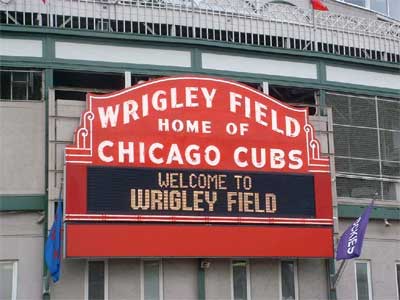
I would like to see "World Series Champs!" on this marquee in my lifetime, wouldn't you?

It’s uncomfortable. It’s unpleasant. And it’s absolutely necessary.With Chicago Mayor Rahm Emanuel’s “Fenway Plan,” the Cubs potentially could gain in the neighborhood of $150 million in advertising and sponsorships from Wrigley Field and the surrounding streets.

It’s a thought that causes excitement for a marketer and terror for a baseball purist. A time where advertising settles into the role of Bad Guy, and people begin to get emotional about the future with a mixture of fear and anger. Some say Wrigley is beautiful and that the addition of a Jumbotron in right field or a lot more ads would be horrible. Some say it’s a wreck and are all for change as long as they don’t have to pay for very much of it at all. And some dare to suggest that the Cubs should move to the suburbs and knock the stadium down altogether. I wager most of those in the last category are the same bright minds who said the Bears should play in Gary.

At the end of the day, I turn to the brand itself as my guide. And that’s where the answer of all this becomes clear as day.

The Cubs’ brand is Wrigley Field. Think about how rare that is for a moment. We can over-romanticize the Friendly Confines, but there is a very short list of stadiums that are so embedded into their teams that is impossible to unlink the two. This is one of them. In other locations where professional teams are based, you can transport them across town, to a suburb or across a river and the fan base won’t bat an eyelash.

But even the brands with the most cherished heritage need to make some concessions to the modern era. The Cubs’ brand is no different. It’s a new ownership, a new management team and even a new philosophy that’s trying to build a culture of winning. Look around the game – is someone going to think Yankee Stadium or Fenway Park is any less hallowed ground because of some giant ads? I’ll take giant ads if it brings a giant championship.

Purists will grumble that a Wrigley with increased advertising upsets the beauty of the place. You know what? They may have a point. But you know what else I’d hate to see even more? A wrecking ball hitting it and watching them play in the suburbs. That my heart could not take (sorry, suburbs).

Yes, they have a responsibility to respect tradition, too.

Only a fool would make the kind of improvements that practically eliminate the iconic elements that make Wrigley, well, Wrigley – like the scoreboard, for example. The foul poles that carry Jack’s “Hey Hey” catchphrase. The front marquee. The ivy. But there can be a best of both worlds. Advertising does not have to upset the character of a ballpark if done with taste. It’s a challenge. But not an impossible one.

Yes, I have not agreed at all with how much some ads have dominated architecture in this town more than ever on Mr. Emanuel’s watch, and I’m an advertising practitioner. But in this case, there’s a difference. I don’t expect bank advertising draped on the Wabash Avenue Bridge but I do expect it in a baseball stadium. Whether or not people welcome it, they expect it. And if you think they’re going to stop coming because of it, I give you Exhibit A: 103 straight years of not winning a championship. They’ll live. They put lights on the place and although there was a stink, most got over it. When the Bears redesigned Soldier Field to look like a spaceship landed in it, some people had a stink and most got over it.

By the way, one thing to point out to my social-media brethren who say advertising is “dead” – judging by the mayor’s proposal, it still matters a whole lot. Sure, in our world of tweeting and posting, traditional advertising’s role is rapidly changing. But it’s not going away. And if you’re rooting for this home team’s ability to eventually and consistently compete in baseball’s top tier, you’d better be rooting for advertising and its benefits for the long-term.

And when the Cubs win a World Series? Here’s what I think.

You’ll be dancing along the blocked off streets of Sheffield and Waveland or inside the stadium watching the last out of the World Series replayed over and over on the Jumbotron.

At that point, I’d pity the poor soul who says, “Yeah, but I sure wish Wrigley didn’t have this many ads.”

(Original post: http://www.chicagobusiness.com/article/20120418/BLOGS06/120419785/advertising-is-a-cubs-fans-best-friend#ixzz1sUowQgC8)

Quick Reminder: The Art of Marketing Conference

Since there’s just a week remaining, time is ticking down on your opportunity to get into the Art of Marketing Conference on Tuesday, April 24th at the Chicago Theatre. If it isn’t already sold out yet, follow this link to read our past post on further details and see how you can grab a special discount off the ticket price as a Chicago Brander reader. Should be a great day of social media insights from Seth Godin, Gary Vaynerchuk, Mitch Joel and others. Can’t wait!


What would Burnett, Bernbach and Ogilvy think of social media?

I thought it would be fun to imagine what would happen if the three biggest titans of advertising — Leo Burnett, Bill Bernbach and David Ogilvy — came back to civilization for one week to provide their views on our modern day developments, most notably social media. Their lunch meeting might sound like this:

Bill Bernbach: Gentlemen, great to see you again.

David Ogilvy: And you, old boy. How was everyone’s week in getting reacquainted with the world?

Leo Burnett: Well, things must be going OK over at my old place. They haven’t taken my name off the door. Would any of you care for an apple?

Bernbach: No, but thank you, Leo. I suppose we should get right to what’s on our minds and a shock to our systems, eh?

Ogilvy: Indeed. The Internet. It’s quite a marvel. You can’t ignore it. It’s everywhere. And this social media is consuming everyone’s lives.

Burnett: I saw Facebook and at first, I have to say I wasn’t a big fan. There’s a big banner at the top that you can use to put a picture on, but you can’t do any promotional copy! What’s the point?

Bernbach: And the layout of these channels struck me — you can only customize them so much. I wondered what kind of world people are living in where such limitations are placed on copy and art direction.

Burnett: I didn’t love the fact that we’re not seeing the product benefit clearly with social media either, but . . . I think what I’ve come to accept is that it’s so very different from advertising. I’m actually not sure that some brands or perhaps even some agencies understand that, which is a tragic mistake.

Ogilvy: I’ll tell you, though — what I do appreciate about it is how people are using social media to listen to the audience. The research person in me loves that. Now if we can utilize this new technology to better understand what drives the audience to behave in the way they do and buy the things they buy . . . They’re actually sharing nuggets of insight if we’re just smart enough to listen.

Bernbach: There is one thing that troubles me. I’ve found in this new era that it’s very chic to label advertising as interruption. To the point of where some people are calling it “dead.” I just don’t agree with that assessment — not at all.

Burnett: Agreed. When it’s a lousy ad, you can consider it interruption. We have always started from a position where we are an uninvited guest at their dinner table or in their living rooms trying to earn their trust. When it’s a great ad that makes you laugh, cry, think . . . feel anything, that’s what I call a welcome surprise. A person can look forward to that again and again. If we know how to reach for the stars in what we create, that is.

Ogilvy: People are triggered to hate advertising because so much of it is not very good. But that doesn’t mean it should be eliminated, nor does it mean that you can’t compel the reader to wave a banner in your brand’s favor. Electronic devices to keep advertising out be damned — people will beat a path to your product or service if you know how to speak to them. That held true in our time, and it holds true today.

Bernbach: I do like websites and blogs a bit more for the creative freedom you can have — and at the same time, what brands are able to control. Like anything, it’s got to be an interesting, imaginative and fresh experience. And it’s entirely possible for the person visiting to be immersed in the brand on a website. Some copywriters and graphic designers these days complain about how it’s not the world that it used to be when they worked on traditional ad campaigns, but is there not an opportunity for great copy and great design on the web?

Burnett: Right. I don’t see the difference. Doesn’t a website need exceptional art direction? Doesn’t a blog require outstanding writing? If it’s not a TV spot, doesn’t it need to be an entertaining video to hold the person’s attention?

Ogilvy: Yes. When TV came along, it changed so much about what we did in some ways, but in other ways it didn’t change a thing. The type of media was different, but just as ever, we still needed to make the experience for the person absorbing our advertising into something magical.

Burnett: So you believe social media can be magical, too?

Bernbach: After that first impression that jarred me, I can say I do. The way to artfully tell a story has always required an element of sophistication that speaks to the audience with respect rather than a “buy now” message that hits them over the head. Whether it was Tony the Tiger, a Volkswagen or the man in the Hathaway shirt. We have always had to work so hard to be invited into people’s homes, listened to, accepted and championed. Now we have to work just as hard to be invited into their computers and their social circles. What’s changed, really?

Burnett: True. But there is something special happening. There’s no doubt about it. You know it when you hear the term “revolution” kicked about like it was in our day. That’s exciting. Yet what’s equally exciting to me is the principles we lived by in our time are still relevant today — as you said, storytelling for a brand.

Ogilvy: We still have a little bit of time — is there anything else from today’s era we love?

Burnett: Absolutely. I’ve seen it and can’t get enough of it.

Bernbach: What’s that, Leo?

Burnett: “Mad Men.”
(Originally ran here in Crain’s Chicago Business: http://www.chicagobusiness.com/article/20120404/BLOGS06/120409908/what-would-burnett-bernbach-and-ogilvy-think-of-social-media#ixzz1rkxEaX7E)

Chicago Train Stations Flooded by Orange Juice.

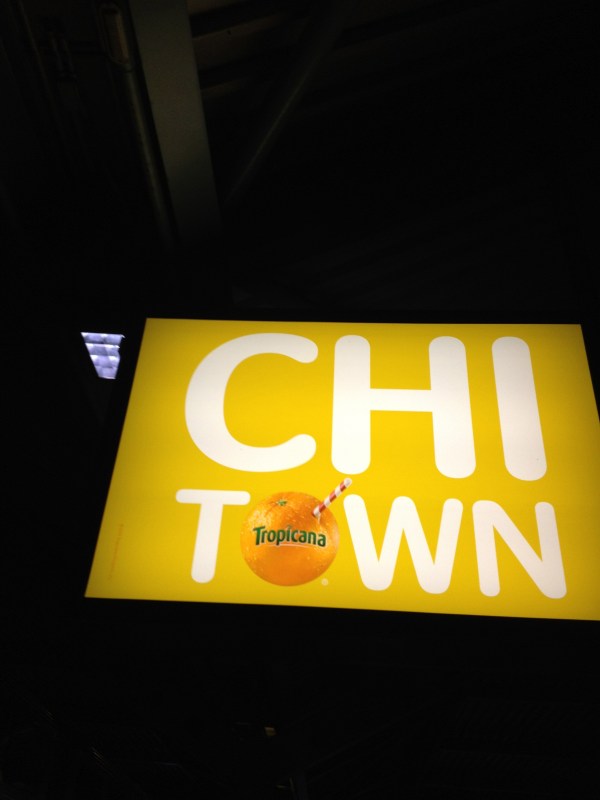
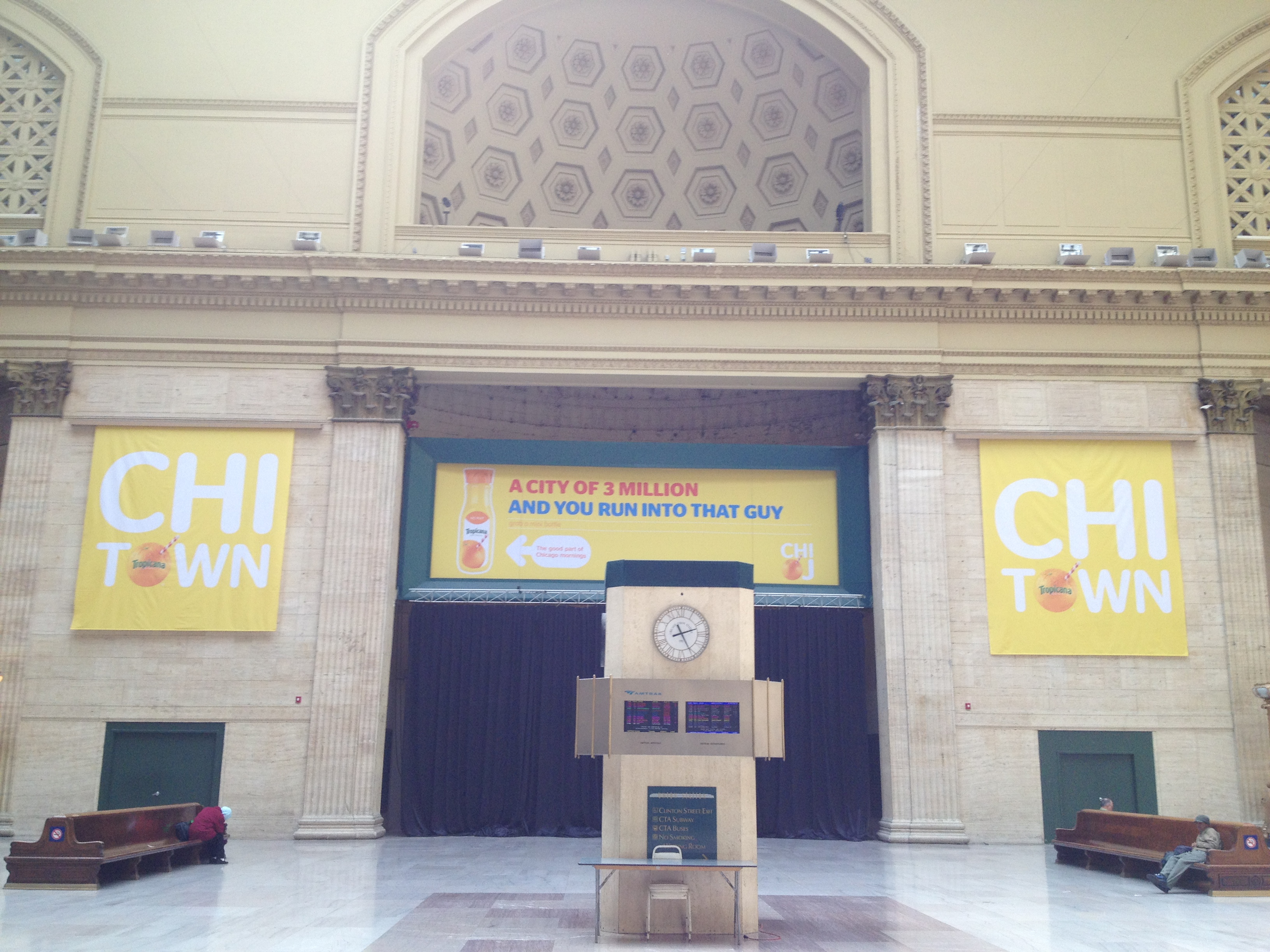
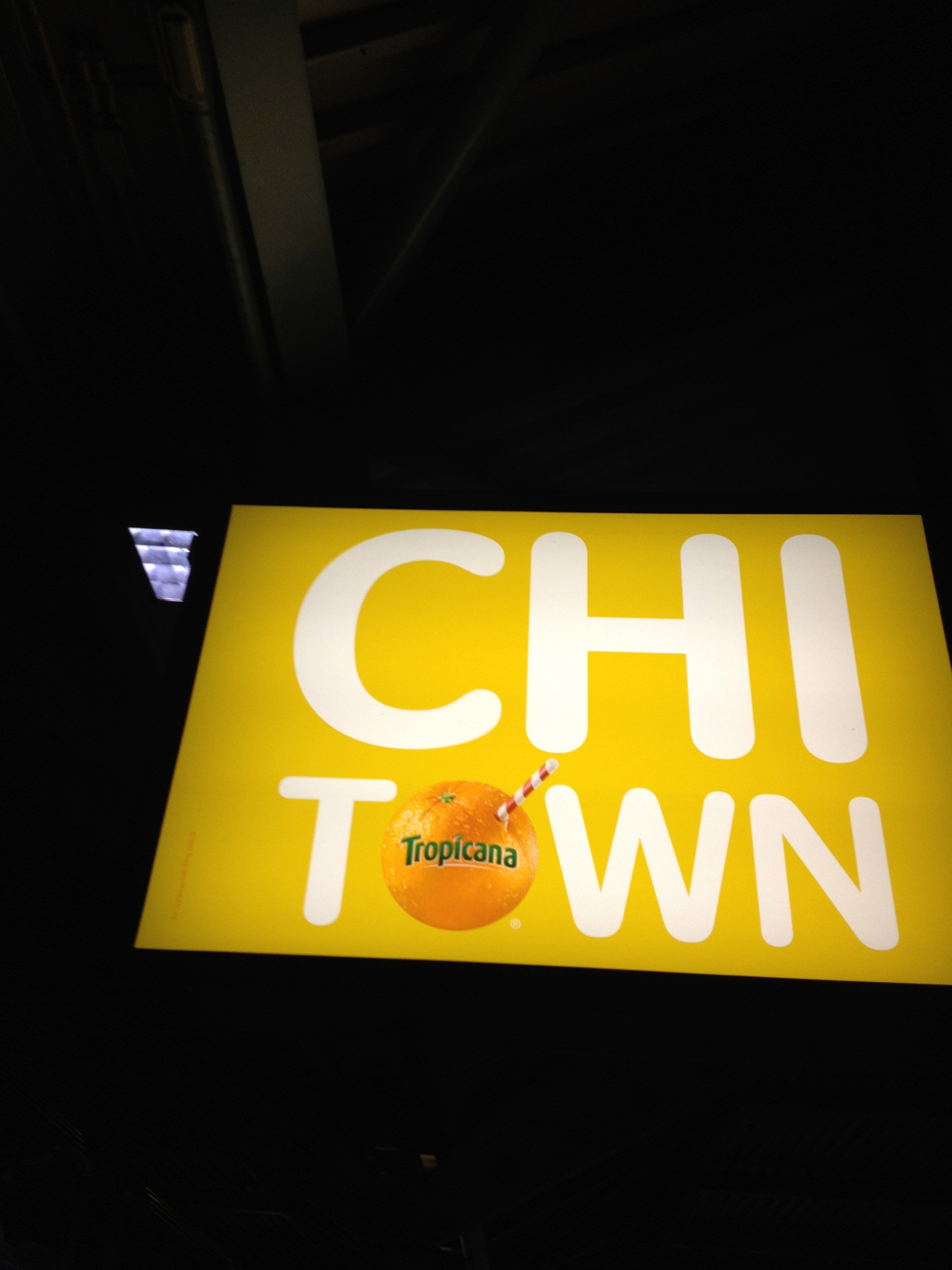
If you’re walking around Ogilvie Train Station and Union Station recently, you’ve seen these ads from Tropicana draped literally all over the station.

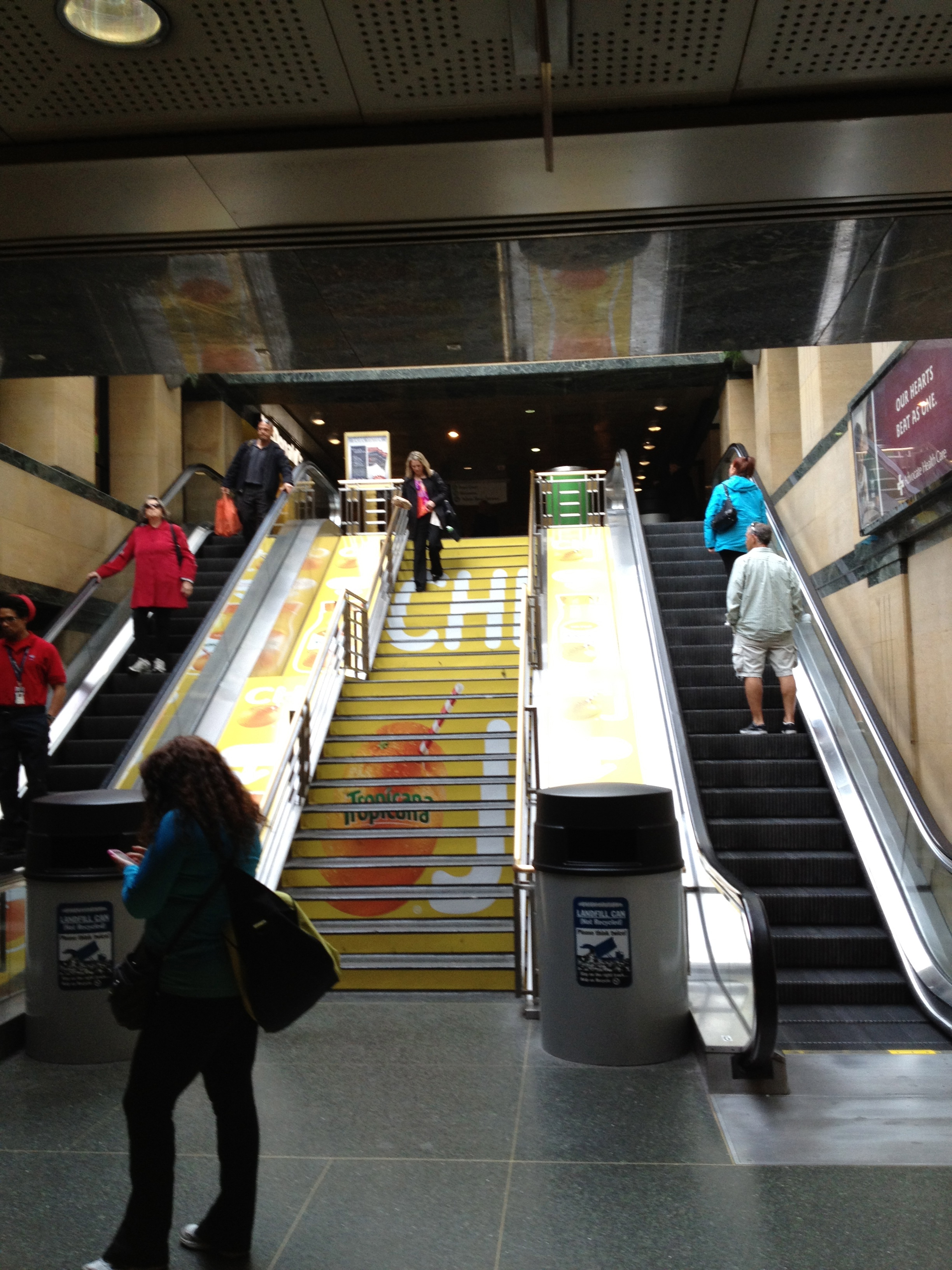
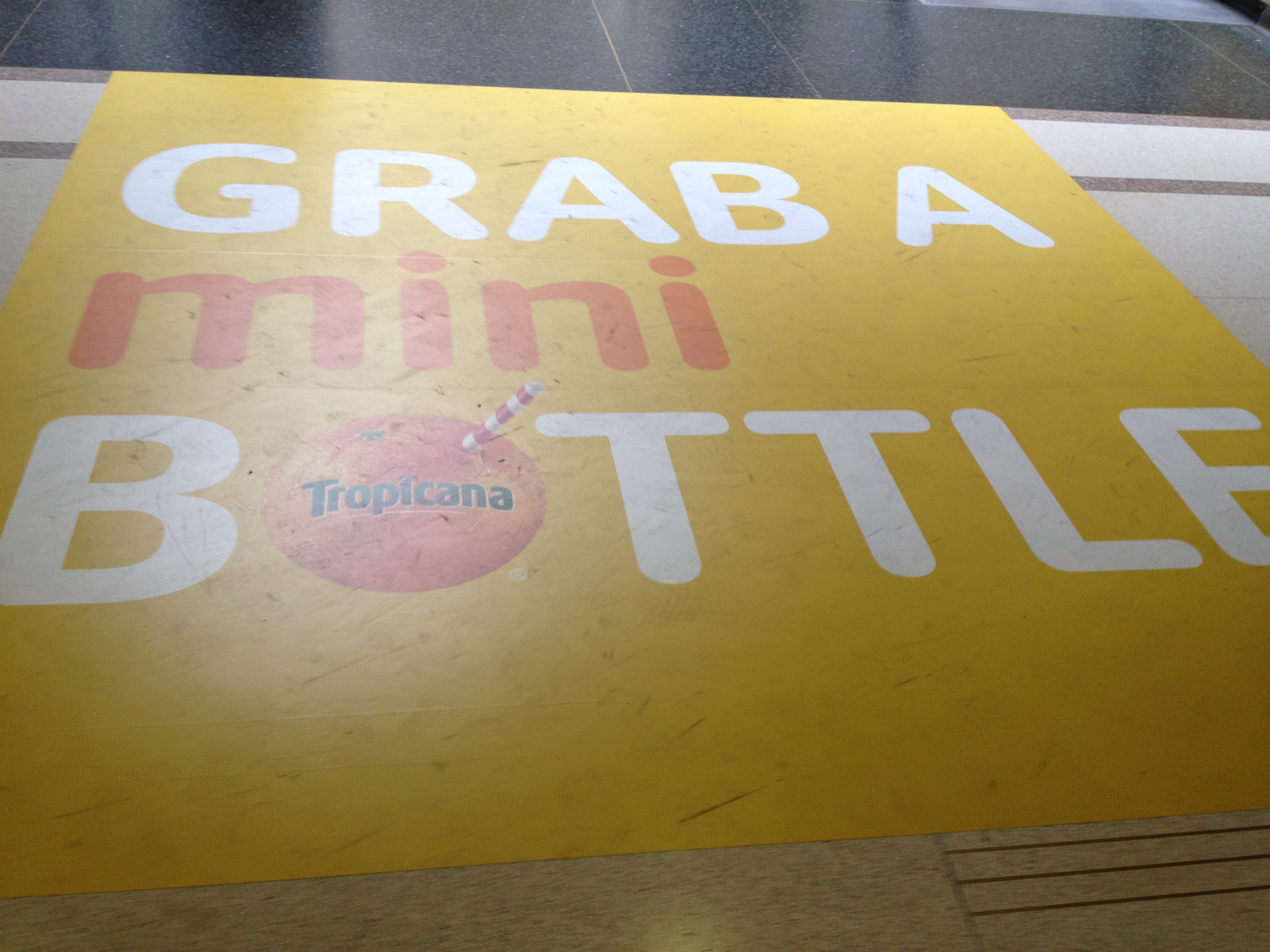
There are the hanging banners. The overhead billboards. The ads on the steps. And wrapped around a pole. And on the floor.

And it all just feels like way, way too much.

And the stairs too…

I know, the brand development person in me should feel differently. But this is one of those moments we have to step out of our own skin as advertising people and marketers and realize that shoving our product down the consumer’s throat within every 5 steps, up, down and all around is the reason why people can get annoyed by advertising, if not hate the hell out of it.

Of course we in the industry think it’s great because it’s our copy, our design, our brand and oh, isn’t it beautiful the way that yellow pops just how the way we thought it would in that meeting back at the agency when we saw it mocked up on boards? Isn’t it glorious how big it all is and how it’s everywhere the eye can see?

Well…maybe not.

What we love because we’re so close to it may not be as loved by the common folk. The more I see media buying domination to this extreme extent, the more it feels like the ad itself is talking and it’s saying:

“Hey, it’s me! Traditional advertising! Look, I’m still here and I’m everywhere! Remember me? Look up from your smartphone, tablet and laptop! You can’t ignore me!”

Rather than buying up every available piece of ad space in a concentrated area to get their point across, what if Tropicana had taken all that money they invested and used some of it to give away free samples to those very same commuters on their way to work instead? Put the product right in their hands if you’re going to spend that kind of money. They’re picked up by the pleasant surprise of having some extra Tropicana sunshine in their morning. They smile. They say thank you. They talk about it to others on their way to work – “Hey, where’d you get that Tropicana?” It’s instant gratification of the brand.

Isn’t that what we want, really? People to feel good about our brand and tell others? With that sweet and unexpected taste of Tropicana goodness, isn’t it conceivable that they’ll return for another bottle tomorrow?

I guess I’ll just look down at the floor. They couldn’t possibly put it there too…never mind, they did.

Sure, perhaps overloading them with ads just short of tattooing an orange on each person’s forehead would achieve the same result. But I like my chances better with my approach.

This isn’t against traditional ads either or even the creativity of the ads themselves. Far from it. My point is this – if an ad is great and gets people talking, do those people need to be overloaded with its presence to the point of potential turnoff? Who cares if it shares space with other ads if it’s so much better? Even the most gigantic ad possible can be OK because it’s not everywhere.

In a city like ours, with some of the most unique architecture in the world, there’s a balance that we have to maintain between advertising product and infringing on the beauty of what makes a structure great. We can be tasteful and achieve our goals in the same breath. It’s times like these that we have to remember we’re the town of Leo Burnett and Daniel Burnham – if our work would make both of them happy, we’re doing right by their legacies.

We’re in the branding business. Not the architecture wallpaper business.

A well-done shout-out to Chi-Town. Maybe they didn’t need much else.

With some well-placed signs that hit commuters once they exit the train into the station, how much more do we need? Apparently, a gigantic amount more. That feels a little too perky in the morning.