You Are Not Your Business Card.

There’s a question we all seem to get in networking situations – “What do you do?” Invariably, we answer with“I’m a (occupation) and I work for (company).”
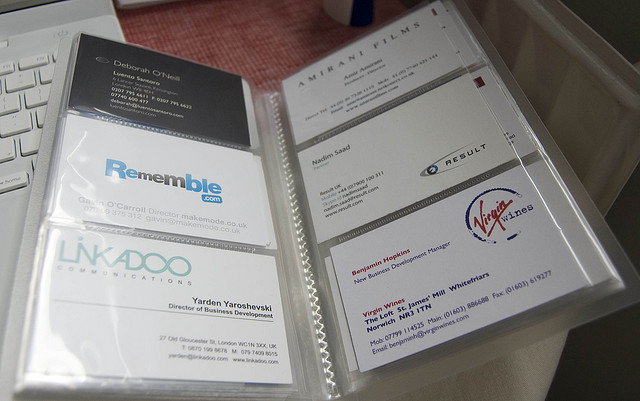
I started thinking about how this defines so very little about why people find our personal brands memorable. We lead with what’s on our business card. But when people talk about you to others, what will they say?

Having just finished the excellent Guy Kawasaki book, “Enchantment,” I’ve realized that likability and trust make for a more compelling position than simply relying on where you work and what you do to bowl people over. Primarily because it shares so little of you as a person.

“He’s a great accountant.”
Not bad, I suppose. But I’ve heard the beginning and end of the whole story.

“The guy oozes talent and niceness from every pore. He made the process of working with him a complete and utter joy.”
Wow. I want to know more. Why was that process so enjoyable? Can I meet him? And by the way, wouldn’t we all want to be described in this way instead?

How does one get to a description like the second option?

A good place to start is to de-business card yourself. I don’t mean actually trashing them all but mentally learning to strip away the contents. All of it. The company. The title. The e-mail address. The phone number. Even the occupation itself.

Imagine all that going out the window. What’s left?

If you find yourself grasping for an answer, don’t feel bad. The first time I thought about this, I called myself a “content marketer” or “brand strategist.” But I knew I was so much more than that. So I became excited by the challenge of conveying myself as a brand and who I envisioned myself to be. This led me to consider the best places to express this personal brand:

Some good places to start:

Your LinkedIn Profile
So many people consider just the summary and work history of LinkedIn. But think about the applications you can add that convey other factors, like what you’re reading (Amazon Reading List), what your interests are (don’t just list the professional ones) and Groups (boards, country clubs, etc.). Assuming you’ve had positive connections, those Recommendations will inevitably help people see the side of you that’s a relationship builder – so don’t be afraid to ask colleagues and clients for them!

Blog
I can’t say enough about how a blog will help you develop an original voice that’s helpful, humble and eager to share content. Building credibility is important, but the reward isn’t in trying to be an all-knowing authority that never gets a response. The reward is in inspiring conversation that grows beyond a post and takes on a life of its own (all the while, the positive attributes of bringing a “community” together are credited back to you).

Twitter
People are feeling you out to see if you’re someone worth following. Here lies an opportunity to prove your thought leadership and show your passions on a topic unique to your industry that extends far outside just “what you do” and “who you work for.” One tool I like to use to add depth and context to my tweets is PeerIndex. The broader my PeerIndex “topic fingerprint,” the more it overlaps nearby related topics and the more I tend to garner interest. For example, if you tweet about a new piece of technology, you may expand your authority by conveying how that technology has implications for media or science rather than commenting purely on whether or not you like it.

YouTube
It takes some practice to get comfortable in front of the camera, but if you do, it can go a long way toward someone visualizing taking a meeting with you. As you do engage in YouTube videos, however, I encourage you not to picture yourself merely as “VP of…” Again, think above and beyond your current status and instead picture yourself as a leader, resource, a helpful ally in a peer’s search to find answers. Think of how transparent you can be on a topic that stirs your passions. Then keep a schedule of when you can consistently record and upload videos.

We’d all like to think we’ll be at an employer that makes us happy for quite some time – and perhaps we will be. But even so, developing your personal brand beyond what your business card says you are enables you to define yourself as something so much more than a title and occupation – a likable, trustworthy personal brand that people can’t get enough of.

(This post originally ran in PersonalBrandingBlog.com)
Where Have You Gone, Ashton Kutcher?

I heard you left Twitter the other day because you sent out a Tweet you shouldn’t have about Joe Paterno and the whole Penn State fiasco. And you’re right – it was dumb of you to jump to conclusions with that Tweet imploring the University to keep him before you knew the full facts.

But you know what, Ashton? It’s OK. Really. You made a stupid Tweet but it’s no reason for you to leave Twitter altogether (or hand it off to someone else to manage your account).

See, Ashton, while I respect you for trying to be more responsible, it’s exactly why I’d like you to come back. Because while you were apologizing, Magic Johnson was on Twitter calling Joe Paterno a “hero.” Within 5 minutes, he got a backlash so bad that he was trying to Tweet what he really meant by that. Last I checked, Magic is still on Twitter.

I suppose everything that comes out of Kim Kardashian’s Twitter stream is a stroke of educated genius? Or Paris Hilton? Or Perez Hilton? Or Lindsey Lohan? They’re still hanging around the Twitterverse.

You’re a Midwesterner, Ashton, so I know you must watch quite a few Bears games when you’re not shooting your sitcom. So you must remember when a few dumb NFL players last year shot off Tweets questioning Jay Cutler’s manhood when he bowed out of a playoff game due to injury? I’m pretty sure none of them were physicians with knowledge of the injury entailed, none of them were in the game and none of them were Jay Cutler, so they couldn’t know what the pain actually felt like.

Nope. They Tweeted anyway from a cowardly place that was nowhere near Soldier Field. And some of them, unlike you, Ashton, didn’t even say they were sorry for it. Gee, maybe they should leave Twitter too.

Point being, Ashton, is this: Celebrities, athletes and us common folk have all said things in our life, whether online or offline that we all wish we could take back. It’s what makes us human. We apologize for our shortcomings when it happens and we try to move on. Like you did. Why? Because we know this:

Tweets are not press releases.

They should not be treated as such.

The very thing that makes us enjoy this relatively new universe of social media is that we can feel closer to people we would never/rarely otherwise get to interact with in the real world. Some are respected authorities in our industry, some are celebrities. And in exchange for entering that domain, we should be willing to cut each other a certain amount of slack just as we would in the offline world. Particularly when it’s accompanied by a quick acknowledgement of the mistake.

Of course, I can’t suggest everything in the world is fine to say and allows you to be off the hook. That’s silly. There are extreme and dangerous exceptions, especially among intentionally hateful people who would use social media as an amplifier for their views.

But Ashton, you slapped your own hand in a way that suggests everything under your Twitter handle from now on will be screened and filtered carefully before it goes out – I don’t think that’s the answer. I’m just not in favor of a social media strategy that involves high screening by committee. I think I’ll see the Lochness Monster and Bigfoot hug before I see a fast-moving social media committee.

There has to be a certain amount of trust involved once you’ve given designated people clear guidelines. And yes, maybe they’ll still veer slightly off course from time to time, but come on. If every last Tweet and post has to be reviewed by multiple parties before it goes out, you’re defeating the purpose of being involved in social media at all because it’s probably not going to be as real-time as it should be. And THAT’S when you should get out or avoid social media because you’re missing the whole point of commenting on what’s current and relevant to an audience that expects that.

It’s a Tweet. It’s not an Official Company Position. That’s why people say things like “These views do not reflect my company” in their bio if they really have to.

So come back, Ashton. You screwed up and said something bad. It’s OK. I forgive you. I’ll even watch an episode of Two And A Half Men if it’ll make you feel better.

The Chicagoland Conversation with Free Green Can

In just three years, Free Green Can has taught thousands of Chicagoans to help the environment by doing what they already do – pitch their trash and recyclables into a dual purpose recycle/trash container. With the Park District and major sports teams in town on board, the company has some exciting plans in the works for 2012 – including building on the revenue sharing opportunities for potential advertisers and host companies.
I sat down with Dave Whorton from Free Green Can to discuss how his company is putting corporate profitability and environmental responsibility on the same page.

Dave Whorton of Free Green Can

How did the inspiration from Free Green Can come about? I hear it was from an unlikely source.

DW: That’s right. About 3 years ago, our founder, Steve Holland, was at a park where his son was playing baseball. After the game, his son wanted to recycle his plastic bottle, but couldn’t find anywhere to do it. So Steve wanted to champion that cause by helping the park out with some recycling bins. Before long, the concept grew to the point of where the can is now patented.

It’s great that the idea from a 13-year-old kid really spawned Free Green Can. When you say one person can make a difference, one person really did make an environmental difference – throughout Chicago.

To be clear, the Free Green Can isn’t just for recycling, right?

DW: Absolutely. We are a dual-purpose trash and recycling bin, with half the bin divided down the middle. What we believe is that if we offer a recycling solution everywhere there’s a trash problem, people will generally do the right thing. By having a trash and recycling option in one bin, it makes life a lot easier and people will always do the right thing when presented in that fashion.

What could one Free Green Can mean for the environment over the course of a year?

DW: One Free Green Can, in a year, will save 15 trees.* When you think about our impact in the Chicago Park District, we have 2500 Free Green Cans placed. That’s going to be a very exciting environmental impact for us. It’s one of the big motivations for us as to why we do what we do every day.

How many Free Green Cans are there in the Chicagoland area?

DW: There’s our crown jewel, the Chicago Park District, where we have 2500 cans placed on the Museum campus, in Grant Park and along 16.5 miles of lakefront trail – from 63rd Street Beach to Osterman Beach. Also, at U.S. Cellular Field, we have 375 Free Green Cans. We’ve got 35 cans surrounding Wrigley Field. We were just at Fiesta Del Sol, which is the largest Latin festival in the Midwest. Several Aldermen are working with us now to place Free Green Cans in their wards.

Besides the recycling advantages, speak to the revenue sharing opportunities for businesses that choose to use Free Green Can.

DW: We provide the cans for free. We can do this by the advertisers that have come on board to support us. Those advertisers have four panels to share their messages with a very captive audience that engages with the product.

We take 10% of the revenue earned and give it back to the venue that uses our cans.

Think how that affects municipalities, for example. Everyone’s struggling in these tough budget times. So when advertisers support us, we’re so excited to give back to these host locations in partnership with these companies.

How does a potential advertiser go about working with Free Green Can?

DW: You come to us and let us create a solution for your type of company. If we get the chance to know your brand, we have price points for everyone from small businesses to Fortune 100 companies.

We have companies coming to us with Quick Response (QR) Codes that link back to a website. Well, we can help create that QR Code for a small business or use it for large companies featuring it as part of their marketing plan.

What are your goals for the rest of 2011 and heading into 2012?

DW: What we’re so proud of is how we’ve been embraced by the city and the Chicagoland Chamber. We’re really re-inventing public recycling in the city of Chicago. At the end of this year, we’re going to be able to say we’ve helped the Park District, several wards, Cubs, White Sox and more.

We’re going to use that as springboard to help showcase Chicago to the rest of the country as we go into other cities and say, “Look what we’ve done for Chicago and we’re ready to do the same thing for you.”

That said, we want to make sure our backyard is taken care of, with small businesses here who never thought they could advertise in the out-of-home industry.

Your product is a help to the environment, but how can people make the business environment better for you to succeed as an entrepreneurial company?

DW: I’ve traveled a lot and believe this is one of the cleanest cities in the world. But it can always improve. Now it’s ingrained in people’s minds that recycling is what you should do and that throwing it in a garbage can is not enough.

We’re trying to preserve the awe that residents and visitors have for our city. So for us as a small business when considering where to base Free Green Can, the question was “why not Chicago?”

The Chicagoland Chamber has done a great job of helping us get the word out and offering support, advice, guidance and counsel. That’s one of those things as a small business that you rely upon – people who have a feel for the pulse of Chicago. The connections that the Chamber has made for us have been phenomenal. We want to start giving back to the Chamber with as much enthusiasm as they’ve given to us.

(This post originally ran as a piece for The Chicagoland Chamber.)

*Number is based on if Free Green Can is filled with 25% paper, 25% plastic, 25% aluminum and 25% glass.

6 Cultural Changes Inspired by Theo Epstein (pt. 2)

Continued from the previous post, here are 3 more changes you can consider for a stagnant culture that Theo Epstein might think about in instilling a winning Cubs culture.

4) Losing becomes a self-fulfilling prophecy. 

Essentially, if you believe you’re a bad team, you’re going to perform like one even though in reality you aren’t. Look, I don’t believe for 2 seconds that a curse has anything to do with the Cubs perpetual losing. It’s the same way in organizational cultures. Everything happens – or doesn’t happen – for a reason. If the management believes the team is as good as anybody or even better, yet the rest of the team doesn’t appear to believe it, where’s the disconnect and why is that happening? It could be lack of clarity or distant leadership. Lack of metrics that everyone understands. Lack of everyone in the organization understanding what’s valued most. Or lack of talent that just isn’t there and has been permitted to stay for far too long. And more.

“(In Boston), it wasn’t a curse. It was just the fact we hadn’t gotten the job done, and we identified several things the franchise had done historically that probably got in the way of winning a World Series, and we went about trying to eradicate those. That’ll be part of the process here.” 

Epstein talked about “a Cubs way of playing the game.” We’ve come to think of that as a bad thing. But his definition included better baseball fundamentals for better play.

5) Identify quality metrics for smarter decision-making.

In baseball terms, General Managers like Billy Beane, Epstein and others are part of a new breed that ties sabermetrics (objective statistics) to measure on-field contributions. I’m not sure that will translate into a signing of Albert Pujols or Prince Fielder, but if it does happen, it won’t be merely because of home runs, RBIs and the common statistics we read about in the papers.

In a cultural situation, the more that metrics are locked away so that the rest of the team won’t know what they are, the more they’ll be unclear on vision and goals. I recently read a book entitled “Employees First, Customers Second,” in which the CEO of an Indian I.T. company opened up a company of thousands to be able to see performance reviews of one another, even management. You’d think it would cause a major company revolt, but instead, it brought the employees together to work even harder – particularly managers who had no idea they were perceived that way. Everyone knew each other’s areas for improvement. If this notion scares you, what does that really say deep down about confronting your weaknesses? We all have them.

6) A winning culture needs to be continuously fed.

Epstein clearly believes that this involves the development of a strong minor league farm system that feeds talent to the big leagues regularly for lasting results. A business may not have a minor league farm system, but it does need to grow talent and brand ambassadors by giving them the opportunity to be the face of the organization – like engaging in social media on behalf of the company, for example. And it means feeding contributors regularly with rewards that they value for their own life, not just what management thinks they should value.

The thought of cultural change busting 103 years of losing is mighty exciting. But cultural change that creates quite the dynasty of your own? That might be even more thrilling.

What kinds of things are you doing to shift a stagnant culture? Share them with us! We could all use a little push out of our comfort zone.

6 Cultural Changes Inspired by Theo Epstein (pt. 1)

When you’ve had a bad year for 103 years, what would you do to turn things around?

It’s practically incomprehensible for us to relate to a question like this because while a business can have a bad month, bad quarter or – in this economy – a bad year, we usually don’t know what it’s like to have consecutive bad decades.

It was something I couldn’t help but wonder as I was speaking at the Chicagoland Chamber about vision, brand strategy, culture, and how to keep that culture thriving. Maybe because, long before Theo Epstein ever came aboard as President of Baseball Operations for the Chicago Cubs, we’ve often heard of the need for the North Siders to instill a “culture of winning.”

“The goal is to win a World Series, but it’s about how we get there. We need to build a foundation for sustained success, including player development, for something that’s going to last. We don’t want to be the type of club that gets there and then disappears for 4 or 5 years. We want to be playing baseball every October someday.”

– Theo Epstein, Cubs President of Baseball Operations

How does one find this elusive culture of winning? Well, I think organizations searching for that may be able to learn a few things from Epstein based on his past stop and already what he’s doing here. And if you’re a Cubs fan, you should be encouraged by this too. Let me explain with 6 key observations.


1) Visions have to be clear, concrete and more specific, not broad core values nobody can understand.

What I find refreshing about Epstein is that, when he announced the search for a new manager, he let everyone know exactly who he was looking for in a candidate – one of those aspects being that the manager had to be someone with major league experience. For better or worse, that immediately ruled out hometown favorite and popular choice Ryne Sandberg.

But when you leave no doubt as to what you’re looking for in an organization as far as the kind of talent that belongs (and doesn’t belong), then you set a strong tone that people can get behind. The same holds true for your customers – you can’t be for anybody with a buck. So who are you for? And not for? Do your people get that too?


2) Locate the cancers in the environment as quickly as possible. Then remove them.

You can give someone with a poor attitude the chance to turn that attitude around (warnings, probation). But if they don’t, they should be removed before the cancer spreads.

I have seen environments where some people had become so jaded with “that’s the way it always is” and “we’ve always done it this way” and that’ll never work” statements that it permeates throughout the rest of the culture. You can’t build a winning culture with people that way and it doesn’t take many of them. And the more you make excuses for people who don’t deserve a free pass, the more others will be impacted. In relation to the Cubs, this is why Carlos Zambrano will probably never pitch at Wrigley again, unless in an opposing team’s uniform.


3) Winning cultures have to be accountable.

My colleague, friend and co-presenter Rob Jager of Hedgehog Consulting often speaks of this. Managers can speak all they want about how employees should do this or that, but if they don’t follow the same practices, the words coming out of their mouth have significantly less meaning. If someone is a nice person who doesn’t produce (and assuming they’re in the role they’re supposed to be in), they too should be removed. Mike Quade is probably a nice enough fellow, but the team’s fundamentals on defense were horrible. That points to poor management and is a big reason why Epstein wiped the slate clean by deciding, in order to have a winning environment, a change needed to be made.


In the next post, I’ll provide 3 more cultural changes you can make based on how Theo might run your organization.